Building a Globally Compliant, Future-Ready Indian MICE Ecosystem
1. The Imperative of Sustainable Transformation in MICE
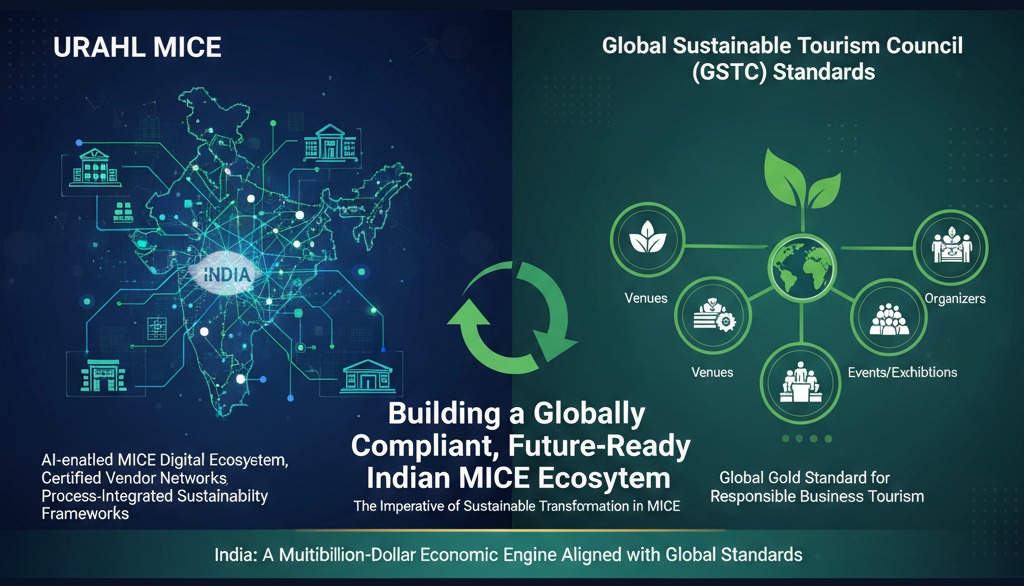
The MICE (Meetings, Incentives, Conferences, and Exhibitions) industry stands at a critical juncture where sustainability is no longer an optional narrative but a global compliance mandate. The Global Sustainable Tourism Council (GSTC) has formalized comprehensive sustainability criteria—covering Venues, Event Organizers, and Events/Exhibitions—that now define the global gold standard for responsible business tourism.
For India, where MICE is projected to become a multibillion-dollar economic engine, aligning with these standards is essential for international competitiveness, investor confidence, and environmental stewardship. URAHL MICE, through its AI-enabled MICE Digital Ecosystem, certified vendor networks, and process-integrated sustainability frameworks, is at the forefront of translating GSTC standards into actionable practice within the Indian hospitality and business events landscape.
2. Understanding the GSTC MICE Framework
The GSTC MICE Criteria (v1.0, 2024) is structured across four core pillars, each applying to the three stakeholder groups—Venues, Event Organizers, and Events/Exhibitions.
A. Sustainable Management
- Establish a sustainability management system.
- Set measurable environmental, social, and governance (ESG) objectives.
- Ensure legal compliance and transparent reporting.
B. Socio-Economic Benefits
- Promote local employment and fair wages.
- Ensure accessibility and inclusion.
- Support community engagement and cultural integrity.
C. Cultural Heritage Preservation
- Protect and showcase local culture.
- Prevent commodification or cultural distortion.
D. Environmental Stewardship
- Minimize resource use (energy, water, materials).
- Implement waste reduction and recycling.
- Measure and offset carbon emissions.
- Procure sustainably and reduce single-use items.
Each pillar integrates indicators, evidence requirements, and continuous improvement mechanisms, transforming sustainability from a marketing claim into an operational discipline.
3. URAHL’s Alignment with GSTC Standards
URAHL’s operational and digital frameworks have been architected around these four sustainability pillars, embedding compliance within every stage of the MICE lifecycle—from vendor selection and event planning to post-event reporting.
Below is a structured alignment:
A. Sustainable Management: Institutionalizing Responsible MICE Operations
| GSTC Requirement | URAHL Response | Implementation Example |
| Establish sustainability policies & monitoring systems | URAHL’s MICE Process Matrix Dashboard integrates ESG metrics for venues, vendors, and F&B providers. | Every event is tracked via an internal sustainability index, quantifying water, power, and waste metrics. |
| Legal and ethical compliance | URAHL standardizes contracts through the Process Flow Dashboard ensuring adherence to labor, safety, and data protection laws. | Vendors undergo compliance audits before certification. |
| Sustainability reporting | Ecosystem Command Dashboard generates automated ESG reports for clients, aligning with GSTC documentation standards. | Clients receive post-event carbon and waste summaries. |
Through these mechanisms, URAHL transforms sustainability into data-backed governance, eliminating ambiguity and manual oversight errors.
B. Socio-Economic Benefits: Inclusive Growth through Responsible Commerce
| GSTC Objective | URAHL Practice | Tangible Impact |
| Local community inclusion | URAHL’s vendor network (Hotel Supply Express) prioritizes local suppliers, artisans, and event service providers. | Local MSMEs gain exposure and recurring income. |
| Gender and diversity equity | HiringHole.com, a URAHL arm, integrates equal opportunity and inclusive recruitment practices for event staffing. | Increases female and youth participation in hospitality employment. |
| Fair wages and working conditions | All contracts require proof of fair wage policies per GSTC’s social safeguard clause. | Prevents exploitation and enhances workforce loyalty. |
| Accessibility and inclusion | Venues certified through URAHL’s Process Matrix must demonstrate wheelchair access, signage clarity, and inclusive design. | Ensures physical and digital accessibility in line with global standards. |
URAHL thereby positions sustainability as social capital, reinforcing community linkages and inclusivity.
C. Cultural Heritage Preservation: Celebrating Authentic Indian Contexts
| GSTC Criterion | URAHL Strategy | Real-World Execution |
| Respect for cultural sites | URAHL collaborates with heritage boards and tourism bodies to ensure events near heritage areas comply with conservation guidelines. | No intrusive lighting, sound, or structural damage permitted. |
| Integration of local art and culture | URAHL’s event concepts (under HotelCareHub & TripGinny) promote regional art, music, and cuisine authentically. | Local performers and chefs featured at conferences and galas. |
| Cultural education | Delegate kits include information on local customs, language, and etiquette. | Promotes respect and awareness among international participants. |
URAHL ensures that every MICE event becomes a platform for cultural storytelling, not commodification.
D. Environmental Stewardship: Minimizing the Ecological Footprint
| GSTC Indicator | URAHL Method | Key Outcomes |
| Resource efficiency | Smart energy management systems in partner venues; water-saving F&B practices. | Reduces utility consumption by 15–20%. |
| Waste reduction | AI-based consumption forecasting in the Food Menu Dashboard minimizes overproduction and food waste. | Direct waste reduction up to 30%. |
| Sustainable sourcing | Preferential procurement from vendors with eco-certifications (organic, biodegradable, FSC). | Supports circular economy suppliers. |
| Carbon offsetting | Partnership with certified offset providers to neutralize event-related emissions. | Clients receive carbon-neutral certification. |
URAHL’s systems turn sustainability into measurable economics—reducing costs while enhancing compliance.
4. Why GSTC Alignment Matters for India
India’s hospitality and MICE sectors face dual challenges: rapid expansion and global scrutiny. Compliance with GSTC standards is crucial for multiple reasons:
- International Market Access:
Global corporations and intergovernmental organizations now mandate sustainable event certifications. GSTC alignment ensures India remains a preferred destination for such events. - Investor Confidence:
ESG-aligned hospitality assets attract green finance and institutional investors. GSTC certification enhances valuation and funding eligibility. - Policy Synchronization:
The Indian government’s MICE and Tourism Strategies increasingly embed sustainability KPIs (carbon reduction, inclusivity, local benefit). URAHL’s framework directly supports these. - Destination Branding:
As destinations like Singapore, Dubai, and Seoul market their MICE offerings around sustainability, India’s global competitiveness depends on adopting similar frameworks. - Operational Efficiency:
Resource management standards (energy, waste, materials) reduce cost overheads while improving long-term profitability.
5. URAHL’s Integrated Sustainability Mechanisms
URAHL does not treat sustainability as an afterthought; it is digitally embedded through six interoperable dashboards ensuring end-to-end GSTC compliance:
| URAHL Dashboard | GSTC Functionality Supported |
| MICE Food Menu (F&B) | Waste reduction, sustainable sourcing, and local food promotion. |
| Global MICE Venues | Venue sustainability rating and accessibility metrics. |
| Process Flow | ESG checklist automation and contract compliance. |
| Ecosystem Command | Real-time sustainability tracking and reporting. |
| Advertisements & Sponsorships | Green sponsorship campaigns and sustainability messaging. |
| Process Matrix | Governance, certification, and audit trail for continuous improvement. |
Each dashboard contributes to digital traceability, ensuring events can be certified, audited, and benchmarked against global ESG norms.
6. Benchmarking URAHL MICE against GSTC Core Indicators
| GSTC Category | Compliance Level | URAHL Example |
| Sustainability Policy | Full | URAHL’s sustainability charter integrated into every contract. |
| Energy & Water | Full | Smart venue management and AI F&B forecasting. |
| Waste & Carbon | Full | Carbon tracking and offsetting partnerships. |
| Community Benefit | Full | Local vendor-first procurement policy. |
| Cultural Integrity | Full | Curation of regionally themed experiences. |
| Reporting & Transparency | Full | Automated ESG reporting through dashboards. |
URAHL’s system therefore achieves end-to-end alignment, satisfying both GSTC’s criteria and UN Sustainable Development Goals (SDGs 8, 12, 13, and 17).
7. Future Roadmap: Deepening GSTC Integration
To maintain leadership, URAHL is pursuing:
- GSTC-Recognized Auditor Partnerships: for formal certification audits.
- AI-Driven ESG Predictions: anticipating sustainability risks in planning.
- Blockchain for ESG Data Integrity: ensuring traceable, tamper-proof reporting.
- State-Level Training Programs: enabling Indian venues and vendors to become GSTC-ready.
- URAHL Green Label: an indigenous certification linked to GSTC standards, helping small vendors gradually align.
8. Why This Matters: The Indian Context
India’s MICE sector is expanding rapidly—but sustainability alignment ensures long-term resilience:
- It future-proofs venues against regulatory shifts.
- It positions India as a global responsible destination.
- It unlocks green capital and international collaborations.
- It supports national ESG commitments and SDG targets.
URAHL’s GSTC-aligned MICE ecosystem represents India’s bridge between economic ambition and environmental accountability, proving that sustainability and profitability are not competing but co-reinforcing imperatives.
9. Conclusion
Sustainability is no longer an aspirational tagline—it is the operating license for the future of MICE. Through the integration of GSTC’s global standards into every element of planning, execution, and reporting, URAHL MICE has redefined what responsible event management means in the Indian context.
By embedding ESG intelligence into its digital infrastructure, enforcing vendor accountability, supporting local economies, and reducing ecological footprints, URAHL ensures that every meeting, conference, incentive trip, and exhibition contributes to both economic growth and planetary stewardship.
As India positions itself to become a global MICE powerhouse, URAHL’s alignment with GSTC standards is not merely compliance—it is leadership in action, shaping a future where sustainability defines competitiveness and innovation defines success.