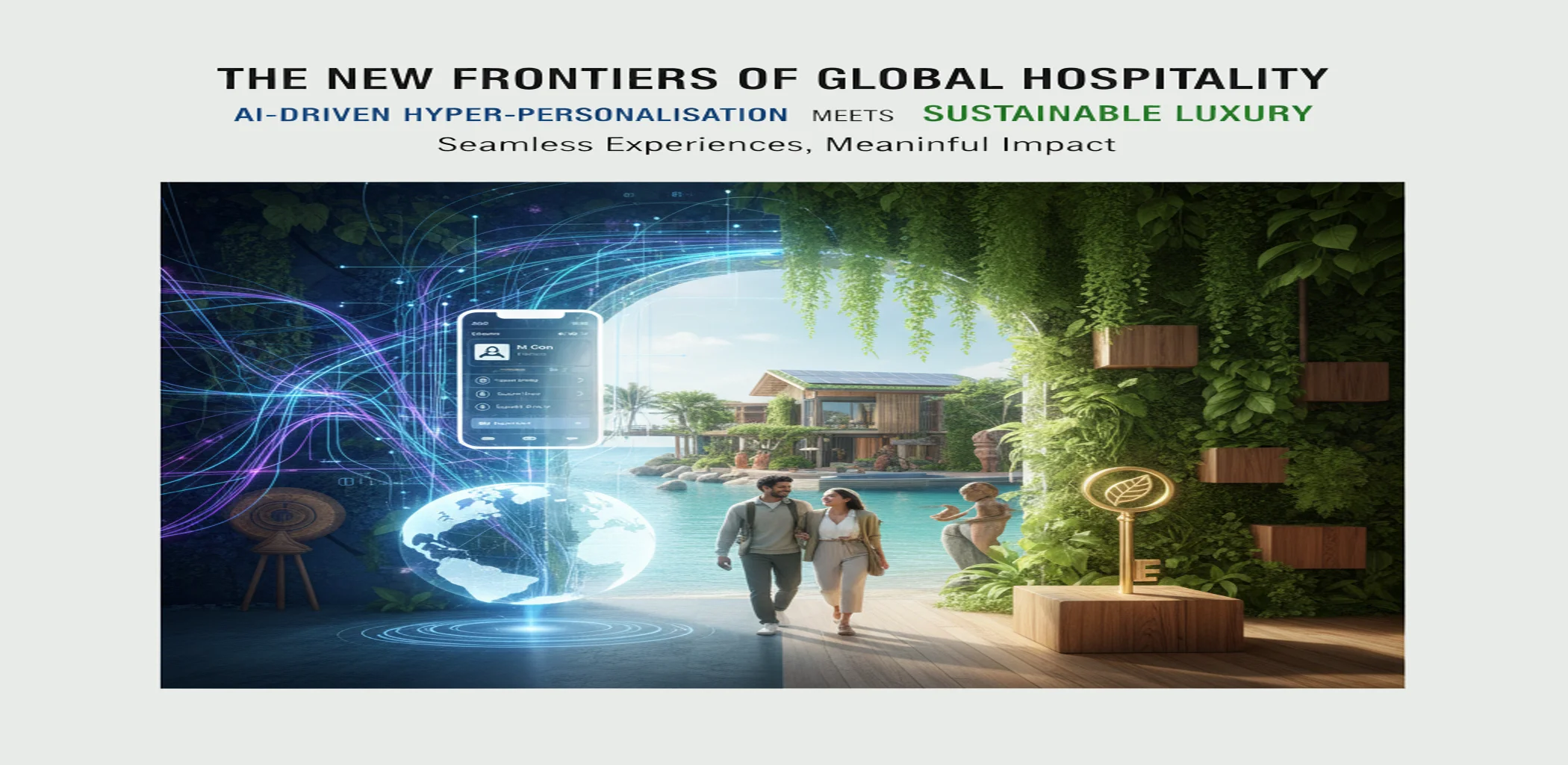
In an era where travellers are more connected, more demanding and more socially conscious than ever, the global hospitality industry is undergoing a profound transformation. Gone are the days when a stay simply meant a comfortable bed and friendly service. Today’s guests expect not just hospitality—they expect an experience, one that is personalised to their preferences, seamless in execution, and meaningful in impact. At the same time, they are placing increasing value on sustainability: eco-responsibility, local community engagement, minimal waste and ethical operations are no longer optional add-ons—they are front-and-centre. As such, one of the most compelling, trending topics in global hospitality is the fusion of AI-driven hyper-personalisation with sustainable luxury practices—a convergence that is redefining how hotels, resorts, and hospitality businesses design services, engage guests, manage operations and articulate their brand purpose.
1. Why This Trend Matters Now
1.1 Guest Expectations Have Evolved
Today’s traveller is smarter, more informed, and more value-driven. They don’t simply want to stay somewhere—they want to feel something, to have a story, to be recognised, and ultimately to belong. According to recent trend reports, roughly 74% of travellers prefer hotels that personalise stays based on their preferences.
Meanwhile, sustainability has shifted from an optional marketing line to an expectation. Many guests will actively seek out hotels that can demonstrate credentials around waste reduction, energy management, local sourcing and ethical operations.
1.2 Technology Enables What Was Once Impossible
Just a few years ago, delivering truly personalised guest experiences at scale across a hotel portfolio was expensive or impractical. Today, however, thanks to advances in AI, IoT, smart analytics and cloud-based systems, even mid-market properties can deliver tailored experiences: recommending meals, adjusting the room environment, offering local experiences and anticipating needs proactively. At the same time, sustainability technologies—smart sensors, waste-analytics platforms, energy-management tools—are becoming commercially viable and expected.
1.3 Competitive Differentiation in a Saturated Market
The hospitality sector is crowded: countless hotels, resorts, serviced apartments, boutique properties and alternative accommodations all compete for attention. In this environment, delivering the “same as everyone else” is no longer sufficient. Properties that can combine exceptional personalisation and demonstrable sustainability will stand out. As one industry summary puts it: “Hotels and resorts that integrate innovation with a guest-centric approach will stay ahead.”
2. What AI-Driven Hyper-Personalisation Looks Like in Practice
2.1 Pre-Arrival and Booking Phase
From the moment the guest considers a booking, AI systems are quietly working. Based on previous stays, preferences, loyalty-data, online behaviour and even social media insights, hotels can craft personalised offers: a particular room type, personalised minibar suggestions, preferred pillow type, or tailored experiences (spa treatment, local adventure, gastronomic tasting) all suggested before arrival.
2.2 Check-In and In-Stay Experience
Once the guest arrives, the experience continues seamlessly. Smart rooms equipped with IoT devices monitor guest comfort (temperature, lighting, window blinds), and adjust settings automatically or via app/voice control. A guest’s preferred room temperature, music genre, favourite snack can all be remembered. AI-powered concierge chatbots are available 24/7 to answer queries, make suggestions, or upsell relevant services.
2.3 Dining, Activities and Localisation
Personalisation extends beyond the room. Based on profile data, hotels can suggest restaurants, curated dining menus (including dietary restrictions or favourite cuisines), local experiences that align with guest interests (art, outdoor adventure, wellness). Smart F&B systems can dynamically adjust offerings, menus, portion sizes, even pricing based on demand and guest profiles.
2.4 Post-Stay and Loyalty Activation
The guest experience doesn’t end at checkout. AI systems analyse stay data, feedback, behaviour to send personalised follow-up offers, loyalty-based suggestions, and customised communication. The aim is to convert a one-time guest into a brand advocate. Personalisation at this stage is a key driver of guest lifetime value.
2.5 Back-End Operations Powered by AI
While the guest sees the seamless personalized front-end, much of the magic happens behind the scenes: dynamic pricing algorithms adjust room rates in real time, demand forecasting tools optimise housekeeping and maintenance scheduling, predictive analytics reduce equipment downtime, smart sensors manage energy and water usage. All these contribute to better guest experience and improved operational efficiency.
3. Sustainable Luxury: Reimagining “Luxury” for Today’s Conscious Traveller
3.1 The Shift From Opulence to Authenticity & Purpose
Luxury today is no longer defined purely by marble lobbies and grand chandeliers. The definition of luxury is evolving into something more meaningful: authenticity, immersion, craftsmanship, local culture. Properties that engage local artisans, feature regional cuisine, integrate with local communities and operate with minimal environmental impact are capturing the attention of premium guests.
3.2 Operational Sustainability as Brand Differentiator
Sustainability is no longer a back-office checkbox—it has become part of the guest value proposition. Hotels are incorporating renewable energy, solar panels, rainwater harvesting, smart lighting and HVAC systems, elimination of single-use plastics, digital receipts, and zero-waste kitchens. These operational measures reduce cost, risk and environmental footprint while enhancing the guest experience.
3.3 Sustainability in Guest Experience
Sustainable luxury also touches the guest journey. Examples include menus sourced from local farms, zero-waste food preparation, bespoke wellness retreats rooted in local culture, carbon-offset options for guests, and eco-certification labels that convey trust. Guests increasingly select destinations not just for comfort but for meaningful impact.
3.4 Branding, Storytelling and Purpose
For hospitality operators, sustainability is as much about narrative as infrastructure. Guests want to understand why a property is sustainable: What local communities benefit? What heritage is preserved? How much carbon is offset? Storytelling around sustainable practices builds emotional connection and trust. Properties that transparently share their metrics and journey often get stronger guest loyalty and brand advocacy.
4. The Intersection: Where AI + Sustainability Create Value
4.1 Smarter Resource Management
AI helps sustainability efforts become more effective. For example, smart sensor networks and analytics can optimise HVAC, lighting, water consumption, waste management and F&B operations—reducing energy costs and environmental impact simultaneously.
4.2 Waste Reduction Through Data
AI-powered tools in hotel kitchens and restaurants can monitor food waste, detect patterns of over-preparation or spoilage, and adjust procurement and menu planning accordingly. This not only reduces costs but also supports sustainability claims.
4.3 Personalisation That Supports Sustainable Behaviour
Rather than being at odds, personalisation and sustainability can complement each other. For example, a guest’s pre-stay data might show a preference for plant-based meals—and the hotel can proactively offer a curated sustainable dining menu that aligns with both the guest’s preference and the property’s green initiatives. Or the hotel might suggest eco-friendly local tours, supporting both guest engagement and environmental goals.
4.4 Revenue Enhancement with Responsibility
In many cases, sustainable luxury and personalisation drive revenue. Guests are willing to pay a premium for tailored experiences and environmentally responsible operations. AI-driven dynamic pricing, upselling of curated experiences, and precision in cost management amplify return on investment. Hotels that implement both strategies tend to outperform peers.
5. Strategic Implications for Hospitality Businesses
5.1 Technology Investment Is Now Imperative
If personalisation and sustainability are to be delivered effectively, investments in technology cannot be optional. Hotels need integrated platforms: CRM, PMS (Property Management System), RMS (Revenue Management System), IoT sensors, AI-analytics. As one study notes: “AI tools that integrate CRM, RMS and other systems into a single cohesive platform are key to future readiness.”
5.2 Talent, Training and Culture Shift
Introducing smart rooms, chatbots and sustainability dashboards is only half the battle. Equally important is training staff, rethinking operational workflows, instilling a culture of continuous improvement and data-driven decision-making. Without the human side aligned, technology often fails to deliver its full promise.
5.3 Data Strategy & Privacy Considerations
Personalisation hinges on data—guest preferences, behavioural signals, past history. With that comes responsibility: GDPR and privacy regulations, cybersecurity, ethical use of algorithms. Hotels must have clear data governance, transparency with guests, and robust security protocols.
5.4 Measuring Impact: KPIs Beyond Occupancy
Traditional hospitality KPIs such as occupancy rate, ADR (Average Daily Rate), RevPAR (Revenue per Available Room) remain important—but today’s leaders also monitor metrics like guest-satisfaction scores for personalised offers, carbon footprint per stay, percentage of local sourcing, waste-reduction rates, and direct-booking growth driven by custom experiences.
5.5 Brand and Marketing Alignment
Luxury with responsibility is increasingly a brand narrative. Hotels must articulate their stories: how technology elevates the guest experience, how sustainability is embedded in operations, how personalisation makes each stay unique. Those messages must resonate with target audiences—millennials, Gen-Z, affluent travellers seeking both comfort and meaning.
5.6 Operational Scalability & Cost Efficiency
While many technologies promise guest delight, the business must also deliver cost efficiency. AI-driven housekeeping scheduling, dynamic pricing, predictive maintenance and smart resource management enable hotels to deliver high-end experiences without eroding margins. Sustainability efforts likewise often result in long-term cost savings (energy, waste, water).
6. Challenges & Pitfalls to Watch
6.1 Implementation Complexity & Cost
Adopting AI, IoT and sustainable infrastructure is capital-intensive. Many smaller or independent properties still cite cost or lack of tech-expertise as barriers. Without a clear strategy and phased roadmap, investments may under-deliver.
6.2 Balancing Automation & Human Touch
While technology enables efficiency, hospitality remains a human-centric business. Over-automation can risk losing the warmth and personal touch that guests value. The smartest operators strike a balance: use AI for routine tasks, freeing humans for the truly human moments.
6.3 Guest Privacy & Data Misuse
As hotels collect more data to personalise, the risk of privacy breaches or perceptions of intrusive tracking grows. Transparent consent, clear value propositions (why a guest’s data helps deliver better service), and robust security are essential.
6.4 Authenticity vs. Green-Washing
Sustainability claims without substance will backfire. Guests increasingly scrutinise ESG credentials and expect proof. Properties must ensure their sustainability initiatives are genuine, measurable and communicated credibly.
6.5 Legacy Systems & Integration
Many established properties operate on legacy PMS/RMS systems. Integrating newer AI and IoT platforms may require significant change-management, data migration and vendor coordination.
7. Practical Steps for Hospitality Operators
Here’s a concise roadmap for property owners, hotel groups, resort operators and hospitality supply-chain partners to align with this trend:
- Audit Guest Journey & Data Capture
— Map out every touchpoint: booking, pre-arrival, arrival, stay, checkout, post-stay.
— Assess what guest data you currently have, where gaps exist, and how to collect relevant preferences (with consent). - Define Personalisation Use-Cases
— Choose a few impactful personalisation scenarios: e.g., room pre-conditioning to guest profile, tailored dining suggestions, dynamic upsells based on guest history.
— Set clear KPIs: guest satisfaction, increased ancillary spend, repeat bookings. - Invest in Smart Infrastructure
— Deploy IoT sensors for lighting, HVAC, room controls.
— Implement a unified technology stack integrating CRM, PMS, RMS and analytics.
— Consider a pilot roll-out in one property before scaling. - Embed Sustainable Operations
— Identify low-hanging fruit: LED lighting, smart thermostats, eliminate single-use plastics.
— Introduce digital housekeeping logs, waste-analytics dashboards, local sourcing programmes.
— Develop guest-facing storytelling: e.g., “All produce for your dinner was sourced within 50 km,” or “Your stay offsets X kg of carbon”. - Train & Empower Teams
— Provide staff training on new tech, guest-data handling, sustainable practices.
— Empower front-line teams to use personalised insights (e.g., “Good evening Mr Smith – welcome back. Would you like your preferred pillow and an extra green tea tonight?”). - Measure & Communicate
— Track not just traditional metrics but new ones: guest-profile capture rate, personalization success rate, sustainability-impact metrics (e.g., water usage reduction, waste cut, carbon footprint).
— Communicate results in marketing and guest engagement—transparency builds trust and differentiation. - Scale & Iterate
— Use learnings from pilot properties to refine workflows, technology stack and guest-journey mapping.
— Scale across your portfolio, adjust for local/regional context, and continue innovating.
8. Why It Matters for Hospitality Supply-Chain & M&A Players
For professionals in hospitality investment, supply-chain management, vendor certification and asset acquisition (such as those engaged in hospitality M&A or tokenised hospitality assets), this trend offers significant implications:
- Asset Value Uplift: Properties with smart technology and sustainability features command higher valuations, attract premium guests and reduce operational risk.
- Vendor & Certification Relevance: Suppliers who can demonstrate sustainable materials, IoT smart-room solutions, low-waste kitchen tech or AI-personalisation platforms will be in strong demand.
- Tokenised Model Advantage: For platforms like tokenised hotel assets, demonstrating a technology-forward and sustainability-forward business model strengthens investor appeal, risk mitigation and long-term ROI.
- Integration Potential: M&A due-diligence must now account for tech stack readiness, sustainability credentials, data-strategy robustness and front-line service design—not merely physical assets and location.
9. Looking Ahead: What to Expect in the Next 3-5 Years
- AI as Standard, Not Luxury: What is now cutting-edge will become baseline. Smaller properties will adopt plug-and-play AI/IoT suites.
- Sustainability as Mandatory Framework: Guest preferences will shift toward properties with clear ESG credentials and circular-economy practices.
- Blurring of Business & Leisure (“Bleisure”): Hotels will cater to mixed-purpose travellers—work-and-stay, remote-work hubs, wellness breaks—and personalisation + sustainable amenities will be critical.
- Tokenisation and Guest Engagement: Blockchain and token-based loyalty or ESG-tracking systems may integrate with guest profiles, facilitating transparent sustainability metrics and customised experiences.
- Hyper-localisation & Micro-personalisation: Experiences will become ever more local (community art, local food, regional bees as in-house honey) and personalisation will extend into micro-segments (dietary needs, travel history, cultural preferences).
- Circular Supply-Chains & Smart Procurement: Hospitality supply-chains will shift toward local, low-carbon, data-driven sourcing, supported by analytics and AI to track environmental impact.
10. Conclusion
In a hospitality industry defined by heightened guest expectations, digital acceleration and environmental urgency, the convergence of AI-driven hyper-personalisation and sustainable luxury practices stands out as a formidable trend. It is not merely about adding smart rooms or installing solar panels—it is about reimagining the guest journey, operational model and brand promise. For hotels, resorts, serviced apartments and luxury hospitality brands, aligning with this trend is no longer optional—it is essential for differentiation, relevance and long-term value creation. For investors, supply-chain professionals and asset managers, it represents a powerful lever for growth, returns and resilience. The future of hospitality is personal, purposeful and powered by intelligent sustainability.