
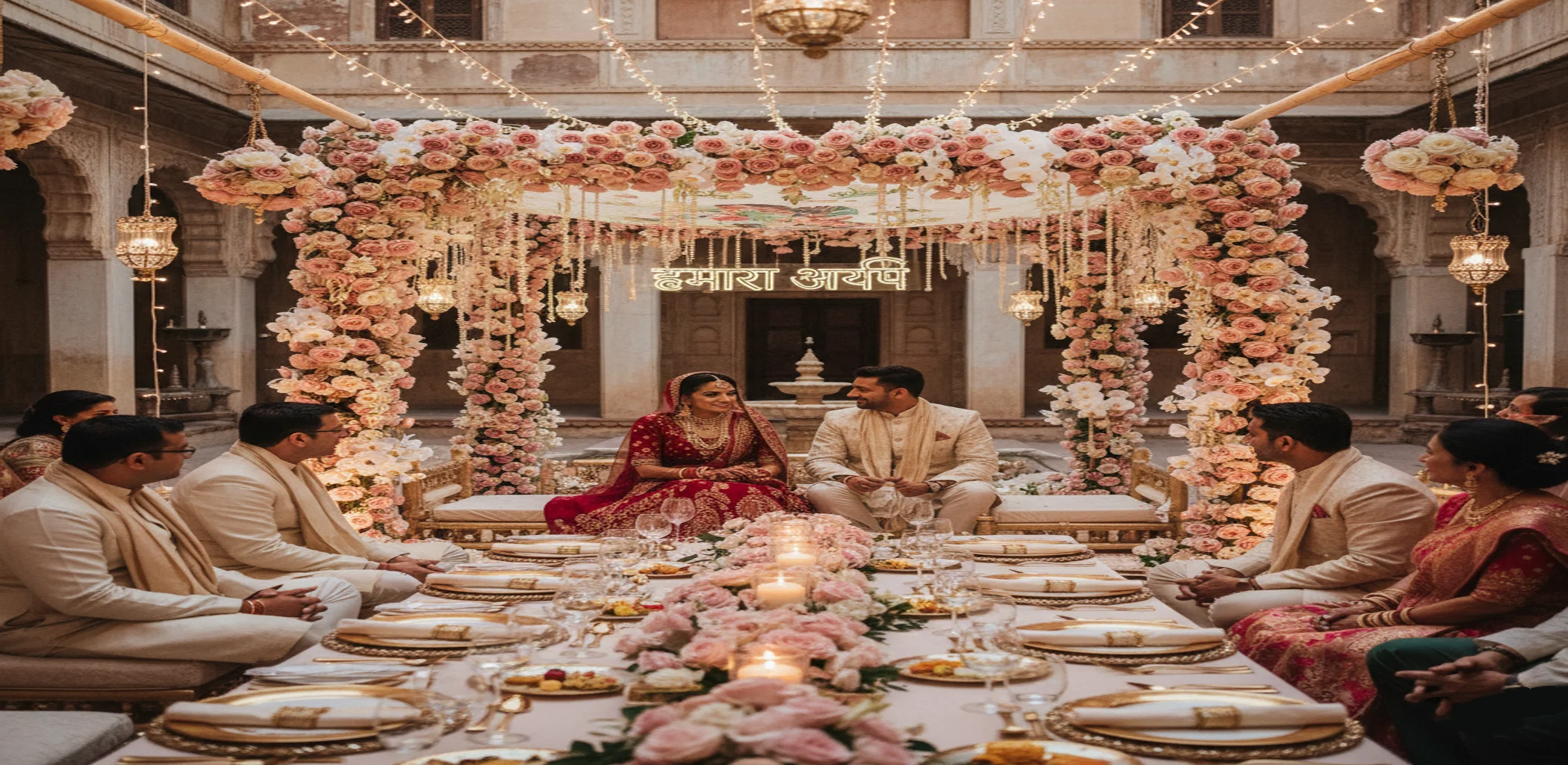
What we mean by Micro-Luxury / Intimate Weddings
In the Indian wedding landscape, this trend essentially means shifting from the traditional “big fat Indian wedding” (hundreds to thousands of guests) to a smaller guest list (often ~50-100 or even fewer) while still retaining or even elevating the luxury, personalization and experience. As one wedding-trend site notes: “In 2025, more couples in India are choosing … intimate gatherings of around 50-100 guests made up of the people who matter most.”
It’s not simply about cutting numbers; it’s about reallocating the budget and focus. The fewer guests typically allow the couple to:
- invest more in premium décor, venue, food and experiences
- spend more meaningful time with each guest
- choose more unique or boutique venues
- tailor the event to reflect their personality and story
As one Indian planner puts it: “Guest lists are getting smaller, but the overall experience is becoming more luxurious and personalised.”
Why this shift is happening in India
Here are some of the key drivers behind the growth of micro-luxury weddings in India:
1. Changing value & guest expectations
- Post the pandemic years, many couples (especially urban millennials/Gen Z) are valuing intimacy, authenticity and experience over grand scale.
- Smaller gatherings allow for deeper engagement: you actually spend time with each guest, rather than just move through hundreds of faces.
- The idea of “quality over quantity” is increasingly relevant: rather than “invite everyone we know”, the list becomes meaningful.
2. Luxe experience with less waste and more control
- With fewer guests, the budget can be channeled into premium touches (boutique venue, gourmet food, designer décor) rather than spreading over 300-500 guests.
- Smaller scale helps reduce logistical stress, waste (food, décor), and makes planning more manageable.
- Some couples see this as an opportunity to reinvest savings into honeymoon, home-buying, or future goals rather than overspending on endless guest lists.
3. Venue & destination flexibility
- Intimate weddings open up a lot more venue-options: boutique resorts, private villas, heritage homes, even family estates or unique off-beat locations.
- These venues often deliver a more “luxury resort” feel for the guest count rather than a banquet-hall mass gathering.
4. Cultural & market shifts
- The wedding industry in India is evolving: couples increasingly demand personalization, branding of their wedding event, and curated guest experiences.
- Some social expectations are shifting: Rather than “how many guests did you invite?”, the measure of success becomes “how memorable/ meaningful was the event?”
What does a Micro-Luxury/Intimate Wedding look like in India?
Here’s a breakdown of how this trend manifests across the various elements of an Indian wedding, with Indian-specific contexts and ideas.
Guest list & scale
- Target guest count: between 50-100 (or even 30-50) close family and friends. Some sources define micro-wedding in India as 10-50 (mini) or up to ~75-100 (mini-luxury).
- Focus on intentional invites: people who matter, can interact meaningfully, share the story.
- Because fewer guests: venue, food, décor budget can “stretch” per guest, giving premium feel rather than economy.
Venue choice & ambience
- Boutique venues: smaller luxury resorts, heritage homes, private villas, garden estates, sometimes offbeat destinations.
- Customised ambience instead of generic banquet hall: personal touches, unique décor, smaller space so it doesn’t look empty.
- Multi-day functions can still happen but with fewer people — so each day becomes more relaxed and experiential.
- Example: A blog cites that micro-wedding couples in India opt for gardens, homestays, boutique resorts instead of large banquet halls.
Décor & design details
- Because guest count is smaller, you can invest in luxury design details: custom signage, designer furniture, curated lighting, experiential décor zones.
- Colour palette & theme can be more tailor-made: one source says micro weddings in India are using handmade décor, soft lighting, earthy colours.
- Because of scale, you can add immersive guest experiences: live interactions, seating lounge areas, interactive décor rather than only ritual spaces.
- Guest experience can be designed in a way that guests feel “immersed” rather than just attending.
Food, catering & guest experience
- Smaller guest list allows: gourmet menus, curated cuisine, signature dishes, multi-course meals, live chef stations. For example, the micro-wedding trend blog mentions “gourmet dining … personalized menus and interactive food stations.”
- Presentation, service, ambiance improved: fewer plates means more attention to each table, better service ratio, fine-dining vibe.
- Personal touches: welcome bags, bespoke cutlery, curated guest gifts, personalised seating arrangements.
Personalisation & guest interaction
- With fewer guests you can plan meaningful interactions: personalised welcome notes, each guest gets time with couple, curated itinerary.
- Guest experience is elevated: not just show-up, but feel part of the story. For instance: interactive music sets, small performance, curated guest activities.
- The couple’s story and personality can be woven in fully: from décor, food, wardrobe to functions and gifting. In a micro-luxury wedding, everything becomes more bespoke.
Fashion, jewellery, entertainment
- Because budget per guest is higher (even if total guest numbers are less), one can invest in designer outfits, luxury jewellery, special experiences for guests (live music, exclusive performances). The micro-luxury wedding trend article mentions “premium services like top-tier photographers, renowned artists, and high-end décor” even though guest list is small.
- Entertainment becomes curated: instead of a large crowd watching mass performances, you might have intimate live acts, acoustic sets, lounge sessions, unique guest-engagement shows.
- Fashion & jewellery become part of the luxe experience rather than mass-wedding-shopping spree.
Sustainability & ease
- Smaller guest list = fewer logistics, fewer accommodations, less travel, less waste. The article from The National highlights that micro/mini weddings help reduce food waste, plastic waste and are more eco-friendly.
- Because the setting is more manageable, the couple can focus more on detail, less on being overwhelmed by scale.
Why this is considered Micro-Luxury rather than just “small wedding”
The term “micro-luxury” is important: it highlights that although the scale is small, the luxury quotient remains high or even enhanced. Some distinctions:
- A small wedding might cut costs everywhere; but a micro-luxury wedding keeps or increases budget per head to deliver premium experience.
- Design, service, venue, food, guest experience are all elevated — smaller scale enables this.
- The guest list itself becomes exclusive, making the event feel like a luxury private gathering rather than “a cheaper wedding”.
- The fewer guests allow for authenticity, luxury, personalization — which itself is the hallmark of luxury.
As one Trend article says: “The idea of a … ‘micro-luxury’ wedding is … focus on quality over quantity — lavish décor, gourmet dining, and immersive experiences for a select few.”
Benefits & advantages
Choosing a micro-luxury/intimate wedding offers several benefits:
• More time with guests
With fewer people, the couple can spend more meaningful time with each guest — conversation, memories, photos, connections — rather than rush through hundreds of handshakes and selfies.
• Higher per-guest value
Budget is spread across fewer guests, so you can allocate toward luxe venue, upgraded food, designer décor, premium service, guest-centric experiences.
• Better logistic control
Managing fewer guests, fewer accommodations, simpler timelines means less stress for couple and planners, freer flow of events, and more flexibility for creativity.
• Venue & setting flexibility
You are not locked into huge banquet halls — you can pick boutique destinations, heritage homes, interesting locations, which might have been impractical for 300+ guests.
• Enhanced personalization
Everything from décor to menu to entertainment can reflect couple’s story, style, culture, values (sustainability, heritage, quirky themes) — more easily than large-scale weddings.
• More memorable and meaningful
Guests often feel more valued (because the environment is intimate), and the couple can build memories deeply rather than superficially.
• Possibly more sustainable / lower waste
Fewer guests means less waste (food, décor, transport, accommodation). As noted in Indian context: micro weddings generate less food waste and more manageable logistics.
• Freedom & authenticity
Less social pressure to invite everyone under the sun; guest list becomes about people you truly want to celebrate with; less “shoulds” and more focus on the couple’s vision.
Challenges, trade-offs & things to consider
While micro-luxury weddings offer many benefits, they also come with certain trade-offs and areas that need careful attention:
• Social and family expectations
In the Indian context, weddings often involve large extended families, many well-wishers and social expectations of “invitations to all”. Opting for 50 guests might require sensitive communication and managing expectations. The drive to smaller guest lists might meet resistance in some families.
• Per-guest cost might be higher
While total guest count is lower, some premium elements might cost more per guest. The couple needs to design budget intentionally: just because guests are fewer doesn’t mean everything goes cheaper – often you upgrade everything.
• Venue cost dynamics
Some boutique venues may have minimum spend or per-guest minimums, so a smaller guest list may not reduce venue cost as much as expected; sometimes the fixed cost is high.
• Guest experience vs scale
Guests might feel “this is smaller” and wonder about missing large-scale excitement. The design needs to ensure the ambience still feels celebration-worthy (not “wedding-lite”). The luxury feel must be conveyed.
• Vendor availability & specialization
Some vendors are geared for large weddings; smaller boutique weddings require flexibility, sometimes customisation. The couple/planner might need to ensure vendor readiness for this scale — décor, catering, logistics all need right sizing rather than default large-scale setups.
• Honour guest relationships
With fewer invites, you need to ensure you don’t inadvertently leave out people who expect invites; choose the guest list carefully, communicate clearly.
• Balancing authenticity vs spectacle
“Luxury” in the context of small-scale means elevated but still authentic; the danger is trying to copy a big-wedding spectacle in a small setting and it ends up feeling forced. The style needs to reflect the scale.
Practical ideas / how to implement — tailored for Indian weddings
Here are actionable ideas and suggestions especially suited to Indian weddings for planning a micro-luxury wedding:
1. Guest list & invite strategy
- Map out names who really matter – close friends, immediate family, mentors, key relatives.
- Use multi-tier guest lists: maybe 50 attend day functions, additional invited for evening only etc.
- Communicate the smaller format positively: e.g., “We’re keeping our circle small so we can celebrate meaningfully” rather than “we couldn’t afford many”.
- Digital invite + personalised message: opt for luxe stationery or bespoke digital invite that conveys the exclusive nature of the event.
- Provide remote participation options for family/friends who cannot attend (live streaming) so they still feel included.
2. Venue & setting
- Choose boutique/homestay/resort/heritage villa with capacity for ~50-100 guests and décor built-in so smaller numbers don’t feel “empty”.
- If destination wedding: pick an off-beat but luxury spot — it becomes the experience itself rather than trying to fill 500 seats.
- Design space to feel intimate: lounge seating, fire-pit, curated alfresco dinner, personalised décor zones.
- Consider multi-day itinerary but fewer guests: e.g., haldi + mehendi as intimate brunch, sangeet with cocktail & live performance, wedding ceremony + gourmet dinner.
- Align décor scale to guest count: fewer floral installations but higher-quality ones; fewer tables but more design detail.
3. Décor, ambience & experience
- Focus on signature moments and signature design elements: one big entrance, curated table design, custom lighting, lounge areas, meaningful décor items (photos, heirlooms, custom signage).
- Use luxury textures/materials: hand-crafted furniture, customised signage, designer installations, quality lighting rather than mass drapes.
- Personalisation everywhere: guest seating with namecards + message, welcome drinks tailored to guest preferences, curated playlists.
- Interactive touches: custom cocktails named after couple’s journey, guest experience zone (photo-wall, live artist sketching, interactive games).
- Ensure the scale of décor fits guest count — small crowd in massive hall looks awkward; match ambience to number of people.
4. Catering & guest food experience
- Opt for gourmet multi-course or curated tasting menus rather than large buffet. The micro-wedding trend article highlights personalised menus and interactive stations. WeddingBazaar
- Use high-quality ingredients, signature dishes reflective of the couple’s culture/story.
- Seating experience: fewer guests allows for better service, perhaps plated meals, lounge areas, conversation tables, chef-table experience.
- Consider beverage experience: signature mocktails/cocktails, bar-stations, curated wine pairing.
- Guest-focused food design: incorporate dietary preferences, kids menu, senior friendly options; make each guest feel catered to.
5. Personalisation & guest attention
- Welcome kits: curate thoughtful welcome bags for each guest (especially for destination/intimate weddings) — artisan items, local craft, handwritten note.
- Guest participation: small number means you can involve guests in mini-rituals, interactive sangeet, ask for guest speeches or contributions.
- Give experiences: e.g., post-wedding brunch with couple, pool lunch, excursion for guests (if destination) — guests feel part of the story not just attendees.
- Gifting: Instead of generic wedding favours, opt for luxury take-aways, tailored to guests, maybe local artisans, good quality souvenirs.
6. Fashion, entertainment & photography
- Fashion & jewellery: Since budget per guest is higher, invest in designer outfit, bespoke jewellery, custom accessories.
- Entertainment: Smaller scale means you can hire boutique live bands, well-known artists for shorter set, acoustic sets, surprise performance rather than standard DJ for thousands.
- Photography & videography: More time, fewer people means better footage, more personal shots, bride/groom time, guest moments.
- 360° experiences: smaller guest count allows more freedom for drone, unique angles, immersive experiences.
7. Sustainability & guest welfare
- Smaller guest list = less waste: less food, less décor, less transport. Aligns well with eco-conscious couples.
- Guest comfort: fewer people means better accommodation per person, better service, easier transport, less chaos.
- Consider wellness/relaxation elements: for intimate wedding, you might include spa sessions, yoga morning, relaxed brunch — luxury components.
8. Logistics, budget & planning
- Budget: Decide budget allocation per guest rather than per event. Because fewer guests, you can invest more per head.
- Vendors: Choose planners/vendors who are comfortable doing boutique/high-luxury events for smaller guest counts (rather than just “big wedding” default).
- Timeline: Since your scale is smaller, you can possibly compress events, allocate more time for each event, fewer “dead hours”.
- Communication: With fewer guests, you can send detailed itinerary, pre-wedding communication, mobile apps or portals with guest info, travel/ accommodation briefing.
- Contingency: Smaller guest list can make last-minute changes easier to manage (e.g., if some guests drop, doesn’t dramatically affect scale).
Indian-specific Insights & Examples
- The blog “Micro-Luxury Wedding: Step Inside the World of New Indian Shaadi Style” says: “Rather than inviting hundreds, couples prefer to invite 20 to 50 dear and close friends and family members. … It’s about quality rather than quantity.”
- Another article points out: “In 2025, more couples in India are choosing personalised micro-weddings—intimate gatherings of around 50-100 guests made up of the people who matter most.”
- On venue/scale and sustainability: “Intimate, bespoke and mindful… weddings where extended family and neighbours are not automatically invited. … The festivities’ carbon footprint is also kept in check.”
- The shift in the market is noted by planners: “Guest lists are getting smaller, but the overall experience is becoming more luxurious and personalised.”
These reflect how the Indian wedding market is adapting to micro-luxury formats while still delivering opulence.
Future directions & what to expect for 2025 and beyond
- More couples will treat their wedding as curated experiences rather than purely social obligations. The guest count will reduce, but each moment will be elevated.
- Boutique venues and “exclusive buy‐out” settings become more common — private resorts, heritage homes, villas can be fully booked for ~50-100 people and feel ultra-luxury.
- The guest list will strengthen focus on “experience”: perhaps destination micro weddings (not 1000 guests in destination but 50 guests in unique setting) become more frequent.
- Luxury elements (designer décor, art installations, bespoke guest experiences) will democratise to micro scale — enabling smaller weddings with big luxury feel.
- Integration of technology, sustainability and intimacy: With fewer guests, the event can be more easily custom-designed to reflect couple’s values (eco-friendly, cultural authenticity, immersive experience).
- Shifting from “size = status” to “experience = status”: The social metric may transition — having 50 highly curated guests may be more ‘luxury’ than 500 generic guests.
- Vendor services will adapt: Planners, venues, caterers will build packages specifically for micro-luxury weddings (50-80 guests) with high-end finish rather than scaled-down large-wedding options.
Sample Checklist for Planning a Micro-Luxury Indian Wedding
Here’s a structured checklist you can adapt:
12–9 months before
- Define your vision: intimate gathering of ~50-100, luxury feel, personalized guest journey.
- Confirm guest list size & structure: immediate family, close friends, key relatives.
- Select venue: boutique resort/homestay/heritage property suitable for your size, with luxury amenities.
- Budget: allocate per guest cost and luxury experience budget (venue, décor, food, guest experience) rather than trying to mimic large-wedding costing.
- Choose planner/vendor comfortable with smaller high-end events.
9–6 months before
- Work on guest experience: welcome kits, itinerary for guests (especially if destination).
- Décor concept and theme: bespoke design, instead of ‘large wedding décor scaled down’.
- Catering: design with fewer guests in mind – signature dishes, interactive stations, high service ratio.
- Accommodation/transport: fewer guests means you can upgrade their journey/stay (luxury resort rooms, transportation with comfort).
- Invitations: send luxe invites, possibly with message explaining intimate gathering theme (to set tone).
6–3 months before
- Finalize guest list & get RSVPs: with fewer guests, managing guest tracking becomes easier; confirm all attending.
- Personal touches: guest seating, welcome notes, guest gifts.
- Run through vendor contracts: ensure décor/presentation/timeline align with intimate luxury objective.
- Plan for photography/videography that captures guest interactions (not just ceremony) since smaller group means more guest time.
- Entertainment: book live/curated experience rather than mass-crowd show.
1–2 months before
- Confirm menu and service details: plating, tasting session, service level.
- Guest communication: send detailed itinerary, dress code (if any), accommodation/travel info.
- Décor walk-through at venue: ensure space feels full, warm, and luxury with your expected guest count.
- Guest gifts and welcome kits ready.
- Coordinate transport/accommodation for guests (especially if destination).
- Final décor/lighting tweaks to enhance intimate luxury vibe.
Wedding day & after
- Ensure the couple & planner greet each guest personally (smaller guest list allows this).
- Make sure service is high quality: each guest should feel valued not just “one among many”.
- Use the downtime: fewer guests means you can have calmer moments, bride/groom can visit tables, relax, enjoy.
- Capture guest moments, candid interactions, meaningful details (because scale allows it).
- Post-event: send personalised thank-you notes/gifts, digital photo share, guest feedback.
- If guests are out-station, consider post-wedding brunch or casual get-together to extend experience.
Final thoughts
Opting for a micro-luxury or intimate wedding in India in 2025 is not about less — it’s about better. It’s about crafting a celebration that feels personal, exquisite, meaningful. For you (considering your interest in weddings and planning), this trend aligns beautifully with a scenario where guest-experience, personalization, design and value matter more than sheer size.
When done well, a micro-luxury wedding offers the best of both worlds: the warmth and connection of a small gathering, and the elegance, refinement and memorable impact of a luxury wedding. It’s a smart choice for couples who want to enjoy their day, spend time with guests, and leave everyone with vivid memories — rather than just tick a social checkbox.