Challenges for India as a MICE Destination, and a URAHL-centric Strategy
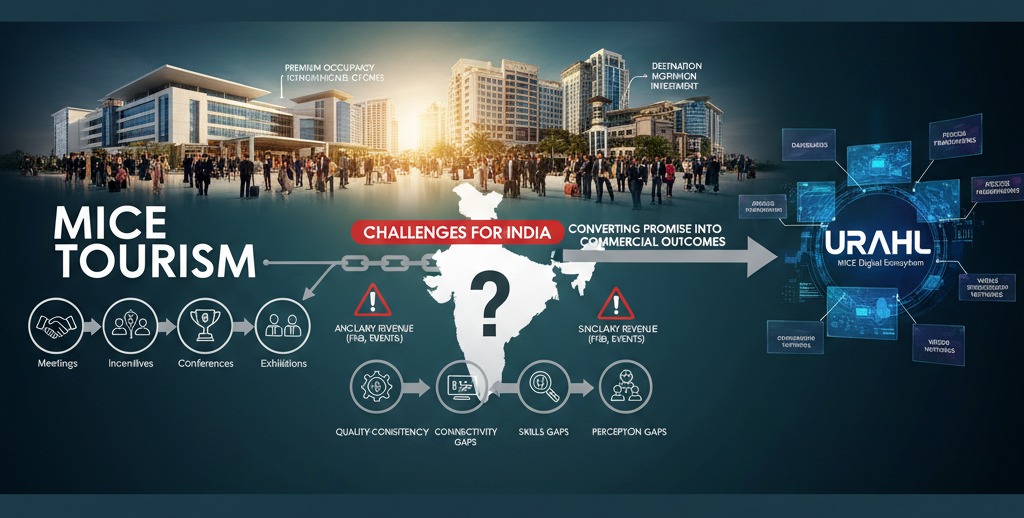
MICE tourism — Meetings, Incentives, Conferences and Exhibitions — is a high-value, low-volume segment that drives premium occupancy, increases ancillary revenue (F&B, banqueting, AV, transport), shortens sales cycles for hospitality B2B offerings, and catalyzes destination-level investment in venues and infrastructure. For India, MICE is both a massive opportunity and a systems-level challenge: the country has scale, cultural appeal and fast-improving venues, but faces quality-consistency, connectivity, skills and perception gaps that limit its ability to capture global MICE share. URAHL’s MICE Digital Ecosystem (dashboards + process frameworks + venue, sponsorship and vendor networks) is uniquely positioned to convert India’s promise into repeatable commercial outcomes for hotels, venues and destination stakeholders. Horwath HTL+1
1. Why MICE matters to hospitality (mechanics & economics)
- Higher RevPAR & premium ADR: MICE groups typically book blocks of rooms at higher Average Daily Rates and generate ancillary revenue through banquets, meeting room rentals, AV, and F&B packages — all of which lift RevPAR and margins for hotels. Institutional bookings also smooth weekday occupancy valleys common in urban markets. Industry reports show MICE and events materially contributed to 2024–25 hospitality growth in India. Horwath HTL+1
- Revenue diversification & season smoothing: Business tourism introduces weekday demand and counter-balances leisure seasonality (wedding and festival peaks versus conference schedules). It also creates repeatable contracted revenue when hotels become preferred suppliers for recurring conferences or corporate travel programs.
- Higher ancillary spend per delegate: A single conference attendee often results in multiple revenue lines — room, F&B, transport, sightseeing add-ons, and F&B upsells during networking dinners. For multi-day events, per-delegate spend can exceed typical transient guest spend significantly.
- Longer customer lifetime & corporate relationships: MICE sells relationships: successful event delivery can convert an institutional organizer into a repeat client or channel partner for corporate travel and long-term procurement.
- Destination marketing & soft power: Large conventions (e.g., trade shows, international summits) produce media spillover and destination visibility that attracts future leisure and business travelers.
(These economic effects are reflected in national hospitality analyses showing improved occupancy and RevPAR tied to events, weddings and MICE activity across India.) Horwath HTL+1
2. Specific impacts on hospitality operations (operational detail)
2.1 Hotel operations & cost base
- Upskilled F&B & banquet operations: Hotels must develop scalable banquet kitchens, modular menus, and specialized staffing rosters to support large, concurrent events.
- AV & technical investment: Professional AV (lighting, interpretation, streaming) becomes essential as events demand hybrid delivery. Investment in AV increases fixed costs but unlocks higher-margin event revenue.
- Housekeeping & logistics: Turnaround efficiency for block bookings, dedicated check-in counters, and logistics for exhibitor freight are required.
- Procurement & vendor management: Hotels expand vendor ecosystems (staging, decorators, security) and require strong contracting processes.
2.2 Sales & commercial behaviour
- Longer sales cycles with higher yield: Conference bookings require RFP processes. Sales teams must price packages, negotiate attrition, and structure sponsor collaborations.
- Account management shift: Dedicated MICE account managers and relationship teams improve recurrence and conversion.
- Dynamic packaging: Hotels bundle rooms with meeting space, F&B credits, and sponsorships to increase overall transaction value.
2.3 Human capital & training
- Staff need training in event management, enterprise client servicing, and hybrid tech operations (live streaming, remote audience engagement). Upskilling reduces delivery risk and improves client satisfaction.
3. India’s strengths as a MICE destination
- Scale & diversity: Major metros (Delhi NCR, Mumbai, Bengaluru, Chennai, Hyderabad) and emerging cities (Kochi, Jaipur, Goa) offer venue diversity and cultural attractions for incentive travel.
- New world-class venues: Investments such as large convention centres and purpose-built exhibition spaces increase capacity to host global gatherings.
- Large domestic market & corporate base: India’s sizable corporate sector, strong start-up ecosystem, and government programs generate domestic demand for B2B events.
- Government focus & initiatives: Central and state tourism policies increasingly prioritize MICE as an economic lever; events and trade missions are being promoted to attract foreign delegations. Ministry of Tourism
4. Challenges India faces as a MICE destination (detailed)
Despite promise, India faces structural and market challenges that suppress full MICE potential:
4.1 Connectivity & accessibility
- Air connectivity inconsistency: While metros are well connected, many secondary cities lack frequent international connections; visa processes and flight timings can deter international organizers.
- Last-mile transport & logistics: Efficient freight handling for exhibitions, reliable delegate transfer, and timely customs clearance for international expo cargo remain pain points.
4.2 Venue & quality variability
- Quality inconsistency across venues: Some newer convention centres are world-class, but support infrastructure (hotels within walking distance, F&B quality, technical suppliers) varies widely. Organisers need predictable, consistently high standards across venue ecosystems. ResearchGate
4.3 Skilled workforce shortage
- Event-specialist human capital gap: India has limited pools of experienced conference production staff, certified AV technicians, and seasoned PCOs (professional conference organisers) in some regions, increasing reliance on imports or trial-and-error.
4.4 Perception & brand positioning
- Global perception and sales: Established MICE hubs (Singapore, Dubai, Barcelona) have strong global sales networks and reputation for reliability — India must overcome perceptions around bureaucracy, on-time delivery and service quality.
4.5 Regulatory & ease-of-doing-business frictions
- Permits, taxation and customs: Complex local permissions, variable tax treatment for events and hurdles in temporary import of exhibition materials can increase time and cost.
- Standardization & procurement friction: Lack of standardized procurement and contracting templates across states complicates long-term event planning.
4.6 Technology & hybrid readiness
- Digital experience variability: Hybrid event delivery requires robust streaming, interpretation, and digital engagement stacks; inconsistent technical readiness reduces attractiveness for international hybrid conferences.
4.7 Sustainability & ESG requirements
- Sustainability expectations: Global associations increasingly demand ESG measures (food waste reduction, carbon reporting) — Indian events must meet these standards to attract certain international associations.
(Market research and industry analyses identify these as recurring constraints to India’s MICE growth.) ResearchGate+1
5. How URAHL MICE Services address these challenges (structured, dashboard-led strategy)
URAHL’s MICE Digital Ecosystem — a combination of six interlinked dashboards and operational playbooks — is designed to convert the above constraints into strengths. Below is a structured mapping of problems → URAHL solutions → hotel/venue outcomes.
5.1 Problem: Connectivity & accessibility
URAHL solution:
- Global MICE Venues Dashboard maintains a searchable, geotagged inventory of venues, hotels within X kms, air connectivity indices, and customs/port contacts for expo logistics. It integrates route & travel time overlays and recommends multi-venue clusters for international delegations.
Outcome for hospitality: Hotels receive curated RFPs matching their logistical suitability; events are routed to venues with demonstrable delegate access, reducing no-shows and improving international organizer confidence.
5.2 Problem: Venue & quality inconsistency
URAHL solution:
- Process Matrix Dashboard implements vendor and venue qualification scores (AV readiness, nearby room inventory, staff certification, sustainability scores). URAHL prescreens and continuously audits venues.
Outcome: Event planners and hotel sales teams can demonstrate verified capabilities to organizers; hotels that meet standards get higher-yield RFPs and preferred supplier status.
5.3 Problem: Skilled workforce shortage
URAHL solution:
- MICE Process Flow Dashboard codifies SOPs for event production (checklists for FOH, banquet, AV, security). URAHL runs certified training bootcamps and makes operational templates (staffing rosters, cue sheets) accessible via dashboards.
Outcome: Hotels reduce delivery errors, lower overtime costs through better rostering, and improve client satisfaction scores — increasing repeat business.
5.4 Problem: Perception & global sales
URAHL solution:
- Advertisements & Sponsorships Dashboard amplifies events through guaranteed sponsor media, managed PR circuits and analytics. URAHL curates international associations and runs co-sponsored roadshows. The Ecosystem Command dashboard provides real-time KPI dashboards to organizers and sponsors.
Outcome: Hotels and destinations get validated third-party marketing muscle and transparent performance metrics, improving global reputation.
5.5 Problem: Regulatory friction & procurement
URAHL solution:
- Process Flow Dashboard includes standardized contract templates (venue contracts, exhibitor terms, customs checklists) and a central legal repository mapped to state regulations. URAHL’s platform flags permits and automates reminders.
Outcome: Faster contracting cycles, fewer last-minute legal blocks, and lower contingency buffers in budgeting.
5.6 Problem: Technology & hybrid readiness
URAHL solution:
- Ecosystem Command Dashboard integrates AV inventory, streaming health, interpreter services, and hybrid participant analytics. URAHL offers a tech-stack marketplace of vetted AV and streaming partners.
Outcome: Hotels can offer packaged hybrid solutions (room + AV + streaming) — capturing organizers who seek global reach.
5.7 Problem: Sustainability & ESG
URAHL solution:
- MICE Food Menu & Venues Dashboards feature predictive F&B consumption models (to reduce waste), vendor ESG scoring, and carbon estimation tools. URAHL can certify ‘green event’ templates.
Outcome: Hotels meet international association requirements and gain access to ESG-sensitive event pipelines.
6. Concrete URAHL programs (operational playbooks) that deliver results
Program A — Venue Certification & Preferred Supplier Network
- Quarterly audits, a graded certification (Gold/Silver/Bronze) in Process Matrix, and automatic inclusion in high-value RFPs for certified hotels.
Program B — MICE Workforce Academy
- Micro-courses (banquet operations, AV troubleshooting, hybrid event facilitation) integrated with Process Flow templates and on-platform checklists; certification improves venue scoring.
Program C — Hybrid Event-as-a-Service (H-EaaS)
- Pre-packaged offers: room blocks + AV + streaming + interpretation + moderation. Sold via Global MICE Venues Dashboard with standardized pricing and SLAs.
Program D — Sponsor & Association Partnership Engine
- Ads & Sponsorships Dashboard curates sponsor bundles, co-funded destination marketing, and guaranteed media commitments — making large events financially viable for hotels and organizers.
Program E — Government & State Liaison Module
- URAHL helps negotiate incentive windows with state tourism boards, integrates state policy calendars into scheduling, and bundles incentives into RFP value propositions.
7. Measurable hotel-level KPIs URAHL drives (examples)
- Incremental RevPAR uplift per certified MICE event (tracked per hotel).
- Reduction in planning lead time (RFP → contract) via Process Flow templates.
- Pilot-to-contract conversion rate for corporate pilots initiated at URAHL events.
- Reduction in event-day complaints (service incidents) after MICE Academy certification.
- Sponsor revenue per event when using the Sponsorship Dashboard.
URAHL’s dashboards enable hotels to track these KPIs in real time and report ROI to owners and asset managers.
8. Case scenario (illustrative): How URAHL converts a weak MICE proposition into a success
Situation: A 250-room upscale hotel in a Tier-2 city has a ballroom but low MICE bookings due to weak AV, inconsistent F&B, and no corporate pipelines.
URAHL intervention:
- Venue assessed and given a Silver MICE certification with remediation checklist (Process Matrix).
- Hotel enrolls nine staff in the MICE Workforce Academy (Process Flow) and upgrades a modular AV kit from URAHL’s partner marketplace (Ecosystem Command).
- URAHL markets the hotel via Advertisements Dashboard to a curated list of regional associations and pitches a hybrid symposium with a Platinum sponsor.
- Sponsor covers part of AV upgrade and pre-pays for a sponsorship tier (Sponsorship Dashboard). Hybrid tech via Ecosystem Command ensures 800 virtual attendees.
- Post-event: hotel reports 95% room block occupancy, high F&B spend, two corporate pilots contracted, and repeat booking inquiries.
Outcome: Quick ROI, improved certification, and placement in higher-value RFPs.
9. Strategic recommendations for India stakeholders (hotels, states, and industry bodies) — how to scale MICE impact
- Create destination MICE clusters: Co-locate hotels, exhibition halls and transport nodes; URAHL’s venue mapping can help planners identify productive clusters.
- Standardize procurement & contracting across states: Adopt URAHL’s Process Flow templates as baseline to reduce friction for associations.
- Invest in human capital at scale: Public-private MICE academies seed talent in Tier-2 regions.
- Subsidize tech & hybrid readiness: Government grants for AV kits and streaming capacity in emerging destinations.
- Build international sales desks: Co-funded by states and major hospitality groups using URAHL’s sponsor & association engine to attract global conventions.
- Measure & report: Publish destination MICE scorecards (occupancy, vendor quality, sustainability metrics) to build trust.
10. Risks, mitigations and governance
- Risk: Over-reliance on a few big events leads to revenue volatility.
Mitigation: Diversify across mid-sized recurring events, corporate circuits, and incentive travel. URAHL’s calendars and Process Matrix help balance the pipeline. - Risk: Rapid venue expansion without skills leads to quality dilution.
Mitigation: Condition certification on workforce training and AV readiness. - Risk: Regulatory surprises (permits/taxes).
Mitigation: URAHL’s Process Flow legal templates and state liaison reduce surprises and speed approvals.
11. Conclusion — the URAHL advantage and next steps
MICE tourism is a transformational growth lever for India’s hospitality industry: it raises margins, stabilizes occupancy, and creates institutional relationships that convert into long-term revenue. But realizing this potential requires an ecosystem approach — standardization, certification, tech enablement, talent and reliable sponsorship economics.
URAHL’s MICE Digital Ecosystem — combining venue intelligence, process standardization, sponsor monetization, real-time command, and workforce training — provides the operational scaffolding that India’s hotels and destinations need to scale MICE successfully. By reducing friction on logistics, improving quality consistency, and packaging hybrid, sustainable event offerings, URAHL converts structural constraints into competitive advantages for Indian hospitality.