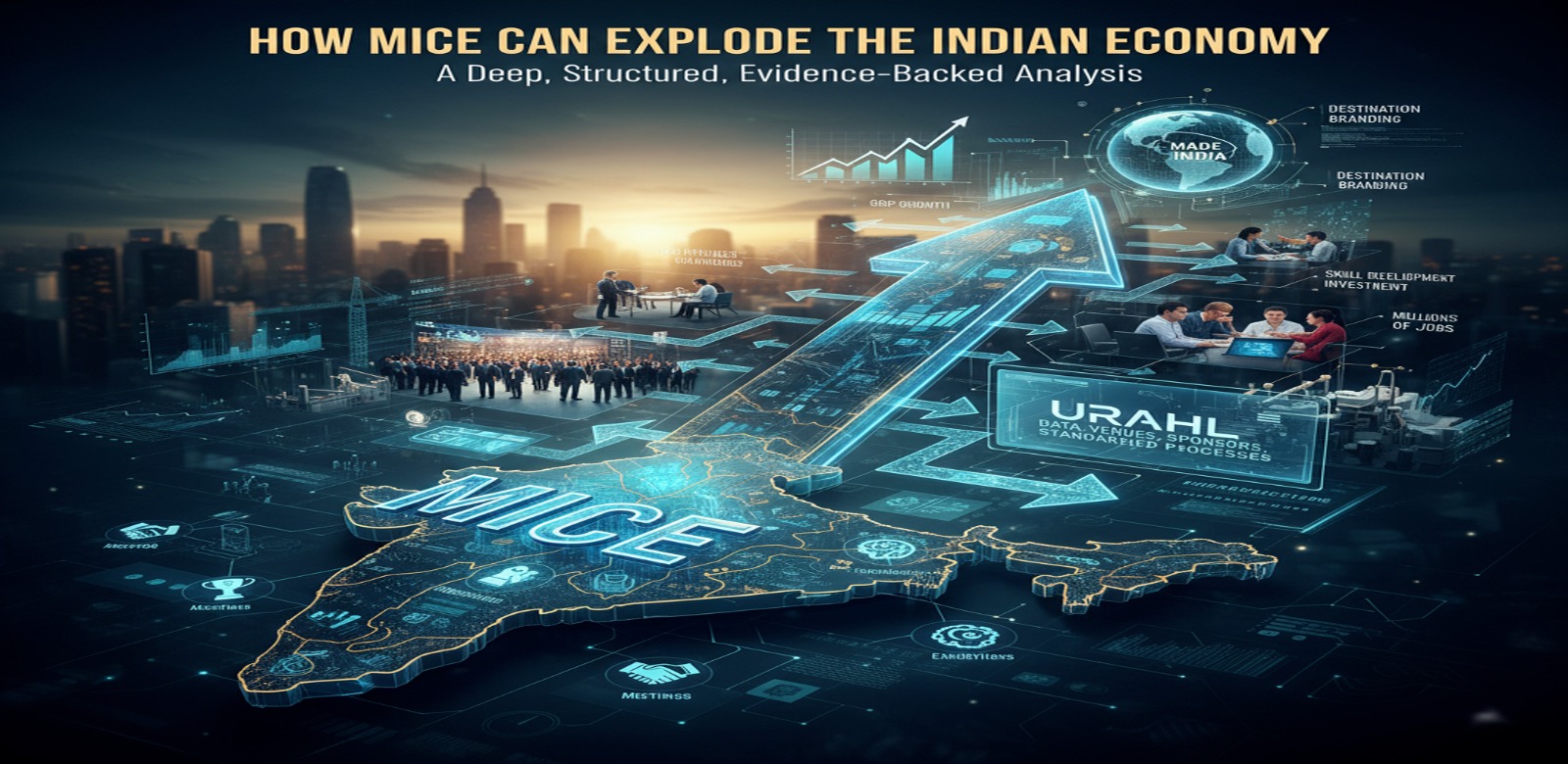
Meetings, Incentives, Conferences and Exhibitions (MICE) are not a niche tourism sub-sector — they are a high-value economic engine that multiplies spending, creates durable B2B pipelines, seed-funds SME supplier ecosystems, mobilizes skill development, and accelerates regional infrastructure investment. In India today the MICE runway is long: market estimates place India’s MICE economy in the tens of billions of USD with multi-year double-digit growth forecasts, and government strategy is actively prioritizing MICE as a national lever for jobs, services exports and destination branding. When scaled through coordinated public-private mechanisms — and with technologically enabled operators such as URAHL mobilizing data, venues, sponsors and standardized processes — MICE can materially raise GDP contributions, create millions of jobs across services and hospitality value chains, and transform secondary cities into high-value economic clusters. Ministry of Tourism+1
1. The scale & growth runway (today → near future)
- Global context: The global MICE market is enormous and growing — estimates for the global MICE market run into the many hundreds of billions of dollars with mid-to-high single-digit CAGRs into the end of the decade. This makes MICE one of the most resilient, high-value segments of travel and tourism. Grand View Research
- India’s opportunity: Multiple market research and government reports converge: India’s MICE market already accounts for tens of billions of USD of economic activity and is forecast to at least double (or more) within five-to-ten years depending on the source and methodology — IMARC, Grand View and government briefings present figures and projections that show rapid expansion for the sector. These projections reflect expanding business travel, corporate program budgets, international association interest, and the multiplication effect of exhibitions and trade fairs. IMARC Group+1
Why this matters: large market size × fast growth = outsized absolute impact on employment, services exports and capital investment flows into hotels, convention centres, transport and technology.
2. How MICE generates economic value — the transmission channels
MICE produces economic impact through distinct, measurable channels. Each channel multiplies value beyond the event itself:
- Direct spending: delegate hotel rooms, F&B, venue hire, AV, staffing, exhibitor space, transport and registration fees. Large exhibitions and conferences generate high per-delegate spend compared to leisure travel.
- Indirect spending (supply chain): procurement by hotels and convention centres (catering suppliers, decorators, logistics providers, security firms, technical crews, printing & signage). This supports MSMEs and local suppliers.
- Induced spending: wages paid to event staff and service providers are spent in the local economy (retail, housing, services), producing a consumption multiplier.
- Catalytic B2B outcomes: deals, procurement contracts and pilot projects initiated at events can create multi-year revenue streams for startups, vendors and corporates — transforming a single MICE event into recurring economic value.
- Destination & brand effects: high-profile international congresses raise tourism demand (business + leisure), attracting future delegates, exhibitors and long-term investment into hospitality assets.
Measured together, these channels give MICE a far higher GDP per visitor and faster ROI on destination infrastructure than generic leisure tourism. Government studies in India have explicitly recognized this multiplier potential and are crafting policy to capture it. Ministry of Tourism+1
3. Employment, entrepreneurship and MSME incubation
- Job creation: MICE is intensely labour-absorptive across skill levels — from banquet staff, AV technicians and logistics crews to professional conference organisers (PCOs), sales teams, transport operators and digital service providers (platforms, streaming, analytics). The hospitality sector’s revival driven by MICE translates into full-time and gig employment across urban and secondary markets. India’s tourism reports show tourism and allied activities already generate significant employment; focus on MICE will push a portion of that toward higher wage, urban professional roles and managerial careers. Ministry of Tourism
- MSME opportunity: Exhibition ecosystems create predictable recurring demand for small fabricators, stall designers, printing houses, local food vendors and technical subcontractors. With repeatable event calendars, MSMEs can invest in equipment and skilled labour, improving productivity and scale.
- Entrepreneurship & startups: MICE events are marketplaces for corporate procurement — startups gain early pilots, revenue and scale faster when they are visible to procurement officials, corporate innovation teams and investor networks all in one place.
Result: a virtuous employment-growth-entrepreneurship loop where events create predictable demand that supports SME capitalization, hiring, and technology adoption.
4. Regional development & city economics — why MICE transforms second-tier cities
MICE does not need to be confined to metros. In fact, its capacity to anchor cluster development is uniquely valuable:
- Infrastructure build-out: a convention centre or reliable cluster of hotels transforms local transport, last-mile logistics, and service quality — infrastructure that benefits other sectors (education, healthcare, manufacturing).
- Higher average spend per visitor: because delegates pay for conferences, sponsorships and exhibitor packages, the local spend is concentrated and premium — faster returns for local hospitality assets and municipal taxes.
- Season smoothing: MICE injects weekday and off-season demand into markets that are otherwise seasonally dependent (e.g., hill stations or coastal destinations), improving total asset utilization.
- Job decentralization: creation of professional roles in Tier-2/3 cities reduces concentration in metros and fosters local talent pools. Recent state initiatives and conclaves (Kerala, Andhra Pradesh examples) illustrate how states are actively courting MICE to diversify regional economies. The Times of India+1
5. Exports of services & foreign exchange
Large international congresses, trade shows and corporate events draw overseas delegates, exhibitors and sponsors — generating inbound foreign exchange and exporting Indian services (event management, hospitality, production). As India captures a larger share of global association congresses, the net export value of MICE services (and the soft exports from related tech services) will grow materially. Government ambitions to lift India’s market share of the global MICE pie are explicit and backed by both national and state level promotion strategies. Press Information Bureau+1
6. Innovation, technology adoption and productivity gains
- Platformization & data: MICE pushes adoption of event-tech (registration platforms, matchmaking algorithms, lead capture, hybrid streaming and analytics), creating demand for B2B SaaS and data services. Operators and venues that integrate these technologies see improved conversion, lower CAC for sponsors, and measurable ROI.
- Hybrid & virtual scale: Hybrid events extend reach beyond physical seats, enabling sponsors and exhibitors to monetize digital audiences — improving unit economics and resilience during travel slowdowns.
- AI & automation: Intelligent matchmaking, predictive rooming and demand forecasting reduce waste and improve per-event profitability. URAHL-style ecosystems that embed dashboards and process automation can scale these efficiencies nationally.
Collectively, technology adoption raised by MICE has spillovers into other service sectors — improving productivity, traceability and formalization of the supplier base.
7. Fiscal revenue, taxation and public finance benefits
- Direct tax receipts: GST and other taxes on venue hire, exhibit space, F&B, transport and accommodation.
- Indirect tax base enrichment: wages, profits of local suppliers, VAT/sales taxes — expanded economic activity broadens the municipal and state tax base.
- Public investment ROI: Convention centre investments and airport upgrades can be justified on MICE economic multipliers — fast payback if events are frequent and well-sold.
These fiscal benefits incentivize state governments to design MICE-friendly policies (special incentives, streamlined permits, destination marketing budgets) which catalyse further private investment. Recent central government publications and press releases indicate active policy shifts toward MICE promotion and city convention promotion bureaus. Ministry of Tourism+1
8. Soft power, diplomacy & knowledge economy benefits
Hosting international conferences (health, climate, tech, trade) does more than bring delegates — it positions India as a knowledge hub, shapes global narratives, and opens pathways for institutional collaboration (research grants, trade delegations, FDI dialogues). MICE is thus a strategic soft-power tool that multiplies diplomatic and trade outcomes beyond tourist receipts.
9. Challenges that must be solved (if India wants the “explosion”)
To realize the potential, several structural bottlenecks must be addressed:
- Connectivity gaps: uneven international flight networks and last-mile logistics reduce attractiveness to global association organisers.
- Quality & standards variability: inconsistent venue quality, AV capabilities, and hospitality standards across regions undermine repeat business.
- Skilled workforce shortage: shortage of trained PCOs, AV technicians and event production crews in many regions.
- Regulatory friction / permits: complex taxation, customs clearance for exhibition cargo, and variable state regulations increase lead time and cost.
- Perception & sales network: established global hubs have incumbent sales networks; India must invest consistently in global sales desks and association relations.
- Sustainability demands: international associations increasingly require ESG reporting, carbon footprint reduction and food-waste mitigation — India must scale green event capability.
These are solvable but require coordinated public-private interventions, standardization, and long-term capacity building. The National Strategy for MICE and recent government announcements demonstrate policy recognition — but execution and scale matter next. Ministry of Tourism+1
10. Policy & industry actions that unlock exponential impact
To convert potential into explosive growth, coordinated measures are required across four pillars:
A. Infrastructure & connectivity
- Build and certify more convention centres integrated with airport connectivity and hotel clusters.
- Upgrade customs and freight corridors for expo cargo with “fast-track” protocols.
B. Standards, certification & talent
- Create national MICE service standards and a certification ladder (venue, AV, hospitality, PCOs).
- Sponsor public-private MICE academies that upskill technical and managerial staff — convert gig roles into career pathways.
C. Demand generation & global sales
- Fund city convention bureaus to pursue global associations aggressively (medical, engineering, finance).
- Co-sponsor industry roadshows and buyer-seller meets in target markets to win repeat association congresses.
D. Regulatory & fiscal facilitation
- Single-window clearances for large events, harmonized tax treatments, and temporary duty exemptions for exhibition goods.
- Targeted incentives for Tier-2 host cities to absorb initial marketing and infrastructure costs.
Government strategy documents and recent press releases explicitly endorse several of these measures; what remains is operational scale and private sector partnership. Ministry of Tourism+1
11. The role of platforms & operators (why URAHL-style models matter)
Large, platformized operators and ecosystems like URAHL are pivotal because they can:
- Standardize processes (vendor onboarding, contracts, pilot templates) so that venues across India present consistent, investible options.
- Aggregate demand across sectors (corporate, association, trade) to negotiate better rates and guarantee delegate volumes.
- Provide data & dashboards that measure sponsor ROI, delegate flows and post-event conversions — essential to modern event economics.
- Run certification and training programs that raise the supplier base quality.
- Co-invest in hybrid tech and sustainability initiatives that small individual hotels cannot afford.
When government initiatives provide incentives, private platforms execute at scale — a necessary public-private marriage to multiply MICE outcomes.
12. Measurable impact scenarios — simple modelling
(These are illustrative scenarios built from industry multipliers and market estimates.)
- Conservative scenario (steady growth): If India doubles MICE revenue over five years (consistent with many forecasts), the sector could add tens of billions of USD in annual GDP contribution, create hundreds of thousands of direct jobs and support 2–3x that number indirectly in supply chains. Grand View Research
- Accelerated scenario (policy + private scale): With targeted policy, city convention bureaus, and platform adoption, India could capture a materially higher share of global association congresses — pushing annual MICE receipts into the USD 100B+ range by 2030 and generating multi-hundred-thousand incremental high-quality jobs (sales, PCOs, tech, hospitality), while catalysing local manufacturing for exhibition supplies and high-value services exports.
These scenarios are directionally consistent with government projections and market research estimates that forecast steep growth through the late 2020s. Ministry of Tourism+1
13. Risks, mitigations and governance
Risk: Over-investment in a few assets (empty convention centres).
- Mitigation: Demand-led development (pre-booked anchor events), phased buildouts and multi-use hubs.
Risk: Quality dilution as capacity grows.
- Mitigation: Certification, mandatory training, and revenue-linked incentive schemes for quality improvement.
Risk: Carbon & environmental backlash.
- Mitigation: Mandatory sustainability plans, predictive F&B ordering to reduce waste, carbon offset programs.
Governance should include public-private oversight committees with industry representation to align incentives and monitor outcomes.
14. Practical roadmap (high-impact first 3 years)
- Year 0–1: Launch national MICE scorecards, fund 3 city convention promotion bureaus, seed 5 MICE workforce academies.
- Year 1–2: Standardize contracts and customs fast-track; certify 25 venues and 100 vendors.
- Year 2–3: Run co-funded global sales campaigns for association conferences; scale hybrid event capabilities and sponsor a national “MICE Technology Fund” to subsidize streaming/AI platforms for Tier-2 venues.
This sequencing balances immediate demand stimulation with durable capacity building.
15. Conclusion — why MICE can explode India’s economy (and how we seize it)
MICE is uniquely potent because it combines high per-delegate spend, repeatable B2B outcomes (contracts, pilots, procurement), supply-chain activation for MSMEs, and the visibility that attracts long-term investment. India already has the ingredients — scale, cultural attractions, improving infrastructure and government intent. What it needs is coordinated execution: standardized quality, upgraded connectivity, targeted incentives, and platform partners who can aggregate demand and deliver measurable outcomes.
If India executes a focused MICE strategy — integrating city promotion bureaus, certification and training, fiscal facilitation, and technology adoption — the sector will not merely grow proportionally; it will catalyse a structural uplift in jobs, services exports, SME incomes, and municipal revenues. In short: MICE is a high-leverage accelerator for the India growth story — and the coming five to ten years are the window when the compound effects of infrastructure, policy, and private platforms can produce an economic explosion that reverberates across the nation.
Selected authoritative sources & further reading
- Government of India — Ministry of Tourism: National Strategy for MICE Industry (2022) and recent PIB/Annual Report notes on MICE initiatives. Ministry of Tourism+1
- IMARC Group — India MICE Market Size & Forecasts (2024). IMARC Group
- Grand View Research & industry market reports projecting India MICE growth through 2030. Grand View Research+1
- Recent press and state conclaves highlighting city-level MICE promotion (Kerala, Andhra Pradesh examples). The Times of India+1