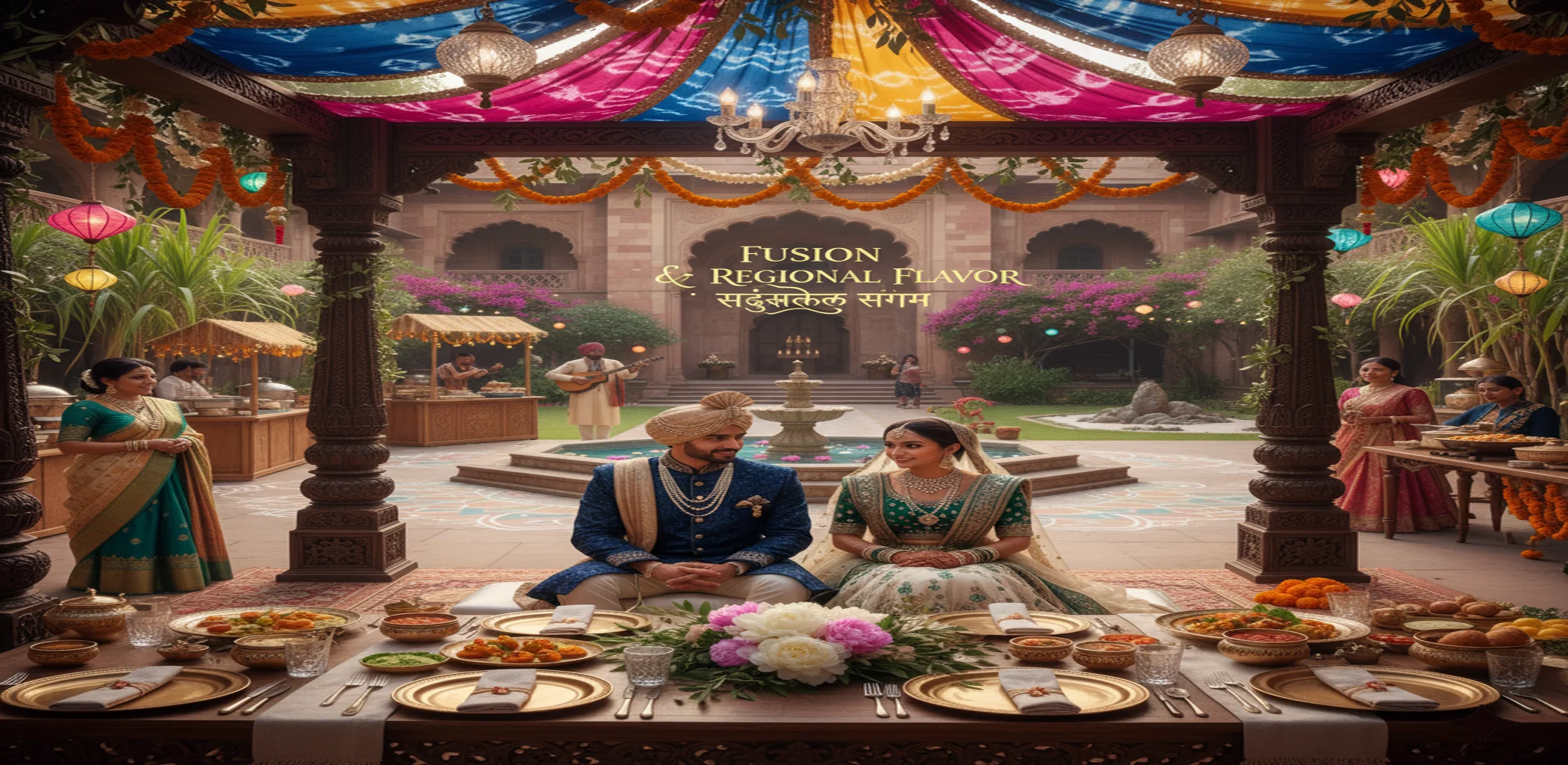
One of the most striking and meaningful trends in Indian weddings is the celebration of fusion & regional flavour — where couples blend cultural traditions, regional aesthetics, local artisan crafts, and culinary delights from multiple Indian regions (and sometimes even international influences) to create a wedding that is deeply personal, richly textured, and culturally resonant. This goes beyond simply picking one region and replicating its style: it’s about weaving together traditions, flavours, crafts and motifs from different regions (North + South, East + West, city + countryside) and sometimes global elements — to craft a wedding that reflects the couple’s heritage, tastes, and story.
Why It’s Gaining Momentum in India
Cultural & Contextual Drivers
- Diverse heritage & mobility
- India is home to a vast mosaic of languages, traditions, art-forms and cuisines. Many couples now come from mixed-region backgrounds (e.g., one partner from Punjab, the other from Tamil Nadu), or live in cosmopolitan cities yet retain strong regional roots. Naturally they want their wedding to reflect both (or multiple) heritages.
- Destination weddings and domestic travel mean that couples often want to bring “home-town flavour” into a venue outside their native place, or mix influences so guests get a culinary/cultural journey rather than a standard banquet.
- One trend write-up says: “Whether it’s a Rajasthani wedding adorned with Bandhani drapes and mirror work or a Kerala wedding featuring banana leaves, coconut decorations … 2025 is all about embracing local flavour.”
- Guests expect uniqueness & storytelling
- Weddings are increasingly seen as experience-design: more than rituals, guests expect an immersive journey. Regional and fusion touches help tell a story (e.g., bride’s Bengali roots + groom’s Maharashtrian heritage, or North/South mix) rather than a generic template.
- The décor, food, and rituals become opportunities to showcase identity, not just tradition for tradition’s sake.
- Culinary sophistication & social media
- Food trends in Indian weddings reflect this fusion/regional shift strongly: menus mixing regional thalis, street-food counters, live food stations offering flavours from East, West, North, South.
- Guests appreciate and share visually compelling, novel food items, regional crafts, immersive décor on social media — fusion/regional elements lend themselves to shareable moments.
- “Back to roots” & local craft revival
- There is a growing interest in showcasing local artisans, folk art, regional textiles, and giving the wedding a sense of cultural authenticity rather than imported mass-props. A trend piece notes: “Regional art and textiles: folk art panels like Warli, Madhubani … in 2025 this theme transforms your wedding into a love-letter to your heritage.”
- This blends well with sustainability and meaningfulness: supporting local crafts, local produce, local vendors.
- Flexibility over rigid tradition
- Modern couples often feel the need to honour tradition, but not necessarily in a rigid or purely traditional way. Fusion means blending, adapting, customizing – for example combining a South Indian “sadya” style lunch with a North Indian dessert station; combining a Punjabi baraat tradition with a Tamil thali setup; or mixing rituals from two regions into one ceremony.
- According to one article: “Couples are no longer choosing between tradition and modernity — they’re embracing both.”
How It Manifests: Key Areas & Practical Ideas
Here’s how fusion & regional flavour can play out across different wedding components in Indian context — plus ideas & considerations.
1. Rituals & Ceremony
- Hybrid ritual flow: If bride’s family is from one region and groom’s from another, consider integrating rituals from both traditions. For example: Tamil kanyadaan + Punjabi varmala + North Indian saptapadi in one sequence; or two distinct sections embedded into the ceremony.
- Regional priest/scripture options: Choose a priest or officiant who understands or is comfortable weaving two regional traditions.
- Cultural décor during rituals: For example, if a South Indian muhurtham is chosen, décor may include banana stem backdrops, coconut lamps, kolam dusting, while also bringing in North Indian floral arch, mirror-work border, or film-song themed signage.
- Welcome/arrival rituals: e.g., you could have aarti for groom’s arrival (North) then nadaswaram accompaniment (South) or dhol + chenda melam mix to create dramatic entry.
- Attire ritual touches: Bride and groom might wear traditional regional dress (e.g., South Indian silk saree & gold temple jewellery) for one function, and wear another regional look (North Indian lehenga & kundan jewellery) for another — or wear fusion versions of each.
2. Décor & Venue Treatment
- Regional craft & materials: Incorporate folk-art panels (e.g., Madhubani, Warli, Gond) or hand-loom textiles (Ikats, Kanchipuram, Banarasi) into decor elements — backdrops, table runners, signage. The “Artistic Regional Narratives” theme highlights this.
- Zoning based on regional motifs: For multi-day events, each day can reflect a different region: e.g., Day 1: Maharashtrian coastal theme (coconut, banana leaves, foot-path kolam), Day 2: Rajasthani royal theme (mirror-work, camel motifs, bright Bandhani fabrics). This gives guests multiple experiences.
- Food-zone & décor synergy: Walk-in zones themed by region: “Punjabi Lounge”, “Kerala Beach Bar”, “Gujarati Farsan Corner”. Décor, props, signage, and food all echo the region.
- Colour & texture mixing: For example, mix the deep red/gold of North Indian tradition with vibrant South Indian teal/emerald, juxtaposed with rustic Gujarati mirror work and pastel Bengali kantha. Balanced carefully, the result is rich not chaotic.
- Regional entrée décor pieces: At entrance you might have a “living mandap” inspired by temple-architecture (South) and then use silver-thali handing installations (West), jute mirror-work panels (Rajasthan), etc.
- Seasonal & locale connection: If wedding is in a destination (e.g., Goa, Udaipur, Kerala backwaters) tie region’s local materials into décor — indigenous plants, local flowers, coconut shells, regional lanterns — so the venue naturally speaks its flavour.
3. Cuisine & Catering
- One of the most visible domains of fusion/regional flavour:
- Multiple regional menus: Offering a North Indian feast (butter chicken, naan, kheer) alongside South Indian thali (sambar, rasam, appam), East Indian fish curry, West Indian farsan. One write-up states: “Regional food trails … Kannada wedding may serve Bisi Bele Bath and Mysore Pak” etc.
- Live stations & regional fusion dishes: Live dosa counters with fusion fillings, street-food carts featuring chaat & idli, regional delicacies re-presented elegantly.
- Fusion cuisine: Mix regional Indian flavours with global formats — e.g., paneer sushi, kulcha pizza, misal fondue, mango lassi popsicles.
- Storytelling meals: Use menu cards describing each dish’s region of origin, share a short note about the bride/groom’s regional roots associated with that dish, making the meal part of the cultural experience.
- Beverage zones: Regional drinks – kokum mocktails (Goa/Maharashtra), sol kadhi (Konkan), filter coffee cocktails (Karnataka/Tamil Nadu) – tied into the bar.
- Dessert & sweet-station diversity: East Indian rosogolla, Punjabi jalebi, South Indian payasam – presented in creative international formats.
4. Fashion, Jewellery & Personal Style
- Regional dress-mixing: The bride or groom might adopt different regional traditions across functions: e.g., one day a Kanjeevaram silk saree (Tamil), the next a Banarasi lehenga (Uttar Pradesh). Groom might wear a Kerala mundu + jacket or a Punjabi sherwani + napkin turban.
- Fusion wear: Bridal outfits blending regional crafts: e.g., South Indian zari work with Gujarati mirror-work; or lehenga with Phulkari jacket, or saree with Indo-western cape. (Fusion fashion trends in 2025 emphasise this.)
- Jewellery & accessories: Mix regional symbolism: Tamil “thali” style, Maharashtrian nath and mundavalya, Punjabi kaleere — used across days; or a custom piece that blends motifs from both families.
- Bridal party dress code: Encourage guests to wear attire from various Indian regions (e.g., lehengas, sarees, dhotis, mundus) as a nod to the multi-regional theme.
- Kids & close family outfits: Use sibling/regional pairings: e.g., kids in Punjabi juttis + South Indian veshti and shirt; siblings in mirror-work Bandhani dupattas + Kutch embroidery.
5. Guest Experience, Entertainment & Activities
- Regional performances: Incorporate folk-dance/traditions from the regions being represented: Garba (Gujarat), Bhangra (Punjab), Kuthu (Chennai), Yakshagana (Karnataka) etc. This adds variety and authenticity.
- Cultural zones for guests: Create interactive stations: e.g., “Make your own Bandhani dupatta” (West), “Kolam drawing corner” (South), “Mini workshops on Madhubani painting” (East).
- Music & playlists: Blend regional music with contemporary beats – bilingual DJs mixing Punjabi beats, South Indian kuthu, Bengali fusion tracks; live folk + remix sets.
- Welcome kits/gift bags: Fill with regional treats: e.g., Mysore pak (South), Thecha & peanuts (Maharashtra), Mirchi vadas (Rajasthan), Jaggery sweets (Bihar) – to reflect regions. Include a small card explaining the region & meaning.
- Signage & guest information: Use bilingual signs/display boards referencing region – e.g., “Welcome to our Maharashtrian-Punjabi fest”, guest tables named after regions or Indian rivers/cultures.
- Multi-day journey flow: For a 2-3 day wedding schedule, each function may represent a region theme: Day 1: North Indian sangeet/regional dance; Day 2: South Indian wedding ceremony; Day 3: Fusion/global brunch/after-party. Provides variety, honouring multiple traditions.
Indian-Specific Insights & Trends for 2025
- A trend article on regional Indian weddings for 2025 states:
“Custom backdrops, regional floral arrangements, and folk-art installations are giving weddings a strong cultural identity.”
- Regarding catering trends:
“From Rajasthani thalis with modern plating to South Indian tiffin counters served tapas-style, regional and fusion menus are among the most talked-about wedding catering trends.”
- On décor themes:
“Artistic Regional Narratives … transforms your wedding into a love-letter to your heritage – through folk art, textiles, language, music, and food.”
- On destination/local context:
“Local flavours … opting for domestic wedding locations and local vendors … aligns with the spirit of promoting indigenous talent, culture and craftsmanship.”
These reflect how both regional authenticity and fusion creativity are being emphasised in Indian weddings in 2025.
Benefits & Why it Works
- Deeper emotional resonance: When you consciously weave region + culture + story, it feels more meaningful to you and your families (and guests) — not just generic.
- Memorability & differentiation: Guests remember the regional/ fusion touches — the mini-thalis, the craft installations, the folk dances, the region-based décor. It stands out.
- Inclusive of diverse backgrounds: If one partner is from one part of India and the other from another part (or if families span regions), this trend allows both sides to feel represented.
- Cultural pride & nostalgia: Many guests appreciate seeing crafts, cuisines, rituals they recognise — it builds connection, especially for older family or regionally-based relatives.
- Richness of experience: Fusion means you’re not tied to one template — you can pick the best of various regional traditions, cuisines, crafts.
- Storytelling through the wedding: The wedding becomes a narrative journey through regions, flavours, traditions — aligning with the couple’s identity, rather than copying an imported format.
- Modern yet rooted: Fusion/regional flavour helps the wedding feel contemporary (because you’re mixing styles) but rooted (because you’re using regional traditions, crafts). Guests seeking authenticity and novelty both are satisfied.
Challenges & Things to Consider
- Cohesiveness vs fragmentation: If you bring too many regions or fusion ideas without a unifying thread, the wedding may feel disjointed. You’ll want a central design philosophy or “story” that ties the varietal elements together (e.g., “Our Indian journey from Assam to Arunachal”, or “North-Meets-South in our union”).
- Cost & logistic implications: Regional crafts, bespoke décor, multi-cuisine menus often cost more or require specialized vendors. Travel of ingredients, catering staff, craft installers across regions may add cost/time.
- Guest palate & expectations: Some guests may prefer familiar cuisine rather than exotic regional dishes or heavy fusion items. A balance is key: include familiar staples along with regional highlights.
- Vendor expertise: Not all wedding vendors/planners are fluent in multiple regional traditions or fusion execution; choose vendors who have done regional/fusion weddings or are willing to adapt.
- Time & planning: Incorporating regional craft, multiple cuisines, cultural performances often needs more lead-time (sourcing artisans, importing regional materials, custom props).
- Cultural authenticity & respect: If you use a region’s craft/tradition, do it with respect and authenticity rather than as a superficial motif. For example, a folk-art backdrop should be created by a proper artisan rather than a cheap print.
- Guest flow & transitions: If you have function zones for different regions, ensure movement between them is smooth, and guest doesn’t feel like they’re switching entirely different worlds unexpectedly (unless that’s the design).
- Balance between tradition and modernity: Fusion should support the ritual & meaningful aspects of Indian weddings rather than undermine them; make sure the core rituals are respected, and regional traditions properly represented.
Blueprint / Checklist for Planning a Fusion & Regional-Flavour Wedding
Here’s a practical sequence you can follow to plan your wedding with fusion and regional flavour, adapted for Indian context:
12-9 months out
- Define your narrative: e.g., “We are from North India & South India – our wedding celebrates both homes.” Write a short “story” of what that means (heritage, food, craft, décor).
- Choose guest size and functions (e.g., mehendi, sangeet, wedding ceremony, reception) and decide whether each function will carry one region theme, or there will be multiple region themes across days.
- Select venue with capabilities for region-specific décor/food zones. Confirm logistics for multi-cuisine catering, artisan décor, multiple function-zones.
- Allocate budget for regional/fusion items: décor (custom craft panels, folk installations), cuisine (multi-region menus), performances (regional folk dance + fusion DJ), guest experience (regional welcome kits).
- Engage a planner/vendor who is comfortable with multi-region/fusion weddings, or have sub-vendors for each region you intend to highlight.
9-6 months out
- Finalise décor themes: Decide colour palettes, craft materials, region motifs, signage, zones. Example: West Indian mirror-work, South Indian temple décor, Bengali terracotta panels.
- Finalise cuisine strategy: Choose at least 2-3 regional cuisines for different functions or zones. Work with caterer for fusion items. Menu tasting to include regional dishes plus fusion experiments.
- Finalise attire strategy: Decide which day you’ll wear which regional style (or fusion style). Communicate to bridal-party/guests if you want them to wear attire from specific region or fusion style.
- Plan entertainment: Book regional folk performance(s) + fusion entertainment (live band + DJ), design guest-zones (craft corner, interactive stations) related to the regions.
- Guest communication: In your invite/website, hint at regional theme(s) so guests know what to expect (and what to wear). Provide accommodation/travel info especially if you’re doing destination/regional theme.
6-3 months out
- Decor fabrication & sourcing: Commission custom panels (folk-art prints, mirror work), fabric runners, regional craft props, signage, guest-zone materials.
- Finalise catering details: Menu for each function, live stations, dietary preferences, display of regional names and descriptions for each dish (story-telling).
- Logistics check: Kitchen capacity, staff for multiple cuisines, vendor coordination across zones, décor installation timelines.
- Guest experience planning: Welcome kits/gift bags with regional treats, guest itinerary showing regional experiences (e.g., morning: traditional regional breakfast; night: fusion/live performance).
- Attire/trial fittings: Ensure attire routes for each region/day, coordinate with outfit designers, ensure accessories reflect regional/fusion motif.
1-2 months out
- Send final invites/guest communication: Include dress suggestions if you want guests to reflect the theme (e.g., “Feel free to wear your favourite regional outfit or fusion version”).
- Final walk-through with venue: Verify décor zones, guest flow, signage, food-zone placement, entertainment stage, artisan craft corners.
- Finalize the rundown: Which function emphasises which region, when is fusion element introduced, transitions between functions.
- Confirm guest counts per cuisine zone, finalize plates, allocations, buffet/plant-based options if needed.
- Guest welcome kit ready: Regional gifts, info card about region(s) being celebrated, small craft token or foodie token.
Wedding Day & Post-Wedding
- On-site: Ensure each zone reflects its region— décor, signage, food, music. Transition smoothly between functions/regions.
- Emphasise storytelling: Emcee or signage could narrate “This zone reflects bride’s Tamil heritage” or “Here we bring a taste of Punjab for everyone” etc.
- Guest engagement: Encourage guests to explore craft corners, try regional dishes, write personal notes about region/heritage in guest-book.
- Photography/videography: Make sure your photographer captures regional details (craft panels, food stations, attire, signage) as part of the story.
- Post-event: Thank you cards or digital highlights could include a “regional journey” map of your wedding (North → South), and small keepsake with region motif for guests.
Final Thoughts
A wedding that embraces fusion & regional flavour is both deeply personal and culturally rich. It allows you to highlight your roots, honour family traditions, offer guests a journey of experiences — and at the same time feel modern, unique and tailored to you. Rather than simply replicating one region’s wedding template, you are curating a celebration that reflects many layers of heritage, identity and taste.