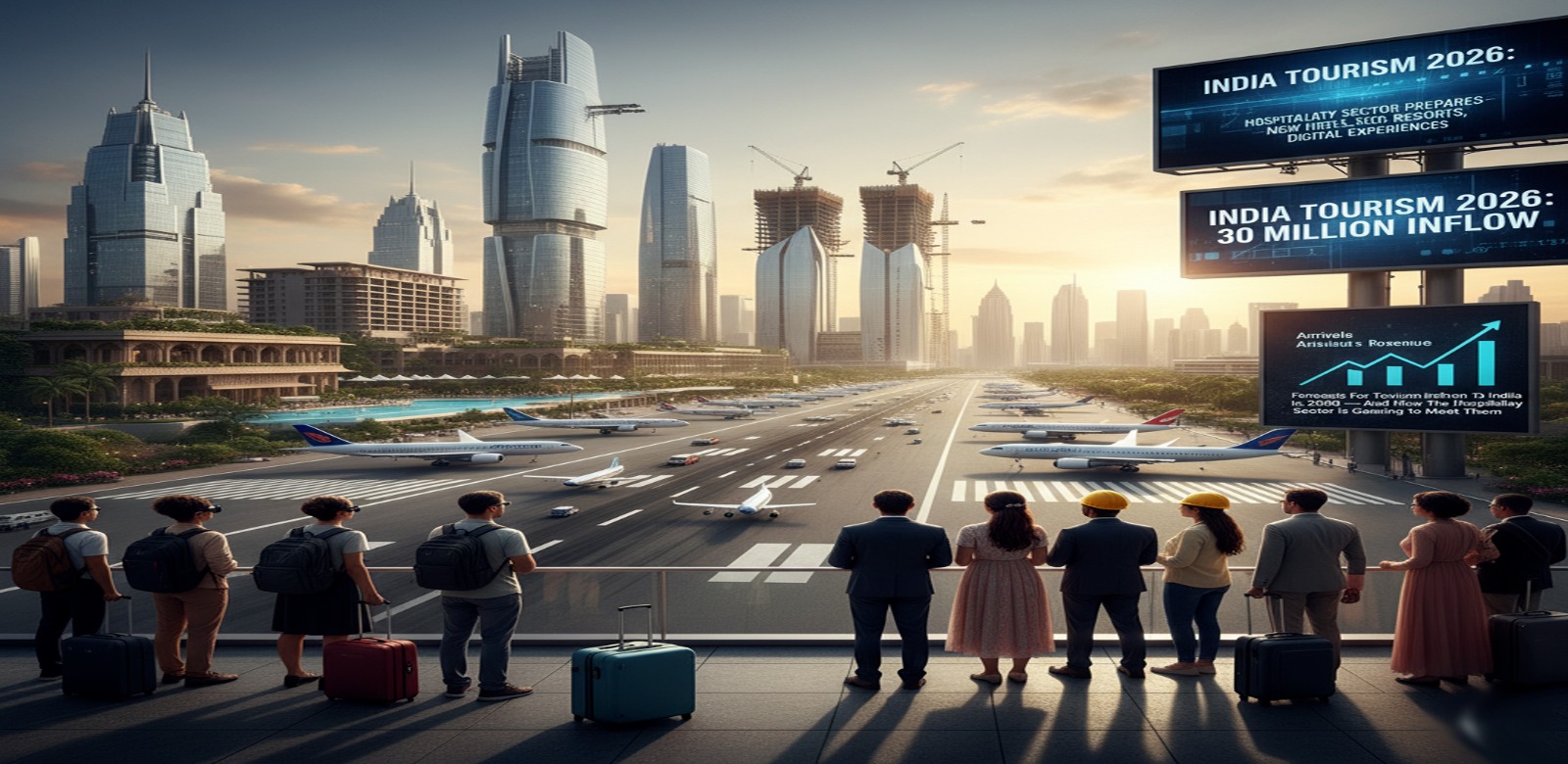
- Most reputable industry forecasts and leading indicators for 2026 point to continued growth in inbound tourism to India versus 2025 — driven by stronger air connectivity, higher disposable incomes in source markets, expanding MICE/business travel, and rising international visitor spend. Several organizations project rising visitor spending and tourism GDP in 2025–26, with aviation capacity continuing to expand. ETTravelWorld.com+1
- Quantitatively: forecasts vary by source and by metric (FTAs vs. total international arrivals vs. tourism receipts). WTTC and several consultancy analyses project continued annual growth in tourism GDP and international visitor spend into 2025–26; aviation forecasts (IATA) point to India being among the fastest-growing aviation markets through 2026 — a crucial enabler for inbound travel. World Travel & Tourism Council+1
- The hospitality sector is responding across five major fronts: capacity pipeline expansion (hotels & alternative stays), workforce & skills, technology adoption (guest experience + operations), distribution & revenue management, and destination/sustainability investments — while state and central government schemes (Swadesh Darshan, PRASAD, marketing campaigns) aim to channel demand to new circuits. India Briefing+1
- Risks remain: uneven recovery from some source markets (notably China in recent years), macro shocks, infrastructure gaps in smaller destinations, and workforce shortages. Success depends on aligning supply growth with quality, sustainability and market segmentation. Scribd+1
1. What the 2026 forecasts say — unpacking the numbers and credible sources
1.1 Types of forecasts and why they differ
Before presenting numbers, a caution: forecasts differ by metric and methodology. Commonly used measures include:
- Foreign Tourist Arrivals (FTAs) — arrivals of foreign nationals (some official series exclude NRIs/OCIs).
- Total international arrivals — sometimes counted more broadly (NRIs on visits, medical tourists included).
- International visitor spend / tourism receipts — measured in rupees or USD; sensitive to length of stay and spending patterns.
- Aviation seat capacity and passenger demand — a leading indicator for inbound volumes.
Different institutions weight these metrics differently (economic consultancies may emphasise spend and GDP contributions, aviation bodies focus on seat capacity and RPKs). For 2026, the broad consensus across sources is continued growth — but not a single unanimous numeric arrival forecast. Key authoritative inputs are described below with the implications for 2026.
1.2 WTTC & sector economic outlook (visitor spend & tourism GDP)
The World Travel & Tourism Council (WTTC) reported record international visitor spend for India in 2024 and projected further increases into 2025; their modelling for near-term growth implies continued momentum into 2026 for visitor spending and travel & tourism GDP. WTTC’s outlook emphasises rising high-value segments (MICE, luxury, wellness) and substantial domestic demand that supports tourism ecosystems — both of which enhance investor confidence for 2026. ETTravelWorld.com+1
Load-bearing takeaway (WTTC): international visitor spend is a key metric — WTTC shows record spend in 2024 and projects continued increases that carry through into 2025–26, implying stronger receipts in 2026 even if arrival growth is uneven across corridors. ETTravelWorld.com+1
1.3 Aviation forecasts (IATA and industry signals)
Aviation capacity is the single most important enabler of inbound tourism. IATA’s analyses and industry reporting show India as one of the fastest growing aviation markets and forecast India’s air passenger market to be among the top global growth stories through 2026. IATA’s local and global outlooks for 2024–26 indicate rising international seat capacity, higher RPKs and sustained load factors — a direct signal that more tourists can physically reach India in 2026. IATA+1
Load-bearing takeaway (Aviation): airlines and airports plan capacity increases through 2026; if executed, this will materially support higher inbound tourist volumes. IATA
1.4 Consultancy and market forecasts (EY, India-briefing, market reports)
Consultancies and market research firms provide supportive forecasts. For example, EY and other advisory pieces see the Indian tourism industry growing at a strong clip (EY suggested 12–15% annual growth over the medium term in their 2025 perspectives), and market research houses project compound annual growth in the travel & tourism market into the latter 2020s. Those growth rates imply 2026 will be another year of expansion, especially in spend, MICE and premium offerings. EY+1
1.5 Government indicators & recent trends
India’s Ministry of Tourism and the Press Information Bureau regularly publish monthly tourism snapshots and FTA numbers. Through 2025 India recorded a substantial recovery in FTAs and visitor spend. Government policy and state initiatives (campaigns, festival & event promotion, infrastructure schemes) are explicitly aimed at capturing more inbound flows through 2026. While the Ministry typically releases provisional monthly numbers, their public briefings and state programs signal an expectation of further growth into 2026. Press Information Bureau+1
Load-bearing takeaway (Government): official monthly snapshots and state initiatives confirm both recent recovery and active efforts to grow tourism in 2026 through infrastructure and promotion. Press Information Bureau
2. A quantitative sense of 2026 (range estimates and scenarios)
Because authoritative single-number forecasts for “FTAs in 2026” are rarely published universally, a practical approach is scenario ranges informed by the above sources.
Scenario framing (three scenarios for 2026 inbound tourism)
- Optimistic scenario (base + strong growth): If global demand remains robust, airlines execute planned capacity increases, and high-spend segments (MICE, wellness, medical) expand, inbound arrivals and receipts could grow 10–15% year-on-year in 2026 vs. 2025; tourism receipts could rise somewhat faster due to higher ADRs and MICE/business travel. (This aligns with WTTC and EY growth narratives.) ETTravelWorld.com+1
- Base scenario (most likely): A 5–10% increase in arrivals with receipts rising 8–12%, reflecting steady aviation growth, continued marketing, and a rebound in most source markets though with lingering underperformance from a few corridors. This is consistent with aviation and IMF/GDP growth forecasts that imply healthy travel demand. IATA+1
- Downside scenario (external shock): If geopolitical, macroeconomic or oil price shocks occur, growth could slow or stall; arrivals might be 0–4% higher (or flat), with receipts constrained. This risk profile remains material but not the base case. IATA
These scenario ranges are consistent with industry commentary (WTTC, IATA) and consultancy reports that emphasise continued growth but stress exposure to macro volatility. ETTravelWorld.com+1
3. Key demand drivers shaping 2026 forecasts
- Air connectivity and capacity — route additions, frequency increases, and more widebody capacity directly raise inbound potential. IATA and airport reports show capacity rising into 2026. IATA
- MICE & business travel recovery — meetings, incentives, conferences and exhibitions have returned strongly; these are high-yield segments expected to recover further in 2026. ETTravelWorld.com
- Rising international visitor spend — WTTC shows record visitor spend in 2024 and forecasts continued spend growth, benefiting from higher ADRs and premium offerings. ETTravelWorld.com
- Diaspora & medical tourism — NRIs, visiting friends & relatives (VFR), and medical travelers provide stable inflows; government promotion of medical tourism and cost-competitive healthcare are growth multipliers. Press Information Bureau
- Focused destination marketing & festivals — state-level programs (e.g., UP targetting domestic & religious flows), and national marketing campaigns boost seasonal peaks. The Times of India
4. How the hospitality sector is gearing up — five strategic responses
The forecasted 2026 inflows are shaping near-term strategies across the hospitality ecosystem. Actions can be grouped into five pillars:
4.1 Capacity pipeline: hotels, alternative stays, and asset investment
- Hotel development pipeline: Developers and brands continue to expand in gateway cities and key leisure circuits. Brand pipelines (economy to luxury) and conversion of existing real estate into hotels are active. Investment reports and state targets (e.g., planned room targets in Andhra Pradesh and other states) reflect room-supply growth aimed at 2026 demand. The Times of India+1
- Alternative and regulated home-stays: States are actively promoting “international-standard homestays” and professionalizing short-term rentals to capture both leisure and experiential travellers. This increases aggregate bed capacity and disperses demand beyond saturated hotspots. The Times of India
- Asset-level upgrades: Existing properties are investing in room refurbishments, F&B upgrades, MICE space enhancements and wellness offerings to capture premium flows and MICE bookings.
4.2 Workforce & skills — hiring, training and productivity tools
- Labor ramp-up: As demand rises, hotels are recruiting aggressively across frontline, F&B, housekeeping and engineering. However, tight labour markets and skill shortages push operators to invest in training academies and partner with hospitality institutes. India Briefing
- Upskilling & certifications: Programs focused on hygiene, guest experience, digital skills (PMS, revenue management tools) and foreign language capabilities (for source markets) are being scaled. Government schemes and private partnerships support training camps for 2026 readiness.
4.3 Technology & operations — contactless, revenue management and automation
- Distribution & revenue optimisation: Hotels are investing in advanced Revenue Management Systems (RMS), dynamic pricing, channel managers and data-driven marketing to maximize RevPAR (revenue per available room) in an increasingly competitive 2026 market. Capacity constraints in some peak periods mean operators want to extract higher yields.
- Contactless tech & guest apps: Mobile check-in/out, in-room automation, guest apps and contactless payments remain mainstream; hotels scaling for 2026 see these as standard expectations from international visitors.
- Operational automation: Robotics for housekeeping and back-of-house automation (kitchen, inventory) are being trialled or adopted to ease manpower pressures and boost efficiency.
4.4 Distribution, partnerships & new products
- MICE & corporate tie-ups: Hotels are building or refurbishing convention & meeting facilities and forming partnerships with event planners to capture 2026 conference demand. City-level bidding for conferences (with state support) is increasingly common. ETTravelWorld.com
- Product diversification: The sector is packaging experiences — wellness retreats, culinary trails, heritage circuits, film tourism, and pilgrimage circuits — to capture niche but high-value tourists. States and private operators co-develop circuits under schemes like Swadesh Darshan. Press Information Bureau
4.5 Sustainability, community & destination readiness
- Carrying capacity & environmental management: With rising inbound flows, operators and states invest in waste management, water conservation, and destination signage. Sustainability certifications (green building, responsible tourism) are being marketed to eco-aware travellers. The Economic Times
- Community participation: Lodges and homestays increasingly include community benefit models to share tourism gains and avoid overtourism backlash — a critical preparedness measure for 2026.
5. Concrete examples and evidence of gearing up (recent actions, projects and targets)
- State targets & programs: Andhra Pradesh’s push for international-standard homestays and ambitious room targets (10,000 rooms by March 2026; 50,000 by 2029) is an example of states preparing their supply side to capture inbound and domestic demand. The Times of India
- Hotel investment pipelines (industry reporting): Brand expansions and conversions in gateway cities continue, with many operators prioritizing MICE and premium segments expected to deliver better ADRs in 2026. Industry reports note robust investor interest in hospitality assets as receipts and occupancy trend upwards. ETTravelWorld.com
- Aviation investments: Airports and airlines expanding international routes, and IATA’s regional reports indicate capacity additions through 2026 that will meaningfully widen inbound seat supply. IATA
6. Sector readiness gaps — what still needs urgent attention
- Micro-infrastructure in smaller destinations: Rapid inbound demand to secondary and tertiary destinations is stressing local roads, waste systems and tourist facilities; many areas need last-mile investments. The Economic Times
- Workforce quantity & quality: Shortages persist for skilled roles (chefs, managers, multilingual front-desk staff), requiring accelerated training pipelines. India Briefing
- Standardization of alternate stays: Homestays and short-term rentals need consistent quality and safety standards to meet international expectations. The Times of India
- Sustainability compliance: Operators must balance growth with environmental safeguards — otherwise tourist experience and destination health may deteriorate. The Economic Times
7. Risks to the 2026 outlook (key downside triggers)
- Geopolitical shocks that reduce outbound travel from major source markets.
- Macroeconomic deterioration (higher interest rates, weaker consumer spending in source markets).
- Aviation disruptions (fuel price spikes, airline solvency issues) that could constrain seat capacity.
- Destination incidents or poor local preparedness (environmental degradation, health incidents) harming inbound perceptions. IATA+1
8. Policy levers and private sector actions that will determine outcomes
- Visa facilitation and targeted market diplomacies to restore corridors that lag (e.g., China or specific regional markets). Streamlined e-visa and landing visa arrangements can improve conversion of demand to actual arrivals. Press Information Bureau
- Investment in aviation infrastructure — runway capacity, international terminal expansions, slot allocations — to match demand growth. IATA data shows aviation growth is foundational to tourism growth. IATA
- Data-driven destination marketing (using National Digital Tourism Mission outputs) to microtarget likely travelers based on intent, seasonality and product match. EY
- Skills & vocational programs — public–private partnerships for hospitality academies and digital training to upskill the workforce ahead of peak 2026 demand. India Briefing
9. What success looks like in 2026 — measurable KPIs for stakeholders
- Arrivals & receipts: Year-on-year increase in FTAs (target dependent on scenario; base +5–10%) and receipts up 8–12%. ETTravelWorld.com+1
- Occupancy & ADR performance: Gateway cities maintain higher occupancy in peak, while regional destinations manage consistent seasonal demand without capacity bottlenecks.
- Sustainability & satisfaction: Improved tourist satisfaction scores, decrease in negative destination impact indices (waste, congestion), and higher percentage of properties with sustainability certification.
- Workforce metrics: Reduction in open hospitality roles and improved training certifications issued to frontline staff.
10. Recommendations — what hospitality operators and policymakers should prioritise for 2026
- Plan capacity smartly: prioritize asset refurbishment and modular capacity that can be flexed with seasonal demand rather than indiscriminate room additions in saturated micro-markets.
- Invest in yield management & distribution: deploy advanced RMS, careful OTA partnerships, and focus on packaging for MICE and premium leisure travellers.
- Strengthen workforce pipelines now: fast-track training and certification programs in partnership with states and institutes to close skill gaps ahead of 2026 peaks.
- Focus on destination stewardship: co-invest in local waste, water and transport infrastructure with state governments and DMOs to sustain visitor experience.
- Build resilience: scenario-test operations for fuel price shocks, currency swings and sudden demand shifts; diversify source markets to reduce dependency on any single origin. India Briefing+1
11. Three 2026 scenarios revisited (implications for the hospitality sector)
- Optimistic (10–15% ARR growth): Operators can command higher ADRs and invest in premium positioning; developers accelerate pipeline projects. Focus: capacity acceleration, luxury & experiential product launches. ETTravelWorld.com
- Base (5–10% ARR growth): Balanced expansion, where revenue management and distribution optimization yield the best returns. Focus: yield extraction and workforce readiness. IATA
- Downside (0–4% ARR growth): Prioritise cost control, flexible inventory and targeted promotions; postpone large greenfield projects. Focus: operational efficiency and diversification of revenue streams.
12. Final assessment — can India capture the 2026 opportunity?
Yes India is well positioned for further tourism growth in 2026, given positive demand signals, record visitor spend reported by WTTC, and expanding aviation capacity documented by IATA and industry reporting. However, realizing the full upside requires synchronized action: the hospitality industry must scale capacity intelligently, governments must accelerate infrastructure and visa facilitation, and destination managers must prioritize sustainability to preserve long-term appeal. The next 12 months are therefore both an opportunity and a test of sectoral coordination. ETTravelWorld.com+2IATA+2
Sources & further reading (selected)
(Representative, not exhaustive — core references used for this article.)
- World Travel & Tourism Council (WTTC) — India visitor spending and outlook. World Travel & Tourism Council+1
- International Air Transport Association (IATA) — Aviation in India and passenger demand outlook. IATA+1
- EY — “The great Indian traveller” & sector trends. EY
- India-Briefing / market reports — sector size and investment notes. India Briefing
- Press Information Bureau / Ministry of Tourism (India) — Monthly Tourism Snapshots and national campaigns. Press Information Bureau+1
- Times of India and other trade press — state initiatives and regional targets. The Times of India+1