Why fashion & jewellery are evolving in Indian weddings
Context & drivers
- Weddings in India are no longer only about tradition and ritual — they’re also about personal expression, style and social /media moments. Thus, brides and grooms want outfits and jewellery that reflect who they are, not just the “expected look”.
- Younger couples (millennials & Gen Z) are more comfortable with mixing tradition with modern aesthetics: the vintage heirloom ring + avant-cut lehenga, or a South Indian temple jewellery piece paired with an Indo-western gown.
- The rise of destination weddings, intimate-luxury weddings and smaller guest lists allow fashion to lean more experimental and individualised.
- Jewellery design and bridal couture are both more accessible, customisable, global-aware (and thus borrowing from international trends while staying rooted in Indian craft) — so you see vintage revivals, bold colour palettes, fusion-outfits, non-traditional silhouettes.
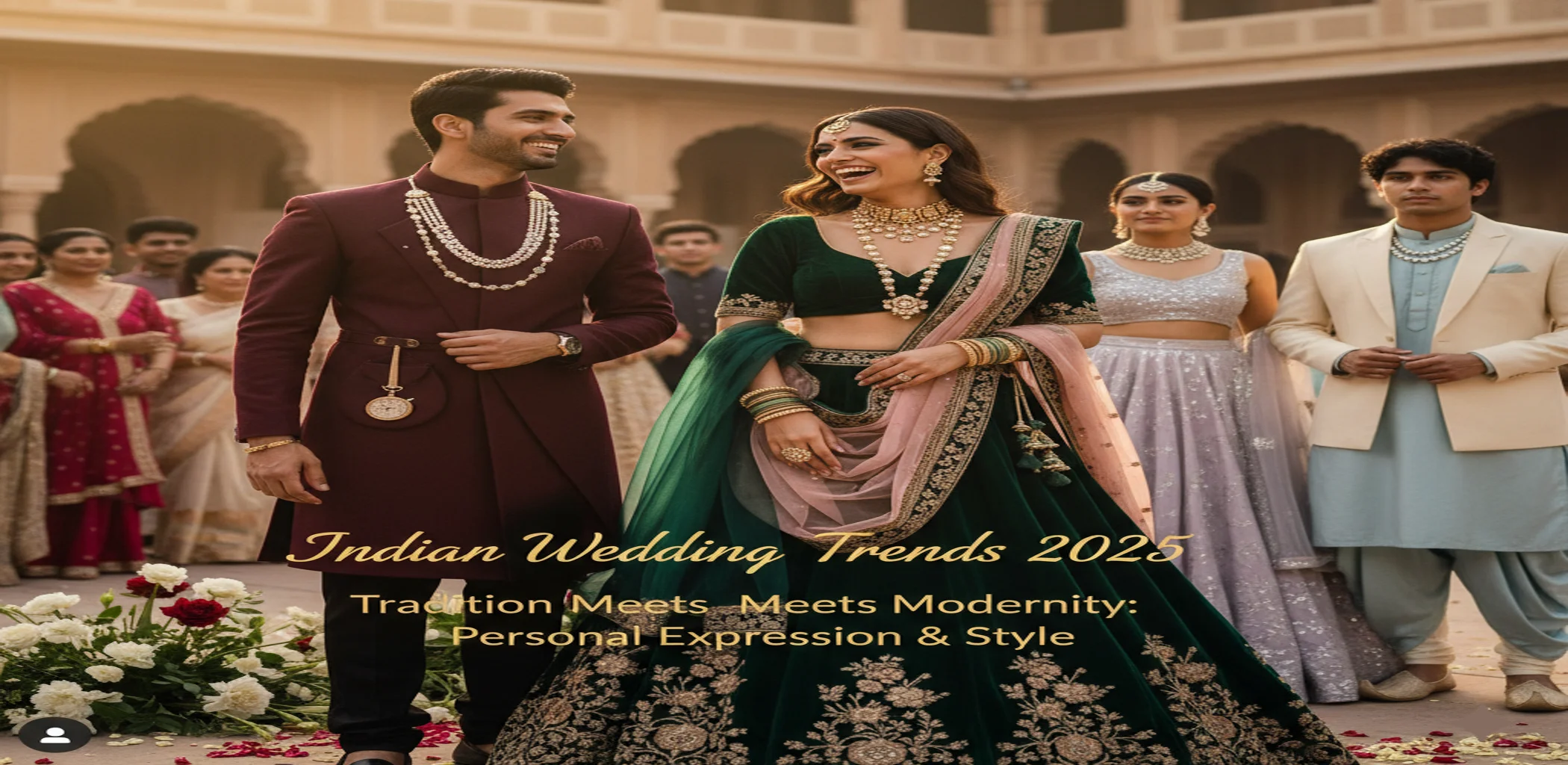
- Many write-ups for 2025 mention key trends like bold colours (emerald-green, wine-tones), pastels, neutrals, non-red bridal outfits, double-dupattas, fusion silhouettes, layered jewellery, customised heirlooms.
What “fashion & jewellery trends” mean in this context
- Bridal wear is expanding beyond classic red-gold lehenga + heavy jewellery stack: we now have new silhouettes (gowns, pant-sarees, cape-lehenga), bold & non-traditional colour choices, sustainable fabrics, lighter weight outfits for comfort.
- Jewellery too is undergoing evolution: heirloom revival, personalised pieces (initials, couple’s motifs), layering necklaces, mixing metals/materials, bold earrings, minimalist sets, coloured stones, vintage rings.
- The combination of fashion + jewellery means more coordinated looks: outfit and jewellery designed together; jewellery not just as an add-on but as part of the ensemble.
- The trend is both towards statement (bold colour, big jewellery pieces) and effortless elegance (lighter jewellery sets, minimalist silhouette) depending on the function and bride’s style.
Key areas & practical ideas
Below are major components of bridal fashion & jewellery with Indian-specific nuance, practical ideas, and things to watch.
1. Bridal Jewellery Trends
• Statement chokers, layered neckpieces, heritage gems
For 2025, jewellery trends in India indicate strong presence of:
- Bold chokers: collar-hugging, with Kundan, polki, gemstones, pearls.
- Layered necklaces: combining a choker + longer haram + pearl strand gives depth and regal feel.
- Heritage styles revived: temple jewellery (South Indian, goddess motifs), Rajwadi jewellery, polki & Kundan in refined forms.
• Coloured gemstones, pastel jewellery, mixed metals
- Pastel gemstones (rose quartz, aquamarine) being used in bridal jewellery sets for soft modern looks.
- Bold gemstone accents: emeralds, rubies, sapphires in bridal jewellery making big impact.
- Mixed metals: gold with rose gold, silver, platinum combinations, offering flexibility, and lighter weight options.
• Personalisation & meaningful jewellery
- Brides are opting for engraved jewellery, name/initial pendants, customised motifs.
- Vintage rings: There’s a surge in searches for “vintage gold rings” for brides, indicating the popularity of heirloom/antique style over purely modern.
• Minimal vs maximal jewellery
- While statement jewellery remains, there is also a move towards minimalist sets — lightweight, less heavy, suitable for intimate weddings or younger brides wanting ease of movement.
- Earrings are becoming dramatic (shoulder-dusters, long earrings) but are paired with simpler necklaces in some cases to keep balance.
• Rings & engagement/wedding bands
- Rings are getting more attention: beyond just standard solitaire, there is vintage-style engagement rings (art-deco, mixed cuts), cocktail rings for brides.
- Wedding bands too are being personalised, mixed metal, coloured gem accents.
Practical Jewellery-Styling Tips
- Choose one focal piece (necklace or earrings) and coordinate the rest of the set around it so your ensemble doesn’t become too heavy.
- If you are wearing lighter jewellery (minimalist), let the outfit do more of the heavy-lifting (colour, fabric, cut) so the look remains balanced.
- Consider function: Mehendi/Sangeet may allow more playful jewellery (coloured stones, pastel sets), while the main wedding may call for more traditional/regal pieces.
- Match jewellery finish to your outfit colour palette: pastel outfit → rose gold/diamond; bold jewel-tone outfit → gold/Kundan with coloured gems.
- Store the jewellery post-wedding: vintage pieces and heirlooms hold value if you keep them in good condition.
2. Bridal Fashion / Outfits & Silhouettes
• Colour & Palette Trends
- Traditional red remains beloved, but in 2025 we see a broad palette: soft pastels (blush pink, mint green), jewel tones (emerald, sapphire, ruby), neutrals (champagne, ivory), metallics (silver, rose gold) and even subtle earth tones.
- Neutrals and nude tones are taking off: modern brides in metro cities choosing ivory, champagne, beige-gold lots for their wedding wear.
- Contrast and dual-palette styles: e.g., one function in pastel, another in jewel, or dupatta in contrasting shade.
• Silhouette & design trends
- Fusion silhouettes: Indo-western blends — e.g., pant-sarees, jacket-lehenga, gown-lehenga hybrids, cape dupattas.
- Structured details: Statement sleeves (puffed, off-shoulder), capes, corset blouses, dhoti-style lehengas.
- Lehengas with double dupattas (one sheer, one heavy) are trending.
- Lightweight fabrics: organza, georgette, soft silks, especially for destination weddings/day functions — helps with comfort and mobility.
- Sustainable fashion elements: hand-loom fabrics, up-cycled embroidery, re-wearable pieces.
• Outfit & Jewellery coordination
- Bridal wear and jewellery should be curated together: e.g., if you’re wearing a bold jewel-tone outfit, your jewellery can pick up contrasting stone or colour for punch.
- For fusion silhouettes (e.g., gown with Indian embroidery) select jewellery that bridges East & West (e.g., diamond choker + a subtle maang tikka).
- Consider functions: For mehendi/haldi you might choose fun lighter coloured outfit + playful jewellery; for wedding ceremony go full glam; for reception maybe simpler outfit + dramatic jewellery, or vice versa.
Practical Fashion-Styling Tips
- Choose fabrics and cuts based on venue/time/function: Day/outdoor wedding → lighter fabrics, soft colours; Evening/indoor → richer fabrics, jewel tones, heavier embroidery.
- Tailoring matters more than ever: silhouette makes big difference. Especially for fusion or modern cuts, ensure fit is perfect.
- Ensure mobility: Important especially for Indian weddings with multiple rituals/functions — choose wearables you can move/dance in.
- Think of re-wear value: Especially for jewellery and outfit if you want them to be used later.
- Make your look personal: Add some bespoke detail (embroidery with initials, meaningful motifs, custom jewellery) to stand out.
Indian-Specific Insights & Examples
- Jewellery trend: “Layered Polki Sets”, “Jadau Chokers”, “Statement Maang Tikkas & Mathapattis”, “Colour-Infused Bangles” are highlighted for 2025 in Indian context.
- Fashion trend: According to a “Guide to Indian Bridal Wear Trends 2025” article: “Bridal lehengas are no longer just red and gold… unconventional shades like ivory, lavender, sage green, and deep wine tones.”
- Jewellery redesign: “Handmade Bridal Jewellery Trends in India 2025” lists pastel jewellery, floral motifs, minimalist marvels.
- Another note: Vintage rings are trending: “Searches for ‘unique vintage rings’ up 190 % in India.”
These together show how Indian bridal fashion & jewellery are adapting for the new decade: mixing tradition + trend + individual style.
Benefits & Why These Trends Matter
- Better personal expression: With broader colour and silhouette choices, brides/grooms can reflect their personality, heritage and contemporary style.
- More comfortable & functional: Lightweight fabrics, modern cuts, two-dupattas, minimal jewellery for some functions help the couple enjoy the day rather than get weighed down.
- Re-wearability & sustainability: With simpler jewellery sets or fusion silhouettes, post-wedding use becomes more realistic; vintage rings or mixed-metal jewellery hold value.
- Cultural blending: Jewellery trends that include regional craft, heritage revivals allow deeper cultural roots to be expressed in a modern way.
- Visual & social impact: Bold colour palettes, layered jewellery, statement silhouettes read well in photographs and social media — important for many modern couples.
- Catering to different functions: Indian weddings often span multiple events (mehendi, sangeet, wedding, reception) — these trends offer flexibility: you may choose different styles for each function but maintain coherence.
Challenges & Things to Watch Out For
- Balance between trend & timelessness: While bold colours or fashion-cuts are exciting, ensure that at least one outfit or one jewellery set will still look classic in 10-15 years (for photos/archives).
- Budget & overload: Big jewellery sets and heavy embroidery can escalate cost quickly. Prioritise what you’ll wear/keep/use.
- Over-accessorising: With statement jewellery + bold outfit, there is risk of “too much”. Use one focal area (neck/earrings/outfit) and keep other details simpler.
- Comfort & mobility: Heavy jewellery or unwieldy outfit silhouettes (especially in Indian rituals involving lots of movement) may hinder ease.
- Colour coordination: If multiple functions/days, ensure different outfits still have coherence, or you may look inconsistent.
- Authenticity vs hype: Vintage/heritage jewellery is trending – but verify craftsmanship, materials. Custom pieces may need lead time.
- Maintenance & storage: Vintage jewellery or mixed-metal jewellery may need more care; bespoke embroidery may require maintenance.
- Vendor lead-times: Custom silhouettes, novel colour palettes, fusion cuts often mean longer lead times. Plan early.
Sample Blueprint for Planning Fashion & Jewellery for Indian Wedding
12-9 months before
- Define your vision: e.g., “I want a bold jewel-tone lehenga for the wedding day, a pastel lehenga for sangeet, a modern gown for reception” OR “I want traditional bridal jewellery for wedding and minimalist jewellery for other functions”.
- Choose bridal wear vendor/designer: Share your brief about colours, silhouettes, fabrics, functions.
- Choose jewellery vendor or start shopping: Decide whether vintage/ heirloom pieces will be used; allocate budget.
- Decide which functions need which outfit/jewellery: e.g., Haldi may be yellow outfit + light jewellery; Wedding ceremony full glam; Reception fusion outfit with statement jewellery.
9-6 months before
- Finalise outfit fabrics, colours, embroidery, silhouette. Consider tailoring & multiple fittings.
- Finalise jewellery: pickups, custom orders (if any), ring choice, earrings, layering sets.
- Align outfit-jewellery coordination: bring jewellery design when trying outfit so you can judge match.
- Consider accessories and under-layers: shoes, clutch, makeup plan (so jewellery/outfit complement makeup)
- Accessorise: Decide hair accessories, maang tikka, matha patti, bangles, rings. Jewellery trends 2025 emphasise bold maang tikkas, layered sets.
3-1 months before
- Final outfit fitting & trial: Ensure comfort of movement, weight of the outfit, length, silhouette, how it photographs.
- Final jewellery fitting: earrings/tested with hair length/style; ring size; comfort of wear throughout ceremonies.
- Functional plan: Identify which outfit+jewellery for which function/photograph slots.
- Prepare backup or reuse-plan: If using heirloom or borrowed jewellery, ensure cleaning/polishing.
- Brief your photographer about your jewellery/outfit highlights so they capture details (e.g., layered necklace, vintage ring).
Wedding Day & after
- On the day: Ensure jewellery is safe and insured (especially heirloom/vintage pieces).
- During functions: Adjust for comfort — you might want to remove heavier pieces for Sangeet dancing, keep lighter jewellery.
- Post-wedding: Store jewellery properly (antitarnish, safe box); outfit cleaning & preservation if you plan to reuse or archive.
- After-party/look: You can reuse parts of your outfit (dupattas, jewellery) to create a “second look” for post-wedding brunch or photos.
- Reflection: Keep your photos/jewellery box/receipts — vintage rings and custom pieces hold sentimental (and often monetary) value.
Final thoughts
- Fashion & jewellery trends for Indian weddings in 2025 are about choice and meaning — you have more palette, more silhouettes, more jewellery styles, more freedom.
- The best outcome comes when you align your personal style (what you love, what makes you comfortable) with fashion trends and cultural heritage — that way you look timeless and current.
- For you, given your interest in weddings, hiring/planning, and marketplace ecosystems: these trends create opportunities — e.g., jewellery rental for vintage pieces, fusion-bridal wardrobe rentals, modular jewellery sets, fashion-consultation services for couples.
- A key takeaway: invest in standout pieces (colour, silhouette, jewellery) but ensure they integrate well with the rest of your vision and functions.
- The wedding day being a once-in-a-lifetime moment, having the outfit & jewellery tell a story — of who you are, where you come from, where you’re going — makes all the difference.