
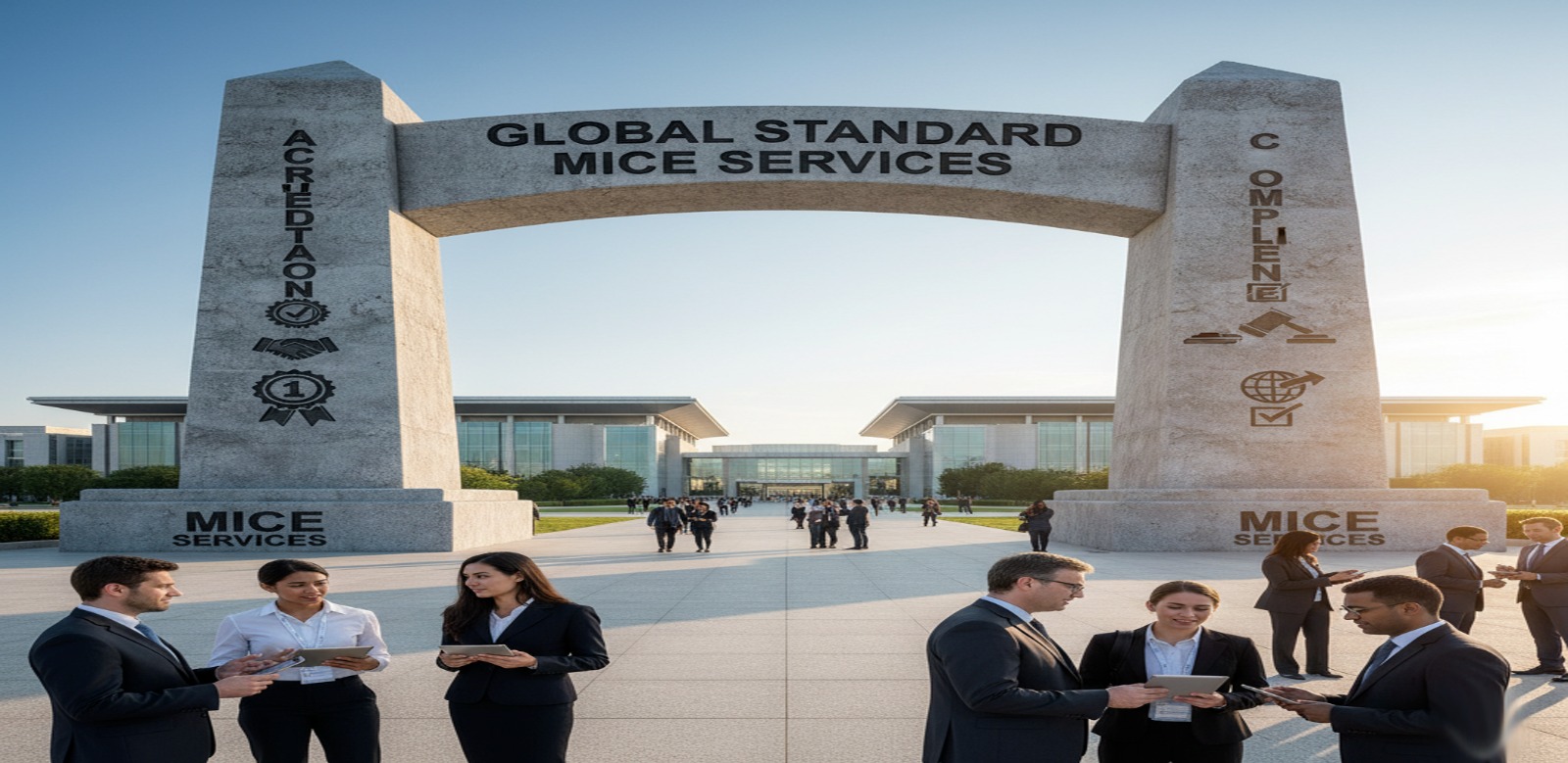
1. Introduction: The Age of Standardized Excellence
The Meetings, Incentives, Conferences, and Exhibitions (MICE) industry has evolved from being a logistical function to a highly specialized, global service ecosystem. It now intersects tourism, hospitality, business communication, sustainability, and digital technology. Clients—whether corporate houses, governments, or international associations—expect consistent service quality, predictable outcomes, and assured safety, sustainability, and compliance across geographies.
In this dynamic global context, accreditation and compliance frameworks are not mere bureaucratic hurdles—they are essential enablers of trust, transparency, and seamless interoperability across borders. Accreditation ensures that every hotel, venue, travel operator, event manager, or technology provider adheres to defined benchmarks of quality, safety, and sustainability, while compliance ensures ongoing adherence to legal, regulatory, and ethical standards.
Together, they form the backbone of a resilient, globally competitive MICE ecosystem, especially for a fast-growing market like India aiming to position itself as an international MICE destination.
2. Understanding Accreditation and Compliance in the MICE Context
Accreditation
Accreditation refers to a formal recognition that an organization or service provider meets specific standards established by a competent authority or industry body. For MICE entities—such as hotels, travel companies, transporters, catering agencies, or event technology providers—accreditation acts as a seal of credibility and global acceptance.
Accrediting authorities might include:
- ISO certification bodies (ISO 9001 for quality, ISO 14001 for environment, ISO 45001 for occupational safety)
- Global Sustainable Tourism Council (GSTC) for sustainability standards
- IATA, ADTOI, or TAFI for travel and tour operators
- FSSAI and HACCP for food safety in catering
- TUV, BIS, and LEED for safety and green infrastructure certifications
- National and state tourism boards, which certify hotels, venues, and travel companies
Compliance
Compliance involves the continuous adherence to laws, regulations, codes of conduct, and ethical frameworks relevant to MICE operations. This includes:
- Local licensing, taxation (GST), and labor laws
- Health, safety, and fire regulations
- Data protection and privacy norms (e.g., India’s DPDP Act or GDPR for global clients)
- Environmental and sustainability policies
- Accessibility and anti-discrimination standards
- Financial transparency and anti-bribery codes
Where accreditation is the foundation, compliance is the daily discipline that maintains the structure.
3. Why Accreditation and Compliance Matter in MICE
The MICE sector is characterized by its interconnectedness and cross-sector dependencies—hotels, airlines, venues, digital tech, logistics, and cultural experiences must all integrate seamlessly to deliver a cohesive event. In the absence of standardized practices, inconsistencies multiply, trust erodes, and the potential for global engagement diminishes.
Let us examine the major reasons why accreditation and compliance are indispensable.
3.1 Ensuring Service Quality and Reliability
Accreditation ensures that MICE operators deliver consistent, repeatable, and high-quality services. Certified vendors adhere to globally accepted processes and metrics—ensuring that a conference in Mumbai, an incentive in Kochi, or an exhibition in Jaipur all meet the same quality thresholds.
For instance:
- ISO 9001 ensures well-documented operational procedures and client satisfaction frameworks.
- GSTC standards ensure sustainability and community alignment.
- FSSAI and HACCP certifications guarantee food safety for thousands of attendees.
Clients prefer accredited service providers because it reduces uncertainty and risk. It acts as a performance assurance—critical for government delegations, multinational corporations, and international associations.
3.2 Building International Credibility and Market Access
Global associations and multinational corporations increasingly shortlist vendors based on accreditation. Being accredited signals readiness to work within international standards.
For India’s MICE operators, global recognition is essential to compete with destinations like Singapore, Thailand, and Dubai, where accreditation is mandatory. For instance:
- The Singapore Tourism Board (STB) mandates sustainability and safety certifications for major venues.
- The Thailand Convention and Exhibition Bureau (TCEB) uses accreditation as a bidding requirement.
- Similarly, Dubai Business Events prioritizes ISO-certified partners for government-backed MICE bids.
Accreditation thus opens doors to global partnerships, cross-border contracts, and international bidding opportunities, reinforcing India’s position as a credible MICE hub.
3.3 Enhancing Safety and Risk Management
Events, by nature, gather large groups of people—creating potential risks related to fire, crowd management, food safety, data privacy, or health emergencies. Accreditation ensures systemic risk preparedness:
- Fire safety and structural audits prevent accidents.
- Emergency evacuation and crowd control plans minimize hazards.
- Health and sanitation compliance prevents outbreaks.
- Cybersecurity certifications (ISO 27001, PCI-DSS) protect sensitive attendee and payment data.
When every partner in the MICE value chain complies with safety regulations, the ecosystem collectively ensures a secure, predictable environment—one of the most critical factors for international clientele.
3.4 Legal and Financial Protection
Non-compliance exposes MICE operators to lawsuits, penalties, and reputational damage. Accreditation systems incorporate legal vetting, documentation, and insurance standards that protect both client and provider:
- Vendor insurance minimizes liabilities.
- Contractual templates ensure transparency in pricing and delivery.
- Labor law compliance prevents worker disputes.
- Anti-bribery certifications (ISO 37001) enhance ethical conduct.
These frameworks protect investments, uphold integrity, and create a trustworthy business ecosystem.
3.5 Sustainability and ESG Integration
The modern MICE industry operates under increasing environmental and social scrutiny. Clients, especially global corporations, prefer partners aligned with Environmental, Social, and Governance (ESG) frameworks.
Accreditation in sustainability ensures:
- Energy and water conservation at venues
- Waste management and recycling systems
- Low-carbon event operations (green logistics, digital documentation)
- Community inclusion (local sourcing, fair wages)
Alignment with GSTC MICE Standards directly enhances India’s appeal as a responsible tourism destination—crucial for ESG-conscious investors and governments.
3.6 Digital Trust and Data Compliance
Digitalization has transformed MICE—from registration apps and virtual conferences to AI-driven matchmaking platforms. With it comes heightened responsibility for data protection and cybersecurity.
Accredited tech providers ensure:
- Compliance with GDPR / DPDP Act
- Secure payment gateways (PCI-DSS certified)
- Data encryption, privacy consent management, and disaster recovery systems
For international clients sharing personal data across borders, such compliance is non-negotiable. It assures digital trust, a new currency of modern MICE delivery.
3.7 Efficiency Through Standardization
Accreditation fosters standardized processes and documentation, reducing operational friction between partners.
For example:
- Standard health & safety forms between hotel, venue, and organizer
- Common vendor codes and performance checklists
- Transparent pricing and contract terms
This uniformity minimizes duplication, confusion, and errors, enabling seamless multi-vendor collaboration. For large conventions with hundreds of partners, standardization is the key to smooth execution.
3.8 Capacity Building and Workforce Professionalization
Accreditation is not limited to infrastructure—it also promotes skill development and training. Most certifications mandate documented employee training programs in safety, hygiene, sustainability, and digital tools.
This leads to:
- Professionalization of the event workforce
- Improved communication and coordination standards
- Better staff retention through skill recognition
- Higher client satisfaction due to knowledgeable service
A globally accredited workforce becomes India’s most exportable asset—capable of delivering world-class experiences anywhere.
3.9 Transparency and Ethical Conduct
Accreditation frameworks embed transparency:
- Financial audits
- Anti-corruption declarations
- Vendor code of conduct
- Client grievance redressal mechanisms
This builds ethical competitiveness—a core differentiator in a market where reputation defines long-term survival.
4. The Collective Benefits: A Win-Win Across Stakeholders
Let us examine how accreditation and compliance benefit each participant in the MICE ecosystem.
4.1 Benefits to Clients
- Assurance of quality and safety in every service component.
- Simplified vendor selection—clients can filter by accredited providers.
- Reduced operational risk—standard processes ensure consistency.
- Transparent pricing and accountability through documented SLAs.
- Sustainability alignment—accredited vendors meet corporate ESG goals.
- Better data protection in digital event environments.
4.2 Benefits to Service Providers
- Market access to international clients and events.
- Brand credibility through globally recognized certification.
- Operational efficiency via documented procedures.
- Legal protection against disputes and liabilities.
- Talent attraction—professionals prefer accredited organizations.
- Continuous improvement through periodic audits and training.
4.3 Benefits to Governments and Industry Bodies
- Better regulation and monitoring of industry performance.
- Enhanced foreign exchange inflows through international events.
- Improved global rankings as a trusted MICE destination.
- Data and analytics for policy-making (via accredited reporting).
- Standardized ESG reporting enabling green event certifications.
4.4 Benefits to Local Communities
- Employment opportunities within standardized, safe workplaces.
- Community participation through ethical sourcing and local vendor inclusion.
- Reduced environmental impact due to sustainability mandates.
- Preservation of culture and heritage through accredited cultural programming.
Accreditation thus creates a ripple effect of socio-economic progress—from city-level to national tourism competitiveness.
5. The Indian Context: Why Accreditation is Urgent Now
India’s MICE sector is projected to cross USD 100 billion by 2030, driven by infrastructure growth, G20 exposure, and rising corporate travel. Yet, the challenge remains fragmentation and inconsistency.
Many smaller service providers still operate without standardized safety, digital, or sustainability protocols. While large hotels and convention centers pursue ISO or GSTC certifications, a vast network of SMEs in catering, logistics, and event tech lack formal accreditation pathways.
Without systemic accreditation:
- India risks losing high-value global bids to accredited competitors (like Singapore or Dubai).
- International associations hesitate to host world congresses due to compliance ambiguity.
- Quality perception remains uneven, despite world-class infrastructure.
By contrast, adopting a national accreditation framework for MICE (aligned with GSTC, ISO, and FICCI standards) would:
- Standardize operations across all providers
- Facilitate international partnerships and associations
- Create transparent vendor directories for government events
- Enable ESG reporting and green event certifications
- Boost India’s MICE brand equity as a “Safe, Smart, Sustainable” destination
6. Accreditation as a Pillar of Digital Transformation
The rise of AI, data analytics, and virtual events has transformed MICE into a digital-first ecosystem. Accreditation frameworks must evolve accordingly.
Digital compliance and accreditation now include:
- Cloud security standards (ISO 27018)
- Data protection (DPDP Act, GDPR)
- Online ticketing and financial integrity (PCI-DSS)
- Cyber risk insurance and digital ethics protocols
- Accessibility compliance (WCAG 2.1) for online participation
MICE providers who demonstrate digital compliance maturity earn greater client trust, especially for hybrid global events involving sensitive corporate data.
7. Case Studies: Accreditation Driving Excellence
7.1 Singapore
The Singapore Tourism Board’s Sustainability MICE Framework mandates carbon accounting, green procurement, and ISO-certified operations for partner venues. This elevated Singapore as Asia’s most reliable MICE hub.
7.2 Dubai
Dubai Business Events requires venues to hold ISO 20121 (Event Sustainability Management) certifications. The city’s “Dubai Assured” program enhanced international confidence post-COVID.
7.3 India’s Emerging Examples
- Hyderabad International Convention Centre (HICC) holds ISO 9001 and 14001 certifications, positioning it globally.
- Kerala’s MICE Conclave emphasizes GSTC-aligned sustainable vendor certification.
- Delhi NCR hotels adopting zero-waste accreditation now attract ESG-conscious clients.
Each case highlights that accreditation is not optional—it’s strategic.
8. Overcoming Challenges in Implementing Accreditation
While essential, achieving universal accreditation faces hurdles:
- Cost and complexity for SMEs to undergo certification.
- Lack of awareness about global standards among small vendors.
- Fragmented regulatory structure across states.
- Absence of a unified national accreditation body for MICE.
- Limited training infrastructure for compliance readiness.
These can be addressed through:
- Government-subsidized accreditation programs.
- Tiered certification models for SMEs.
- Digital compliance toolkits and templates.
- Industry-led mentorship networks (like URAHL MICE Vendor Academy).
9. The Role of URAHL and Integrated Platforms
URAHL’s vision of an AI-enabled, globally compliant MICE ecosystem directly addresses India’s accreditation gap. Through its MICE Vendor Dashboard and Qualification Matrix, URAHL ensures that every vendor—whether a hotel, caterer, or tech provider—is pre-qualified and evaluated on accreditation, sustainability, safety, and ethical standards.
Benefits of such integrated accreditation systems:
- Real-time verification of vendor credentials
- Faster client onboarding
- Streamlined audits and due diligence
- Standardized global compliance for all MICE activities
- Cross-border compatibility and traceability of standards
By institutionalizing accreditation within digital ecosystems, URAHL positions India as a globally synchronized MICE powerhouse.
10. Conclusion: Accreditation as India’s Passport to the Global MICE Future
In the globalized MICE industry, trust equals certification. Accreditation and compliance are not bureaucratic burdens—they are the language of global trust, the currency of competitiveness, and the bridge between domestic potential and international excellence.
For clients, accreditation guarantees reliability.
For providers, it offers recognition and efficiency.
For governments, it ensures safety, reputation, and sustainable growth.
For communities, it promises ethical engagement and opportunity.
As India strides towards becoming a world-class MICE destination, embedding accreditation and compliance into every operational layer—from hotels to hybrid event tech—is not just strategic; it’s indispensable.
The future of MICE in India will belong to those who can demonstrate not only creativity and hospitality—but compliance, accountability, and global excellence, certified and verified.