
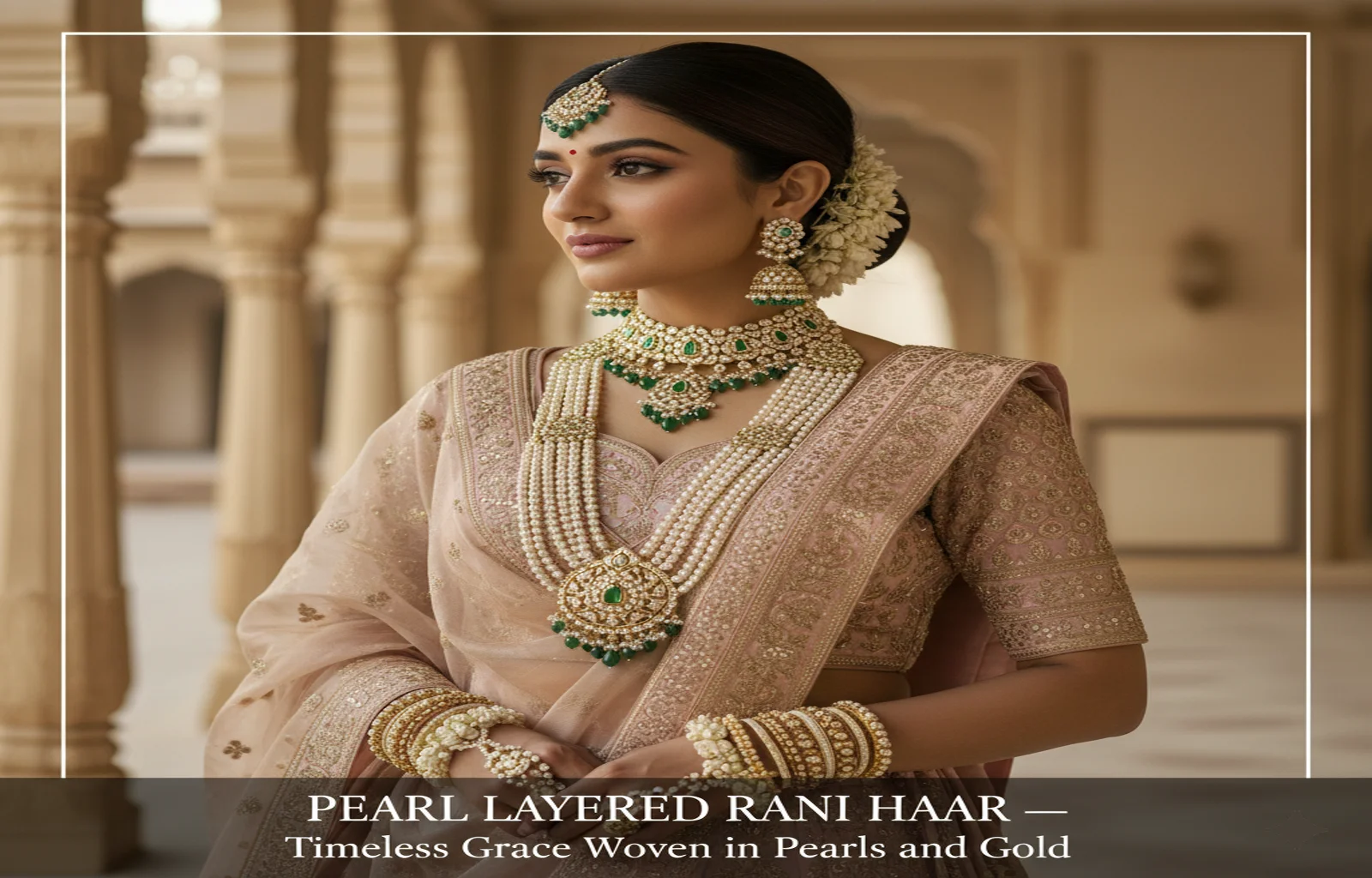
Indian Wedding Jewellery Trends – Pearl Layered Rani Haar: Timeless Grace Woven in Pearls and Gold
The Pearl Layered Rani Haar is among the most elegant and emotionally resonant forms of Indian bridal jewellery. Distinguished by its cascading strands of luminous pearls and anchored by kundan or polki pendants, this regal necklace style embodies an aesthetic of understated grandeur. Rooted in royal traditions and ceremonial elegance, the Rani Haar has long been associated with queens, noblewomen, and brides who favour refinement over ostentation.
With its soft luminosity, balanced proportions, and graceful movement, the Pearl Layered Rani Haar continues to hold a place of distinction in contemporary bridal styling—particularly for daytime weddings, heritage ceremonies, and classic bridal portraits where subtlety speaks louder than spectacle.
Historical Origins and Royal Associations
The origins of the Rani Haar can be traced back to the royal courts of Rajasthan, Gujarat, and Mughal India, where layered pearl necklaces were favoured by queens and aristocrats. Pearls, often referred to as “the tears of the moon” in ancient texts, were treasured for their natural beauty and symbolic purity. Their understated sheen aligned perfectly with the refined tastes of royal women, who sought jewellery that conveyed dignity, lineage, and grace.
Unlike heavily gem-studded pieces designed for ceremonial power, the Rani Haar was often worn in courtly settings, religious rituals, and private ceremonies. Over time, it evolved into a quintessential bridal ornament, representing elegance, fertility, and marital harmony.
The Structure of a Pearl Layered Rani Haar
The defining feature of the Pearl Layered Rani Haar is its multi-strand construction. Dozens, sometimes hundreds, of carefully matched pearls are strung into graduated layers, creating a flowing silhouette that drapes gracefully over the torso. These strands converge at a central pendant or clasp, typically crafted in gold and adorned with kundan or polki diamonds.
The layered design serves both aesthetic and symbolic purposes. Visually, it creates depth, rhythm, and movement, enhancing the bride’s posture and presence. Symbolically, the multiple strands are often interpreted as layers of blessings, prosperity, and continuity.
Pearls: Symbolism, Selection, and Soft Sheen
Pearls occupy a unique place in jewellery, as they are the only gemstones formed organically by living organisms. This natural origin has imbued them with associations of purity, wisdom, and feminine energy across cultures.
In a traditional Rani Haar, pearls are selected with exceptional care. Uniformity in size, shape, and lustre is essential to achieving the necklace’s harmonious appearance. The soft, diffused glow of pearls complements a wide range of skin tones and bridal ensembles, particularly in natural daylight.
Unlike diamonds or coloured gemstones, pearls do not dazzle with brilliance. Instead, they radiate a quiet, moonlit elegance—making them ideal for brides who value subtlety and timeless beauty.
Gold Filigree and Pendant Craftsmanship
The pearl strands of a Rani Haar are often anchored by an ornate pendant or clasp, which serves as the focal point of the piece. Crafted in gold, these pendants frequently feature intricate filigree work, floral motifs, or traditional patterns inspired by royal and temple art.
Kundan or polki diamonds are commonly used to embellish the pendant, adding a touch of sparkle without overwhelming the overall composition. In some designs, meenakari enamel work is applied to the reverse, ensuring that the piece is visually appealing from every angle.
This interplay between the softness of pearls and the richness of gold creates a balanced aesthetic that is both feminine and regal.
Styling with Pastel Lehengas and Heritage Sarees
One of the greatest strengths of the Pearl Layered Rani Haar is its versatility. It pairs exceptionally well with pastel lehengas, ivory or blush-toned bridal outfits, and heritage sarees such as Banarasi, Chanderi, or soft silk weaves. These ensembles provide a neutral canvas that allows the pearls’ natural luminosity to shine.
The Rani Haar is particularly well-suited for daytime weddings, garden ceremonies, and traditional rituals where heavy, glittering jewellery may feel out of place. Its refined elegance enhances the bride’s overall look without detracting from the sanctity of the occasion.
Feminine Grace and Bridal Presence
The movement of layered pearls as the bride walks or turns adds a dynamic element to the jewellery, lending a sense of life and fluidity to the ensemble. This gentle motion enhances the bride’s presence, creating an impression of poise and serenity.
For bridal portraits, the Pearl Layered Rani Haar offers a timeless aesthetic. Its classic proportions and soft sheen photograph beautifully, ensuring that wedding images remain elegant and relevant across decades.
Heirloom Value and Enduring Appeal
Traditionally, pearl Rani Haars were treasured as family heirlooms, passed down through generations of women. Their design, free from overt trends, ensures enduring relevance. When crafted with high-quality pearls and gold, these necklaces retain both emotional and material value over time.
Proper care—such as storing pearls away from harsh light and chemicals—can preserve their lustre for generations, reinforcing their status as legacy pieces.
Contemporary Interpretations
While the classic Rani Haar remains unchanged in its essence, contemporary jewellers have introduced subtle variations to suit modern brides. Lighter constructions, detachable pendants, and adjustable lengths allow the necklace to be worn beyond the wedding day, paired with sarees, anarkalis, or even fusion wear.
These adaptations ensure that the Pearl Layered Rani Haar continues to evolve without losing its traditional soul.
Conclusion: Elegance Rooted in Royal Tradition
The Pearl Layered Rani Haar is a celebration of grace, purity, and quiet opulence. With its cascading strands of pearls, ornate gold detailing, and timeless silhouette, it embodies an aesthetic that transcends fashion cycles. Ideal for pastel bridal ensembles, heritage sarees, and daytime ceremonies, it offers a refined alternative to more elaborate jewellery styles.
For brides who seek elegance over extravagance and tradition over trend, the Pearl Layered Rani Haar remains an enduring symbol of feminine strength, royal heritage, and timeless beauty.
Click Here To Know More About Indian Weddings