
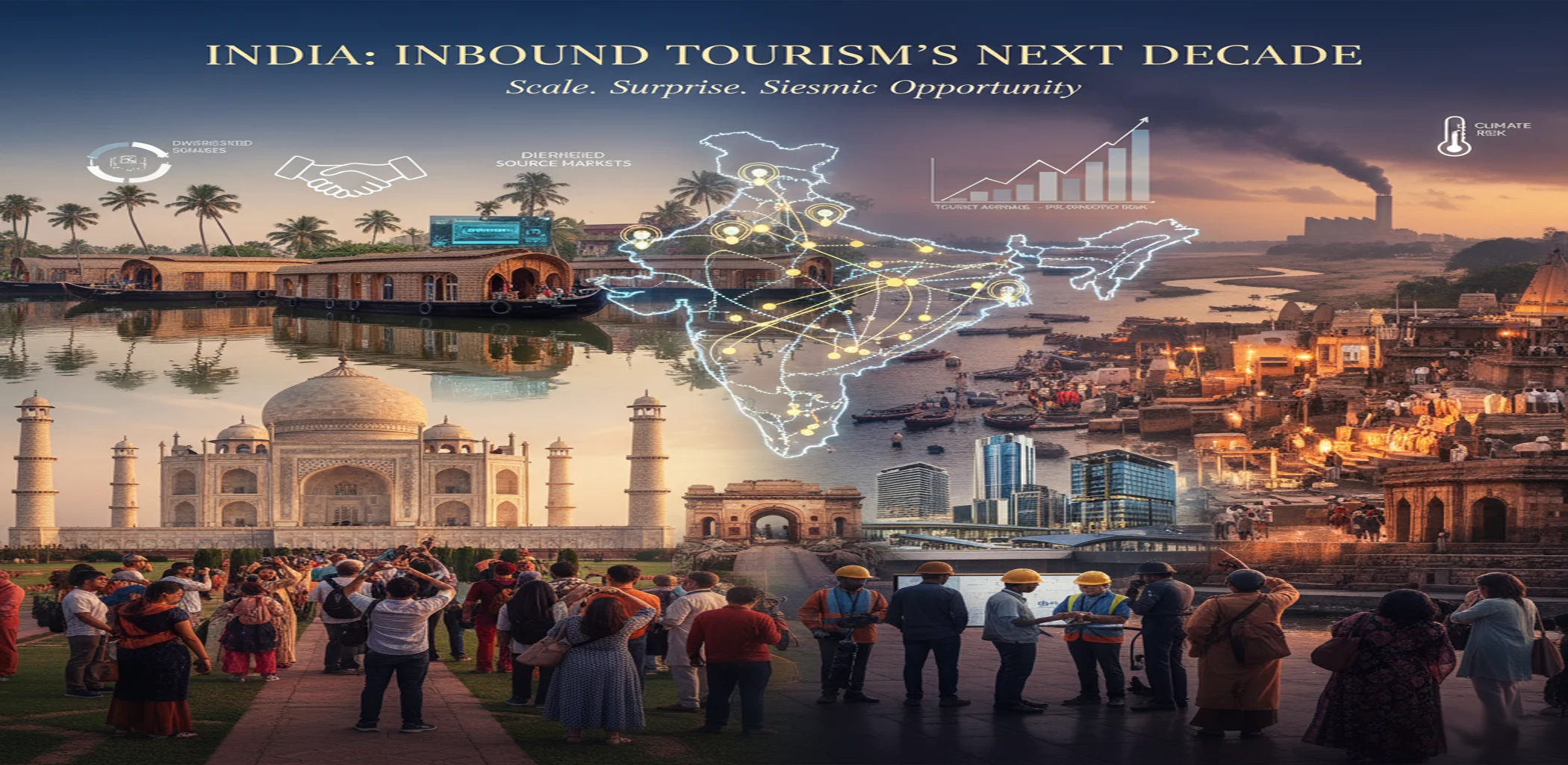
Inbound Tourism in India – a story of scale, surprise and seismic opportunity
Imagine the first glow on the white marble of the Taj Mahal, a houseboat drifting through mirror-calm Kerala backwaters, the ghat-side rituals of Varanasi at dusk — all threads in a tapestry that is India’s inbound tourism story. Over the last three years that tapestry has rewoven itself: arrivals surged past pre-pandemic peaks, source markets diversified, digital visas simplified access, and a wave of public-private investment is turning old choke points into new gateways. But beneath the headlines lie tensions — infrastructure gaps, overtourism at fragile sites, uneven quality, and climate risks that demand urgent strategy. This article gives you the full picture: numbers, trends, policy, products, problems, and a practical roadmap for the next decade.
A snapshot (where we are)
The past few years have been a defining period for India’s inbound tourism industry — a sector that was once shaken to its core by the global disruptions of 2020–21 but has since rebounded with remarkable resilience, speed and structural strength. What began as a slow and cautious reopening quickly transformed into one of the fastest recoveries in the region, driven by pent-up global travel demand, rapid digitalization, rising global confidence in India as a destination, and a nationwide infrastructure push that has improved accessibility like never before.
By late 2022, international flight operations were close to normal, airline networks restored their pre-pandemic frequencies, and major tourism circuits began welcoming steady inflows of travellers. But it was 2023 and 2024 that truly signalled a turning point. According to official tourism compendia and Ministry of Tourism statistical reports, India recorded international tourist arrivals in the high tens of millions, climbing past pre-pandemic peaks and firmly positioning the country back on the global tourism radar. This was not a marginal recovery — it was a decisive return to growth, reflecting confidence from long-standing markets such as the USA, UK, Germany and Australia, as well as emerging ones across Southeast Asia, the Middle East, Eastern Europe and Latin America.
This resurgence did not occur in isolation. Globally, travel was on an upward trajectory. The UNWTO tourism barometer consistently recorded year-on-year growth in international travel, with millions of travellers seeking meaningful experiences, new destinations, and post-pandemic rejuvenation. India was strategically poised to capture this rising tide — and it did. Several factors aligned: improved air connectivity with new routes linking major Indian cities to global hubs; substantial airport modernization across Delhi, Mumbai, Bengaluru, Goa and newer regional airports; and a proactive focus on inbound promotion through targeted marketing campaigns, roadshows and trade collaborations.
One of the most transformative enablers of India’s inbound recovery has been visa liberalization, particularly the rapid expansion and adoption of the e-Visa regime. Digital visas, which began as a facilitative measure several years ago, became the dominant gateway for foreign travellers after the pandemic. By 2024 and moving into 2025, multiple reports indicated a steep rise in the share of e-Visas issued — a clear indicator that simplified access directly correlates with increased arrivals. For travellers from Europe, the Middle East, Southeast Asia and North America, the ease of applying online, faster processing cycles, and reduced paperwork removed long-standing friction points. For India, it meant a broader and more diverse pool of visitors entering the country.
This shift toward digital facilitation also aligned perfectly with the behaviour of the modern traveller — one who expects seamless, app-based services, real-time updates and minimal bureaucratic hurdles. As online travel agencies, airlines and global tourism boards highlighted the simplified visa processes for India, the destination became more competitive compared with markets that still rely heavily on physical or interview-based visa systems.
The Indian government’s “Incredible India” brand, refreshed through newer campaigns, expanded social media presence, and influencer collaborations, further contributed to global visibility. Meanwhile, states launched their own targeted international marketing initiatives, driving interest in both traditional hotspots and emerging regional destinations. The result was a surge not just in arrival numbers but also in the type of visitors — more long-stay travellers, cultural explorers, wellness seekers, digital professionals and repeat visitors.
Key quick facts to carry forward:
India’s international tourist arrivals have recovered to and surpassed pre-COVID levels in the 2023–24 period.
This rebound has been validated through Ministry of Tourism documentation, with strong performance across both leisure and business travel categories. The recovery is broad-based, cutting across regions, age segments and traveller motivations.
Digital visas (e-Visas) have become the largest channel for inbound entry, marking a structural shift in India’s tourism access framework.
The share of visitors entering India through the e-Visa route has continued rising into 2025, as reported by national news platforms and travel trade sources. For many markets, the e-Visa is now the default mode of entry, significantly reducing administrative barriers and accelerating planning-to-arrival timelines.
Together, these developments illustrate a clear picture: India is not just recovering — it is expanding its global tourism footprint, modernizing its systems, and tapping into new and diversified demand sources. The momentum gained between 2023 and 2025 has set the tone for the next decade, positioning inbound tourism as one of India’s most promising engines of economic growth, job creation and international
Why tourists are returning — and why new travellers are choosing India
India’s resurgence as a global tourism magnet is not accidental; it is the result of deliberate policy reform, sector-wide reinvention, and evolving traveller preferences that align naturally with what the country offers. The return of traditional markets — combined with a surge of first-time visitors from regions such as Eastern Europe, Central Asia, the Middle East, and parts of Latin America — shows that India is no longer simply “back” on the global map; it is expanding its position. Four structural drivers underpin this shift.
1. A Refreshed Product Mix
The India of today is not selling the same travel experience it did a decade ago. While icons such as the Taj Mahal, Rajasthan’s forts, or Kerala’s backwaters remain timeless, the country’s product portfolio has multiplied in both breadth and depth.
Wellness travel, centred around Ayurveda, yoga, naturopathy, and integrated spa regimes, has emerged as a major draw for global travellers seeking long-duration rejuvenation stays. From the foothills of the Himalaya to the coasts of Kerala and Goa, wellness retreats now offer curated, medically supervised programmes that rival Europe’s health retreats — often at a fraction of the cost.
Medical tourism is another powerful engine, with India now one of the world’s leading destinations for elective procedures, cardiology, oncology, organ transplants, and cosmetic surgery. High-quality healthcare, globally trained specialists, and competitive pricing combine to bring millions of medical travellers, often accompanied by family members who then engage in leisure tourism.
The MICE sector has also grown dramatically. India’s new convention centres — from Yashobhoomi and Bharat Mandapam in Delhi to Jio World Convention Centre in Mumbai and emerging venues in Hyderabad, Goa, Lucknow, and Gandhinagar — have given global associations and corporates the infrastructure needed to host world-scale events. Delegates frequently combine conference participation with sightseeing, driving higher per-capita spending.
Experiential travel has perhaps seen the most growth. Tourists are exploring rural stays, tribal circuits, craft villages, tea-garden walks, wildlife and conservation tourism, and immersive culinary journeys that go far beyond the standard curry-and-nan stereotype. Himalayan adventure tourism, once niche, now attracts trekkers, climbers, cyclists, paragliders, rafters, and spiritual explorers from across the world. Meanwhile, experiential luxury, particularly heritage hotels, restored palaces, boutique mansions, and glamping resorts, has redefined India’s high-end travel identity.
Collectively, this diversification has expanded India’s appeal from a one-time “bucket-list” stop to a multi-trip, multi-theme destination — whether for healing, culture, adventure, cuisine, nature, or high-end indulgence.
2. Policy and Digital Facilitation
Reduced friction is one of the quiet success stories driving inbound numbers. India’s e-Visa regime — simplified, digitised, and offered to a large and growing number of nationalities — has eliminated many of the hurdles that once discouraged casual travellers. Fast processing times, online fee payments, and digital approvals have made planning a trip to India almost as seamless as visiting Southeast Asia or the Gulf.
Electronic travel authorisations, extended visa categories, and clearer documentation standards have further improved perception and convenience. In many source markets, the e-Visa has become the dominant pathway for travel, with data showing consistent year-on-year rises in digital visa issuance.
Parallel to these administrative reforms is a dramatic upgrade in marketing sophistication. National campaigns — complemented by agile, niche-focused efforts from state tourism boards — now target micro-segments such as wellness seekers, digital nomads, luxury travellers, wildlife enthusiasts, gastronomy-focused travellers, and film-induced tourists. India’s tourism messaging has become more visual, data-driven, and narrative-rich, moving away from postcard clichés to immersive storytelling that showcases people, culture, nature, and experience.
These improvements have helped India break into consideration sets of travellers who might previously have avoided the country due to perceived complexity.
3. Connectivity: Better, Wider, Faster
Air travel has undergone a transformation. More direct flights from major global hubs — including expanded routes to Delhi, Mumbai, Bengaluru, Goa, Hyderabad, and emerging gateways like Jaipur, Ahmedabad, and Kochi — have significantly reduced travel times and improved convenience.
Indian carriers are expanding aggressively with large aircraft orders, while foreign airlines are increasing frequencies in response to stronger demand. Importantly, connectivity is no longer restricted to the metros. Secondary cities now enjoy direct or one-stop access to international hubs, promoting regional tourism circuits such as:
- The Buddhist Circuit (UP–Bihar–Nepal)
- The Western Ghats (Goa–Belagavi–Mangaluru–Coorg)
- Rajasthan’s heritage triangle (Jaipur–Jodhpur–Udaipur)
- The Northeast (Guwahati as a gateway to Meghalaya, Arunachal, Nagaland)
Where travellers once needed multiple segments and long layovers, they can now fly into India far more conveniently and with competitive pricing.
4. A Strong Value Proposition
Despite inflation and global cost-of-living pressures, India remains an attractive value-driven destination. For travellers from Europe, East Asia, the Middle East, and Australia, India’s combination of authentic experiences, rich culture, high-quality service, and relatively lower costs makes it particularly compelling.
Luxury resorts, fine-dining experiences, customised tours, and wellness packages that would cost significantly more in Western markets are priced accessibly in India. For the budget-conscious, backpacker-friendly hostels, homestays, transport networks, and local eateries make long trips affordable without compromising on experience.
More importantly, India’s value is no longer just about being cheaper — it is about offering value-rich experiences: unique, immersive, and often transformative opportunities that are difficult to replicate elsewhere. The renewed and rising interest in India stems from a combination of reinvention, facilitation, connectivity, and consumer alignment. Whether for healing, learning, exploring, celebrating, or conducting business, travellers find in India a depth of experience that few other countries can match. As tourism segmentation sharpens and infrastructure continues to evolve, the momentum is expected to strengthen further in the coming years.
Who’s coming (and who’s growing the fastest)
India’s inbound tourism profile has changed significantly over the past decade, moving from a heavy dependence on traditional Western markets to a more diversified, multi-regional visitor mix. While legacy markets still contribute the highest spending and a substantial share of arrivals, the fastest growth is increasingly coming from new geographies — markets that were once peripheral but are now becoming central to India’s inbound strategy. Understanding these shifts is key for tourism planners, destination marketers, hotel developers, and aviation strategists.
1. Traditional Western Markets: Still the Backbone
For decades, Europe and North America have formed the foundation of India’s international tourism. Countries such as the United States, the United Kingdom, France, Germany, Italy, Spain, Canada, and the Nordic nations remain deeply important. These markets consistently deliver high per-capita spenders, long-stay visitors, and travellers who distribute themselves widely across circuits — from the Golden Triangle to Kerala, Goa, the Himalaya, and wildlife sanctuaries.
The United States has, in fact, emerged as one of India’s single largest inbound sources by sheer numbers and spending power. The UK, despite being a mature and saturated market, continues to show remarkable resilience because of its diaspora links, long-haul travel culture, and strong airline connectivity (BA, Virgin Atlantic, Air India, Vistara).
Germany and France remain among Europe’s most reliable contributors, sending stable volumes of quality-conscious travellers interested in heritage, spirituality, yoga, wildlife, and sustainable tourism. These markets also respond well to government-led and state-led tourism campaigns, given their cultural affinity for history, nature, and experiential travel.
In short, the “core Western markets” have not shrunk in importance; instead, they have strengthened their role as stable, predictable segments that generate reliable revenue and higher average room rates (ARRs) for hotels across India.
2. Fast-Growing Markets: The New Powerhouses
While the West remains dominant in spending, the fastest percentage growth is emerging from regions that were previously underpenetrated. These growth markets are now reshaping India’s inbound landscape.
Gulf and Middle East
Countries such as the UAE, Saudi Arabia, Oman, Qatar, Bahrain, and Kuwait are among the fastest-growing inbound contributors. Reasons include:
- Proximity and short flight times
- Affordable and frequent connectivity through Emirates, Qatar Airways, Etihad, Air Arabia, flydubai, and Air India
- Diaspora connections
- Growing outbound leisure culture among Gulf nationals
- Medical travel, especially for complex procedures and wellness recovery
Saudi Arabia, in particular, is emerging as a significant new source of tourists as its own outbound market expands under Vision 2030.
Southeast Asia
Countries such as Singapore, Malaysia, Indonesia, Thailand, Vietnam, and the Philippines are increasingly choosing India. Proximity, cultural familiarity, business travel, and the spread of low-cost carriers have strengthened these flows. For Buddhist Circuit destinations, Southeast Asia is becoming especially important.
These travellers are often younger, tech-savvy, value-conscious, and open to multi-destination itineraries combining India’s cities, beaches, and cultural hubs.
Australia and New Zealand
Australia has rapidly grown from a mid-sized source market to a top-tier inbound contributor. Rising student mobility, business-related travel, strengthened aviation links, and India’s growing recognition as a long-haul adventure and cultural destination have accelerated this growth. Many Australian travellers are also drawn to India’s wellness and yoga ecosystems.
3. Newly Emerging Regions: Latin America, East Asia & Central Asia
Latin America
A decade ago, Latin American tourist arrivals were negligible. Today, travellers from Brazil, Argentina, Colombia, Mexico, Peru, and Chile are showing increasing interest in India. They are attracted by:
- Iconic cultural sites
- Bollywood and Indian pop culture
- Adventure and spirituality
- Expanded flight connectivity via the Middle East
While absolute numbers remain modest, growth rates are strong, and these markets offer a high-quality, experience-driven segment that often takes long trips covering multiple regions of India.
East Asia
Japan, South Korea, and Taiwan are climbing steadily. Improvements in e-visa systems, rising business interactions, and growing interest in Buddhist heritage, cuisine, textiles, and crafts are driving this trend.
South Korea is emerging as a standout market, driven by strong entertainment-based affinity (K-pop/Hallyu and Bollywood crossover), high disposable income, and interest in adventure sports and Himalayan trekking.
Central Asia
Kazakhstan, Uzbekistan, Kyrgyzstan, Tajikistan, and Azerbaijan have become dynamic new contributors — boosted by aggressive low-cost connectivity, visa-on-arrival access in some cases, and rising awareness of India as a friendly, affordable destination.
These travellers are often repeat visitors, combining shopping, wellness, Ayurveda, short vacations, and business travel.
4. High-Value Segments: Medical, Wellness & Spiritual Travellers
Even as leisure markets expand, India’s high-value inbound segment continues to be anchored by:
Medical Tourism
India is now one of the most trusted medical travel destinations globally. Travellers come for:
- Cardiology
- Orthopaedics
- Oncology
- Organ transplants
- Dental, cosmetic, and fertility procedures
Key source regions: Africa, the Gulf, CIS nations, Bangladesh, Nepal, Sri Lanka, Myanmar, and increasingly East Africa and Central Asia.
Medical travellers typically stay longer and spend significantly more — benefitting hospitals, hotels, long-stay apartments, and wellness centres.
Wellness and Ayurveda Tourism
Kerala, Uttarakhand, Karnataka, Goa, and parts of Maharashtra now host world-class wellness retreats. Guests come for detox, Ayurveda therapies, yoga immersions, and long-duration healing programmes — often staying two to six weeks.
Spiritual and Yoga Travellers
Rishikesh, Varanasi, Bodh Gaya, Dharamshala, and Tamil Nadu remain magnets for spiritual seekers, experiential travellers, and study-based tourists participating in courses, workshops, and long-term stays.
5. Tracking the Data
For precise, country-wise ranking and year-on-year flows, the Ministry of Tourism’s official compendia and annual Data Compendium remain the most authoritative resources. These documents give detailed breakdowns of:
- Top 20 source markets
- Fastest-growing markets
- Visa-category trends
- Purpose-of-visit analysis
- Spending patterns
These official datasets help tourism businesses, policymakers, and researchers understand which markets are expanding, stabilising, or emerging — allowing more accurate forecasting and marketing strategies. India’s inbound tourism is no longer defined by a handful of Western markets. It is now a multi-origin, multi-interest ecosystem powered by:
- Stable Western inflows
- Explosive growth from the Gulf and Southeast Asia
- Rising long-haul interest from Australia, Latin America, and East Asia
- New momentum from Central Asia
- High-value medical and wellness travellers
This diversification makes India’s inbound market more resilient, dynamic, and future-ready — positioning it strongly for sustained growth throughout the coming decade.
Hot trends shaping inbound tourism
India’s inbound tourism resurgence is not simply a numeric recovery — it is a transformation in what travellers want and how destinations are responding. Global visitor preferences have shifted dramatically post-2020, and India’s tourism ecosystem has adapted in ways that unlock new markets, new motivations, and new economic opportunities. Five major trends are now shaping the next decade of inbound growth.
1. Experiential & Place-Based Travel: The New Currency of Tourism
Globally, travellers are moving away from checklist-style sightseeing and leaning into immersive, slow, and sensory-rich experiences. India fits this macro-trend perfectly. A new wave of experiential travel is redefining how visitors engage with destinations:
- Culinary trails in cities like Delhi, Amritsar, Jaipur, Kochi, Goa, and Hyderabad offer curated food walks, chef-led tastings, regional thali explorations, and hyperlocal experiences such as toddy tapping, community kitchens, and spice-garden visits.
- Craft and artisan circuits allow travellers to witness India’s craft traditions at source — from Kutch weavers and Banarasi silk workshops to blue-pottery studios in Jaipur and bronze-casting artisans in Tamil Nadu.
- Village and rural stays are fast becoming the backbone of repeat visitation. Travellers now seek authenticity: staying in homestays, participating in harvests, learning traditional cooking, joining folk performances, and exploring sustainable farm tourism.
This evolution gives India a strong advantage: unlike many destinations that must artificially create “experiences,” India’s depth of culture, craft, cuisine, and community inherently delivers authentic, immersive travel.
2. Pilgrimage & Spiritual Circuits: A Timeless Engine of Demand
Pilgrimage has always been one of the strongest pillars of India’s domestic tourism, but international spiritual travel is now growing at a significant pace. Tourists from Southeast Asia, East Asia, Nepal, Sri Lanka, Mauritius, the Caribbean, Europe, and North America are flocking to India’s spiritual heartlands.
Key circuits driving demand:
- Buddhist Circuit: Bodh Gaya, Sarnath, Kushinagar, Nalanda — witnessing record international footfalls as e-visas and charter connectivity improve.
- Hindu Pilgrimage: International devotees increasingly visit Varanasi, Ayodhya, Mathura–Vrindavan, Tirupati, Rameswaram, Somnath, Dwarka, Puri, and the Char Dham.
- Sikh Tourism: Amritsar’s Golden Temple remains one of the most visited pilgrimage sites in the world, drawing the Sikh diaspora from the UK, Canada, Australia, Malaysia, and beyond.
- Yoga, meditation & spiritual retreats: Rishikesh, Dharamshala, Auroville, and Himalayan retreats continue to attract long-stay seekers who blend spirituality, wellness, nature, and learning.
Pilgrimage tourism is uniquely resilient — economic slowdowns or travel shocks often have limited impact on spiritual travellers. For many inbound markets, pilgrimage is not a discretionary holiday; it is a cultural and emotional obligation.
3. Wellness & Medical Tourism: India’s High-Value, High-Growth Segment
India’s global leadership in wellness, Ayurveda, yoga, and cost-competitive healthcare continues to attract high-value inbound travellers. Unlike short leisure trips, wellness and medical visitors often stay longer, travel with attendants or family members, and spend significantly more on accommodation, food, transport, and post-treatment leisure.
Ayurveda & Wellness
Kerala, Karnataka, Uttarakhand, Goa, and Maharashtra now offer internationally benchmarked wellness retreats that combine:
- Ayurvedic detox and rejuvenation
- Naturopathy
- Yoga immersion programmes
- Panchakarma therapy
- Mental wellbeing & burnout recovery
International travellers increasingly choose India for longer retreats lasting 2–6 weeks, seeking healing, rehabilitation, and lifestyle reset programmes unavailable or unaffordable elsewhere.
Medical Tourism
India is globally competitive in:
- Cardiology and organ transplants
- Orthopaedics and joint replacement
- Oncology
- Cosmetic and dental surgery
- Fertility and reproductive medicine
Key source markets include the Middle East, Central Asia, Africa, SAARC nations, and Eastern Europe. The combination of skilled specialists, modern hospitals, transparent pricing, and globally accredited care has cemented India’s reputation as a trusted medical destination.
4. Film Tourism, Festivals & MICE: Events That Move Markets
Film shoots and cultural events have become powerful tourism catalysts. International productions — from Hollywood to regional Asian studios — increasingly choose India for its landscapes, crafts, and architectural diversity. States such as Uttarakhand, Madhya Pradesh, Gujarat, and Rajasthan have introduced film-friendly policies that reduce red tape and attract global filming crews.
When films or shows go global, the impact is immediate: destinations like Ladakh (thanks to Bollywood), Rajasthan (global OTT platforms), Kerala (international documentaries), and Goa (international film festivals) see measurable visitor spikes.
Festivals as Tourism Drivers
India’s festivals — music, literature, dance, food, spirituality, and traditional arts — are now global draws. The Jaipur Literature Festival, International Film Festival of India (Goa), Hornbill Festival (Nagaland), Rann Utsav (Gujarat), and Sunburn attract international audiences who combine festival participation with extended travel.
MICE & Business Events
With world-class convention complexes in Delhi, Mumbai, Goa, Hyderabad, Gandhinagar, Lucknow, and Bengaluru, India is now a serious contender for global conferences, incentive travel, exhibitions, and trade shows. Each MICE event brings hundreds or thousands of high-spending delegates who often become repeat leisure tourists.
5. Sustainable & Community-Led Tourism: Responsible Travel Goes Mainstream
Sustainability is no longer niche; it is becoming a prerequisite for many international travellers — especially from Europe, Australia, and the Nordic nations. India’s tourism ecosystem is increasingly aligned to this demand.
Key developments include:
- Community-run village tourism models that ensure revenue stays within local economies
- Eco-certification of homestays and nature resorts
- Low-impact adventure and wildlife tourism protocols
- Carbon-neutral or low-carbon tourism initiatives
- Craft, culture & livelihood-based tourism that supports artisans
Government initiatives promoting “tourism livelihoods,” GI-tagged craft clusters, and rural tourism hubs create circular economic value while meeting global expectations for ethical and responsible travel.
This alignment between global traveller values and India’s grassroots social tourism models positions the country strongly for long-term, sustainable inbound growth. Experiential immersion, spiritual depth, wellness healing, cinematic storytelling, and sustainable community tourism are collectively reshaping India’s inbound landscape. These trends point to a future where India is not just a destination to “see,” but a place to feel, learn, heal, experience, and connect — strengthening its appeal across global markets and traveller segments.
Infrastructure, investment and government programs
India’s inbound tourism revival is being strongly reinforced — and in many cases accelerated — by an entire ecosystem of government programs, capital investments, and systemic reforms. Over the last several years, the Government of India and state governments have aligned more closely than ever before to improve the supply side of tourism: infrastructure, product development, safety, connectivity, and destination branding. These interventions are converting traveller interest into actual visits, higher spending, and wider geographic dispersion of tourism benefits.
Three major pillars stand out: destination development programs, capital investment initiatives, and integrated marketing campaigns. Together, they form the backbone of India’s tourism competitiveness.
1. Swadesh Darshan & PRASAD: Building Circuits, Elevating Destinations
The Swadesh Darshan scheme and the PRASAD (Pilgrimage Rejuvenation and Spiritual Heritage Augmentation Drive) program represent some of the most significant long-term investments in India’s tourism infrastructure.
Swadesh Darshan
This centrally funded program focuses on developing theme-based tourism circuits — Buddhist, Coastal, Himalayan, Heritage, Eco, Wildlife, Desert, Tribal, Rural, and more. Funds are allocated for:
- Destination infrastructure
- Wayfinding and signage
- Roads, last-mile connectivity, and amenities
- Tourist interpretation centres
- Safety and sanitation improvements
- Public convenience facilities
- Landscape beautification
- Digital enhancements such as smart kiosks
Swadesh Darshan has helped states redesign and position tourism corridors more professionally. Many destinations that once lacked basic amenities are now more visitor-ready, safer, and aligned with global standards. The upgraded circuits have also encouraged private investment in hotels, restaurants, travel services, and local entrepreneurship.
PRASAD
PRASAD prioritises infrastructure around major pilgrimage destinations — improving temple towns, spiritual nodes, and heritage religious precincts. This includes:
- Riverfront and ghat redevelopment
- Access roads and parking zones
- Waiting halls, interpretation centres, and pilgrim facilities
- Illumination, restoration, and conservation of sacred architecture
- Safety enhancements and crowd flow management
- Integrated development of local markets and crafts
International spiritual tourism — from Buddhist devotees to Sikh diaspora travellers to Hindu religious visitors from Mauritius, Fiji, Trinidad, and Southeast Asia — directly benefits from PRASAD’s interventions.
These programs strengthen India’s cultural-tourism narrative and help convert latent pilgrimage interest into structured, higher-quality visitor flows.
2. SASCI (Special Assistance to States for Capital Investment): Catalysing Big Projects
The Special Assistance to States for Capital Investment (SASCI) scheme plays a critical role in funding large-scale tourism infrastructure. Unlike the circuit-based approach of Swadesh Darshan, SASCI provides states with targeted capital investment approvals for iconic centres and large tourism assets such as:
- International convention centres
- Urban waterfronts
- Major museums and cultural complexes
- Large visitor infrastructure at heritage monuments
- Scenic highways and tourism-centric road corridors
- Ropeways, lakefronts, and adventure hubs
- Integrated tourism townships
SASCI funds allow state governments to execute big-ticket projects that would otherwise require multi-year budget allocations. These investments often catalyse private sector interest — particularly in hospitality, retail, entertainment, and transport services.
States such as Uttar Pradesh, Gujarat, Madhya Pradesh, Andhra Pradesh, Karnataka, and Rajasthan have been major beneficiaries, using SASCI support to upgrade both urban and rural tourism nodes.
3. Marketing Pushes: Domestic Pride + Global Awareness
Tourism growth is not only about creating infrastructure — it’s also about creating demand. India’s marketing strategy now operates on two fronts: building local tourism culture and amplifying India’s global brand.
Dekho Apna Desh
This domestic awareness campaign encourages Indians to explore lesser-known destinations across states, leading to improvements in tourism infrastructure that indirectly also benefit inbound travellers. It promotes:
- Thematic domestic travel challenges
- State-level circuits
- Local culture, heritage, and festivals
- Hidden gems and rural destinations
A more travel-aware domestic population drives supportive ecosystems such as improved amenities, better air connectivity, and upgraded hotels — which eventually serve international tourists as well.
International Roadshows and Brand India Campaigns
India conducts structured tourism roadshows across major global markets — USA, UK, Europe, Australia, the Gulf, and East Asia — to reposition the country as a diverse, experiential destination. These campaigns highlight:
- Spiritual circuits
- Wildlife and conservation
- Film tourism
- Niche adventure regions
- Luxury and heritage stays
- Ayurveda and wellness
- India’s rising MICE capabilities
Additionally, digital marketing campaigns, influencer collaborations, global travel fair participation, and partnerships with airlines and travel companies help India maintain high visibility in competitive international markets.
4. Visible Outcomes: Airports, Heritage Renewal, and Niche Circuits
The cumulative impact of these programs is becoming visible across the tourism landscape.
Airport Upgrades
India has undertaken one of the largest airport modernization expansions globally — with top-tier terminals opening in Delhi, Mumbai, Bengaluru, Goa, Port Blair, and tier-2 cities such as Varanasi, Dehradun, Indore, and Surat. More airports mean more routes, smoother passenger flow, and reduced travel friction — all crucial for inbound tourism.
Heritage Restoration
Conservation-led revitalization of forts, palaces, ghats, museums, temple precincts, and historic waterfronts is creating globally competitive attractions. States like Rajasthan, Madhya Pradesh, Uttar Pradesh, West Bengal, and Tamil Nadu have aggressively restored heritage clusters, resulting in stronger international appeal.
State-Led Niche Circuits
States are developing specialized tourism circuits around:
- Coffee, tea, and spice plantations
- Tribal heritage
- Craft clusters
- Coastal villages
- Jungle and conservation tourism
- Spiritual towns
- River and lake tourism
This niche-focused strategy creates differentiated experiences that attract repeat international travellers who want to explore beyond India’s traditional highlights.
5. Remaining Challenges
While the progress is substantial, execution is not uniformly consistent across the country. Some states demonstrate world-class results, while others struggle with:
- Project delays
- Maintenance gaps
- Fragmented oversight
- Limited private sector participation
- Seasonal dependence
Bridging this geographic imbalance remains the next frontier for India’s tourism modernization. India’s inbound tourism momentum is not accidental — it is supported by a robust, multi-layered architecture of infrastructure investment, destination development, and global promotion. Programs like Swadesh Darshan, PRASAD, SASCI, and aggressive marketing campaigns are transforming both the physical and narrative landscape of Indian tourism. As implementation strengthens and private-sector collaboration increases, India’s tourism supply-side capabilities will become even more competitive in the global arena.
Problems and constraints to fix — candidly
1..Last-Mile Infrastructure Gaps
While India has made enormous progress in highways, airports, and overall connectivity, the real bottlenecks lie in the last mile — the final 5 to 25 kilometres before a visitor actually reaches the attraction, hotel, or local settlement. Poor or inconsistent road quality, confusing or missing signage, patchy street lighting, unreliable public transport, and absence of basic waste management systems can severely dilute the visitor experience.
Secondary and Tier-III destinations — the very places that could decongest metros and create new tourism clusters — often suffer from overflowing waste bins, plastic litter, broken pavements, unclear directions, and erratic water supply. Sanitation infrastructure, particularly clean and well-maintained public toilets, remains inadequate in many areas outside flagship destinations. These issues may seem small individually, but collectively they erode visitor confidence and reduce repeat travel. Given that many global travellers evaluate a country not just by its monuments but by the quality of everyday mobility and cleanliness, last-mile infrastructure remains one of India’s most critical gaps — and one of the easiest to fix with coordinated municipal, state, and PPP-enabled interventions.
2. Quality and Standardization Challenges
Inbound tourism thrives on predictability, consistency, and trust — yet India’s accommodation and services sector remains highly uneven in quality. While metro cities and premium leisure hubs boast world-class hotels, the experience begins to vary sharply once travellers step into smaller towns, pilgrimage circuits, wildlife belts, heritage clusters, and unexplored regions.
There is a noticeable gap in standard room quality, hygiene practices, safety protocols, fire compliance, food handling standards, online reputation management, and service etiquette. Even properties that advertise themselves as “boutique” or “heritage” sometimes lack the professional management practices expected by international travellers.
The absence of a universally accepted and strictly audited grading mechanism — especially outside the luxury segment — makes it difficult for foreigners to make informed decisions. As a result, tour operators often restrict itineraries to a few predictable destinations, limiting both geographical dispersion and socio-economic impact. India needs micro-category standardization, model facility blueprints for homestays, transparent certification, and periodic inspections to build confidence and strengthen destination competitiveness.
3. Human Capital: The Silent Crisis
India’s hospitality industry is one of the world’s largest, but it faces a silent workforce crisis — a shortage of trained, service-focused, multi-lingual, tech-aware professionals. The reality is that international visitors expect a consistent level of professionalism, warmth, efficiency, and communication skills throughout their journey: at airports, hotels, restaurants, museums, transport hubs, and local experiences.
However, the availability of such talent is insufficient and heavily concentrated in metros. Rural tourism belts, heritage towns, nature destinations, and small-scale accommodations rely extensively on untrained or semi-trained staff. The problem isn’t willingness — India’s youth are eager to work — but the lack of structured training, internationally benchmarked curricula, and on-ground capacity-building infrastructure.
A stronger focus on regional tourism institutes, short-term certification courses, apprenticeship programs, digital learning platforms, and tourism-focused vocational training could dramatically improve service quality. The global tourism economy is powered by human warmth and professionalism — and India must scale its human capital to match its ambitions.
4. Seasonality and Carrying-Capacity Stress
One of India’s biggest inbound tourism challenges is seasonality, which puts overwhelming pressure on certain destinations for a few months while leaving them underutilized for the rest of the year. Hill stations, pilgrimage towns, wildlife parks, and popular beach destinations routinely hit carrying-capacity limits, leading to traffic gridlocks, inflated pricing, water shortages, waste overflow, degraded visitor experiences, and rising local resentment.
Many fragile ecosystems — from mountains to deserts to wildlife corridors — are experiencing ecological stress due to unmanaged peak-season surges. Overtourism not only frustrates visitors but also destabilizes local communities who face rising costs of living, loss of traditional livelihoods, and resource depletion.
By contrast, the off-season sees hotels running at low occupancy, reduced staff employment, and minimal economic activity. India needs scientifically measured carrying-capacity guidelines, dynamic pricing, season diversification strategies, destination rotations, and targeted campaigns to promote lesser-known regions during shoulder seasons. Balanced tourism is sustainable tourism — and sustainability is now a key decision metric for global travellers.
5. Data and Forecasting: A Foundational Gap
India’s tourism ecosystem still operates with major information blind spots. While national-level arrival numbers and hotel occupancy trends exist, granular data — such as site-wise visitor flows, real-time occupancy by region, demographic breakdowns, tourist movement patterns, seasonality variations, and revenue per micro-destination — remains fragmented or outdated.
Local-level tourism departments often lack the resources to collect, digitize, and analyze data systematically. As a result, planners, investors, hotel operators, and experience providers must rely on intuition or broad market assumptions. This leads to misaligned infrastructure development, under-informed marketing strategies, and capacity planning mismatches.
A modern tourism economy requires a real-time national tourism dashboard, mobile-based visitor tracking (privacy-compliant), AI-driven forecasting, and integrated datasets that combine hospitality, transport, retail, and event data. Better data leads to smarter destination management, optimal resource allocation, more predictable experiences, and stronger investor confidence.
The good news is that none of these challenges are structural barriers. They are precisely the kind of issues that targeted investment, public–private partnerships, local community engagement, and coordinated policy action can resolve. With the right prioritization, India can transform these constraints into opportunities — and position itself as one of the world’s most compelling inbound tourism powerhouses over the next decade.
Sustainability, community and the social licence to operate
As inbound tourism grows, India faces a central question: How do we welcome the world without compromising the ecological integrity and cultural heritage that make the country extraordinary in the first place?
The answer lies in securing what global tourism scholars call the “social licence to operate” — the implicit approval of local communities, environmental stewards, and future generations. Tourism cannot be an extractive industry. It must be regenerative, ensuring that the people who host travellers benefit economically, socially, and culturally, while natural ecosystems remain intact and resilient.
Community-Led Tourism: The Foundation of Shared Prosperity
One of the most powerful shifts in modern tourism is the global move toward community-led destination development, and India is uniquely positioned to leverage it. Village tourism, when designed thoughtfully, becomes a transformative model:
- Local residents are trained as nature guides, cultural interpreters, storytellers, and adventure facilitators.
- Women’s groups operate homestays, kitchen cafés, weaving clusters, and artisanal craft markets, ensuring money stays within the community instead of leaking to external operators.
- Visitors gain an authentic experience — learning local traditions, observing farming practices, participating in cultural ceremonies — creating a deeper emotional connection with the destination.
These models reduce economic leakage, promote fair distribution of tourism revenue, and strengthen local ownership. They also enhance the dignity and agency of communities, who often become the strongest protectors of both natural resources and cultural identity. India’s ongoing efforts through the Ministry of Tourism and initiatives highlighted by the Press Information Bureau demonstrate how these models, when scaled, can support rural development, preserve heritage, and diversify the inbound tourism portfolio.
Carrying Capacity & Timed Entry: Tools to Protect Iconic Sites
India’s most visited destinations — from the Taj Mahal and Qutub Minar to national parks, hill towns, and pilgrimage hubs — are experiencing stress from surging visitor numbers.
Managing this responsibly requires science-based carrying capacity assessments, which determine how many people an ecosystem or heritage zone can safely host without long-term degradation.
Across the world, iconic attractions have adopted:
- Timed ticketing systems
- Daily visitor caps
- Segregated peak/off-peak pricing
- Visitor routing and guided flows
These tools reduce congestion, protect fragile monuments, enhance visitor experience, and ensure revenue is reinvested into conservation. For India, systematic adoption of these measures will safeguard its most valuable heritage assets while signalling to global travellers that the country is serious about sustainable tourism standards.
Green Certifications: Turning Sustainability into a Competitive Advantage
Eco-conscious travellers — especially from Europe, North America, Australia, Japan, and the Middle East — are increasingly prioritizing low-impact stays, ethical travel choices, and climate-friendly operations. Hotels and tour operators that secure internationally recognized green certifications can differentiate themselves and tap into premium, high-spending segments.
Key sustainable practices include:
- Energy-efficient infrastructure
- Water recycling and rainwater harvesting
- Waste segregation and plastic reduction
- Renewable energy adoption
- Sustainable local sourcing
- Biodiversity-sensitive landscaping
When operators commit to these standards and display verified credentials, they appeal to travellers willing to spend more for responsible stays. This not only enhances environmental performance but also boosts profitability and brand reputation.
Disaster Resilience and Climate Adaptation
India’s most powerful inbound tourism circuits — the Himalayas, coastal belts, river ecosystems, arid regions, and biodiversity hotspots — are among the most climate-vulnerable environments in the world. Extreme weather events, landslides, cloudbursts, coastal erosion, heatwaves, forest fires, and flooding are becoming more frequent.
Therefore, tourism development must integrate:
- Disaster risk assessments
- Sustainable land-use planning
- Climate-resilient construction norms
- Evacuation and early-warning systems
- Visitor safety protocols
- Local training for emergency response
Resilience planning is no longer optional — it is essential for protecting both visitors and host communities. Climate-adaptive tourism models not only reduce risk but also reinforce India’s global reputation as a responsible, future-ready destination.
Ultimately, the success of India’s inbound tourism strategy depends on this balance: welcoming more travellers, generating more revenue, and delivering richer experiences — without compromising the ecosystems, communities, and cultural heritage that form the backbone of Indian tourism.
Sustainable tourism is not a niche anymore; it is the new mainstream expectation. Nations that embrace it early will gain global trust, high-value travellers, and long-term competitive advantage.
Winning product plays for the next five years
India’s inbound tourism opportunity over the next half-decade will be shaped not only by macro drivers — connectivity, marketing, simplified visas — but by the strength and relevance of the tourism products the industry puts forward. The next generation of inbound travellers, especially from high-spending markets, will not respond to generic offerings. They seek immersive, story-rich, convenience-focused experiences delivered with professionalism and meaningful local connection.
To meet that demand, India’s tourism ecosystem must curate distinct, high-value product plays that reorganize existing strengths into compelling, market-ready propositions. The following five strategic plays offer the clearest path for growth, differentiation, and sustained global appeal.
1. Circuit Packages Linking Secondary Hubs – Creating Longer, Better-Spending Stays
The future of inbound tourism growth in India lies in seamlessly connected circuits, not isolated city visits. Strategic two- and three-stop itineraries — pairing a heritage city with a nearby nature escape, or a spiritual circuit with a culinary or craft trail — give travellers a structured, stress-free way to explore diverse experiences within a short radius.
Such “clustered itineraries” achieve three major goals:
- Lengthen stays, increasing per-visitor economic impact
- Distribute traffic beyond overcrowded metro hubs
- Promote lesser-known destinations, especially those recently upgraded under schemes like Swadesh Darshan and SASCI
Examples include Jaipur + Bundi + Ranthambore; Kochi + backwaters + Vagamon; Amritsar + Kartarpur corridor + Anandpur Sahib; and Guwahati + Majuli + Kaziranga. With improved roads and new direct flights into secondary cities, these circuits can become India’s signature inbound tourism USP — easy to book, easy to navigate, and rich with variety.
2. Premium Experiential Hospitality in Restored Palaces and Converted Estates – Capturing the Luxury and Repeat-Visitor Market
India’s restored palaces, forts, havelis, tea bungalows, and colonial estates remain one of the world’s most differentiated hospitality assets. The global appetite for experiential luxury — where history, aesthetics, privacy, cuisine, and slow travel converge — is expanding quickly.
Over the next five years, opportunity lies in:
- Restoration of heritage properties through PPPs, state leases, and sustainable investment models
- Curated boutique luxury experiences emphasizing design, local narratives, exclusivity, and high service quality
- Themed stays: royal cuisine residencies, art and textile workshops, photography retreats, and palace concerts
- Higher-yield destination weddings and private events at heritage venues
- Cross-cultural experiences such as Maharaja-style safaris, curated palace-to-palace journeys, and curated royal family interactions
These products attract luxury travellers from high-value source markets — the US, UK, Gulf nations, Western Europe, and Australia — and encourage repeat visitation because the experience cannot be replicated elsewhere.
3. Specialized Niches: Food, Textiles, Crafts, and Faith – The Deep-Culture Propositions That Set India Apart
Future inbound demand will be led by travellers who want depth, storytelling, and authenticity. India is uniquely positioned to offer niche, specialized tourism products that tap into unmistakably Indian cultural strengths.
Core niches with strong global pull include:
Culinary Tourism
India’s regional kitchens — Awadhi, Chettinad, Assamese, Goan, Kashmiri Pandit, Gujarati Jain, Malabari, Hyderabadi, and more — provide untapped potential for:
- food trails
- chef-led market walks
- cooking masterclasses
- farm-to-table experiences
- spice-route journeys
Textile and Craft Trails
With hundreds of craft clusters — Kutch embroidery, Varanasi weaves, Pochampally ikat, Chanderi, Madhubani, blue pottery — India can design immersive craft journeys combining artisan workshops, museums, homestays, and curated shopping.
Pilgrimage Linked to Festivals
India receives millions of spiritual travellers annually. Opportunities include:
- Buddhist circuits aligned with Vesak and other festivals
- Sikh pilgrimage programs tied to historic gurpurabs
- Hindu pilgrimage and temple trails around major utsavs
- Sufi dargah circuits paired with qawwali evenings
These niche segments attract highly engaged visitors who spend more time, seek curated experiences, and generate stable year-round demand.
4. Tier-2 and Tier-3 Airport Hub Development – Unlocking the Short-Stay and Long-Weekend Inbound Market
India’s aviation network is expanding dramatically, with new airports and rising direct international connectivity to Tier-2 and Tier-3 cities. These emerging hubs — Lucknow, Coimbatore, Guwahati, Indore, Bhubaneswar, Surat, and others — are crucial to unlocking the short-stay inbound traveller.
The strategic logic:
- Shorter access time = higher likelihood of 3–5 day international trips
- Business travellers convert into leisure travellers if secondary attractions are easy to reach
- Low-cost carriers are connecting India with Southeast Asia, Middle East, Central Asia, and parts of Europe
Developing airport-linked tourism clusters, integrating transfer services, hotel zones, and curated weekend circuits will capture a fast-growing segment: young travellers, expats, digital workers, and regional tourists from neighbouring countries.
5. Digital, Hyper-Personal Marketing – Micro-Segments Will Define the Next Tourism Wave
Inbound tourism marketing is shifting from mass communication to precision, personality-based targeting. The next five years will be defined by how well India uses:
- behavioural travel data
- AI-driven segmentation
- influencer partnerships
- platform-specific storytelling (Reels, Shorts, vlogs)
- customised itinerary builders
- multi-language content for non-English-speaking markets
India must move from “Incredible India” as a single monolithic message to multiple micro-narratives — Ayurveda for wellness seekers, textile journeys for design professionals, spiritual circuits for diaspora communities, wildlife experiences for adventure travellers, and food trails for global culinary explorers.
Hyper-personal marketing, combined with frictionless digital transactions, can significantly lift conversion rates and improve India’s share of high-intent travellers.
Practical recommendations (for policy makers & industry)
For policy makers:
Prioritize integrated destination management plans for 20–30 strategic destinations
India’s tourism map is vast, but not all destinations deliver equal return. A focused strategy should identify 20–30 high-impact sites — a mix of heritage cities, spiritual hubs, wildlife destinations, and nature circuits — and develop Integrated Destination Management Plans (IDMPs) that combine:
- transport planning
- waste and sanitation systems
- utilities and water supply
- disaster resilience
- digital infrastructure
- signage, interpretation, and accessibility
- skills development pathways
- sustainability guidelines
This integrated planning ensures that destinations grow with balance, maintain carrying capacity, and deliver a globally competitive visitor experience. IDMPs also help state governments and private investors align on a single roadmap.
• Expand skills and capacity-building programs for frontline workers
A modern tourism economy depends on well-trained frontline professionals — from hotel staff and guides to drivers, adventure instructors, and local community operators. India’s current skill ecosystem is improving but remains fragmented. Scaling capacity-building programs through ITIs, tourism institutes, digital academies, and state-led training missions can:
- raise service quality
- create inclusive, rural employment
- reduce visitor dissatisfaction
- professionalize guiding and hospitality roles
Press Information Bureau updates already highlight progress, but the next leap requires mandatory certification norms, multilingual training, soft-skills development, and strong industry participation.
• Continue visa facilitation but align it with safety, compliance, and quality standards
Visa liberalization has been one of India’s biggest inbound tourism drivers. Expanding e-Visa categories, simplifying approvals, and improving digital processing speeds should continue — but must be coupled with:
- robust visitor compliance systems
- clear safety guidelines for tourism operators
- monitoring mechanisms for illegal or low-quality tourism businesses
Visa policy should enable growth while protecting India’s reputation as a safe, reliable, high-quality destination.
For Industry
• Invest in guest experience standards and a fully digital guest journey
Tourists today expect a seamless, mobile-first travel experience. The most competitive operators will invest in:
- digital check-in/out
- integrated mobile payments
- e-guides and digital concierge systems
- local experiences discoverable via apps
- automated feedback and grievance redressal tools
Improving efficiency reduces operational costs and elevates India’s hospitality brand. Standardization of service quality across hotels, tour operators, and transport providers will help India consistently meet global expectations.
• Partner with local communities for authentic, equitable experiences
Community involvement is no longer optional. Industry players that collaborate with local artisans, storytellers, tribal groups, and rural entrepreneurs can build powerful, differentiated travel products. Authentic experiences — cooking with a local family, learning a traditional craft, hiking with trained village guides — depend on strong community partnerships.
Such engagement not only enhances visitor satisfaction but also ensures equitable revenue sharing, strengthens local stewardship of natural and cultural assets, and reduces economic leakage from rural destinations.
• Use dynamic pricing and yield management to smooth seasonality
India’s seasonality challenge creates periods of overcrowding and long gaps of low occupancy. Dynamic pricing, coupled with intelligent demand forecasting, allows hotels and operators to:
- attract visitors in off-peak months
- optimize profitability
- manage high-season pressure
- align rates with carrying-capacity goals
Yield management and bundled packages can stabilize revenue streams, making businesses more resilient to shocks and promoting balanced destination usage.
For Destination Managers
• Implement visitor management systems at high-footfall attractions
Iconic sites — from the Taj Mahal to major wildlife reserves, ghats, forts, and pilgrimage centers — are often strained by visitor volumes. Destination managers should adopt:
- timed admissions
- daily visitor caps
- sensor-based crowd monitoring
- predictive footfall forecasting models
- real-time digital dashboards
These systems prevent congestion, protect heritage ecosystems, and significantly improve visitor experience. In addition, providing multilingual signage, improved interpretation, and designated photo points can guide visitor flow more effectively.
• Develop low-impact transport solutions
Reducing congestion around major attractions is critical. Solutions include:
- electric shuttle loops
- hop-on-hop-off transport models
- bicycle and e-bike networks
- well-marked walking circuits
- designated pedestrian-only heritage zones
Such measures reduce noise, emissions, and traffic chaos, while enhancing the ambience of heritage and nature destinations. The improvement in air quality and visitor comfort directly supports longer dwell times and positive reviews.
Risks to watch
As India accelerates its inbound tourism ambitions, it must remain vigilant about a set of structural and emerging risks that can disrupt momentum. A well-designed tourism growth strategy acknowledges these vulnerabilities upfront, builds buffers, and plans for resilience. The following four categories represent the most significant risks that policymakers, industry players, and destination managers must actively monitor and mitigate.
• Geopolitical shocks or sudden visa reversals from source markets
Tourism is one of the most geopolitically sensitive industries in the world. Political tensions, diplomatic disputes, sanctions, travel advisories, or abrupt visa policy changes in major source countries can dramatically reduce inbound flows overnight. Even a temporary advisory based on perceived safety concerns can depress demand for months and disrupt aviation routes, tour bookings, and business travel. India must therefore:
- maintain diversified diplomatic engagement
- continuously strengthen global safety perception
- ensure rapid-response communication channels to correct misinformation
- cultivate a broader global market mix to avoid vulnerability to external politics
Building diplomatic predictability and promoting India’s safety credentials will be as critical as infrastructure investments.
• Overdependence on a few source markets increases volatility
While markets like the USA, UK, Germany, Australia, and GCC countries will remain high-value, excessive dependence on any small cluster of countries makes the inbound sector vulnerable to cyclical downturns, inflationary pressures abroad, currency fluctuations, or changing outbound travel preferences. A shock in even one of these markets can materially impact India’s arrival numbers and tourism revenues.
A resilient strategy requires:
- deeper penetration into under-indexed regions (Latin America, Africa, Central Asia, Eastern Europe, East Asia)
- multi-language marketing content to attract non-English-speaking audiences
- product adaptation for cultural fit
- airline partnerships to open new direct routes
- targeted promotion of niche segments that appeal to diverse demographics
The broader and more diversified the demand base, the more stable India’s inbound tourism performance will be in the long run.
• Environmental shocks threaten seasonality, safety, and destination viability
India’s tourism ecosystem spans some of the world’s most climate-sensitive geographies — the Himalayas, Western Ghats, Sundarbans, desert belts, Andaman & Nicobar, and coastal circuits. Increasingly frequent climate events such as heatwaves, glacial outburst floods, cyclones, landslides, wildfires, and flooding pose major risks.
These shocks can:
- disrupt peak seasons
- damage infrastructure
- raise insurance costs
- deter international travellers due to perceived instability
- jeopardize fragile ecosystems that draw tourists in the first place
To mitigate this, India must accelerate:
- climate-adaptive tourism planning
- resilient infrastructure development
- early-warning and evacuation systems
- visitor safety protocols
- responsible zoning and construction norms
Climate resilience is no longer an environmental agenda — it is a tourism survival strategy.
• Unchecked commercialization can erode authenticity and local support
Tourism thrives only with community goodwill. Excess construction, standardized mass-market attractions, displacement of local businesses, and overtourism dilute the cultural and natural authenticity that travellers seek. When communities feel excluded or exploited, they may resist tourism, creating friction and negative sentiment. Destinations also risk losing the very character that differentiates them globally.
Safeguards require:
- strict enforcement of heritage and environmental regulations
- community-led tourism models that ensure benefits flow locally
- zoning protections and limits on unsustainable construction
- cultural preservation programs
- transparent mechanisms for revenue-sharing and community consultation
The social licence to operate must be earned and maintained; without it, tourism loses the trust that underpins long-term viability.
.
The outlook — bold, but conditional
India stands at a pivotal moment: the foundations for exponential inbound tourism growth are finally aligned, and the next decade could see the country emerge as a top-ten global tourism destination in both arrivals and visitor spending. This ascent will not be the result of a single iconic project or a headline-grabbing mega-attraction. Instead, it will be built on something far more enduring — India’s unmatched geographic and cultural diversity, combined with a tourism sector that is beginning to professionalize at scale.
The signs are clear. Air connectivity is expanding, new airports are reshaping accessibility, visa regimes have become more flexible, heritage assets are being restored, and the domestic market has already proven the country’s capacity to manage high tourism volumes. International interest is rising not only for India’s traditional monuments but for its newer pillars: wellness, medical travel, culinary journeys, nature circuits, crafts, events, and spiritual tourism.
However, India’s rise is not automatic. It is bold, promising, and within reach — but it is also conditional.
Sustaining this trajectory requires disciplined, long-horizon investments across four essential pillars:
1. Infrastructure that keeps pace with ambition
High-quality airports, reliable surface transport, safe public spaces, efficient waste management, and resilient utilities are the bedrock of any major global destination. The pace of growth must be matched by upgrades that ensure comfort, predictability, and safety for visitors.
2. Human capital that reflects India’s hospitality promise
Service excellence will determine whether India becomes known for warmth and professionalism or for inconsistency and friction. Scaling training programs, formalizing skills, and elevating frontline service quality will shape India’s long-term reputation more than any marketing campaign.
3. Stronger data systems for smarter decision-making
Without granular, real-time data on arrivals, spending, flows, carrying capacity, and seasonality, destination management remains reactive. A modern tourism economy depends on data-driven planning, predictive analytics, and transparent reporting to optimize performance and avoid overstrain.
4. Sustainable, community-centred growth models
India’s most powerful tourism assets — its heritage sites, natural ecosystems, cultures, and local communities — are also its most fragile. If tourism grows without protection, it risks degrading precisely what makes the country unique. The future must prioritise:
- conservation
- low-impact mobility
- community-led tourism
- climate resilience
- safeguards against overtourism
Done right, this ensures that tourism delivers long-term prosperity without eroding authenticity or community goodwill.
The Long-Term Promise
If the public and private sectors align their incentives — better coordination between ministries, smarter investments by industry, and more empowered destination managers — India can achieve a transformative outcome:
More visitors, higher-quality visitors, higher spending per trip, and tourism that protects and enriches the places it touches.
The country’s story is already compelling. With discipline, collaboration, and innovation, India’s inbound tourism can evolve into one of the world’s strongest and most resilient travel economies — not just attracting global travellers, but inspiring them, surprising them, and bringing them back again and again.
Closing — the visitor’s story
Inbound tourism, at its heart, is not a numbers game — it is a narrative of human curiosity meeting a country’s capacity to welcome, inspire, and care. Every arrival is a story in motion: a traveller choosing to step into India’s layered culture, intricate landscapes, and living traditions. What India does with that moment — how it receives, engages, and supports that traveller — determines whether the encounter becomes a fleeting memory or the beginning of a long-lasting relationship.
The immediate challenge for India is not simply attracting visitors, but converting curiosity into durable, high-value loyalty. The most successful tourism economies in the world do not rely on first-time arrivals; they thrive on repeat visitors who understand a destination deeply and return with purpose. India has the cultural capital, emotional resonance, and diversity to inspire this repeat demand — but only if the experience consistently meets modern expectations of comfort, seamlessness, sustainability, and authenticity.
A high-value visitor is not defined only by spending power. They are ambassadors who carry stories home: stories about local hospitality, safety, the ease of moving around, the richness of experiences, and the sense of being genuinely welcomed. These stories matter. They build reputation, influence travel planning networks, and shape perceptions in markets where India competes for mindshare against simpler, more linear destinations.
Equally important is the story on the ground — the community’s story. Tourism must enrich local lives, not overshadow them. When communities see visible benefits — better livelihoods, preserved heritage, improved infrastructure, respectful visitors — they become partners, not passive bystanders. This social licence is the true foundation for sustainable growth. Destinations where locals feel alienated or overrun inevitably lose their charm, their authenticity, and eventually their visitors. Destinations where communities co-create experiences become stronger, more resilient, and more distinctive.
India’s next chapter in inbound tourism will be written by those who treat tourism not as short-term extraction, but as long-term stewardship. This means protecting fragile ecosystems even as visitor flows grow. It means investing in people — guides, hosts, small business owners, young tourism professionals — who animate the tourism experience. It means designing policies and products that celebrate cultural expression rather than commodifying it. It means understanding that the most powerful tourism strategy is one where local pride and visitor delight align.
When India gets this right, the payoff is extraordinary:
• Visitors who stay longer, spend more, and return often.
• International credibility as a destination that manages growth with responsibility.
• Communities that see tourism not as a burden but as a pathway to prosperity.
• A national brand built on empathy, storytelling, innovation, and respect for heritage.
In the end, the story of inbound tourism is not only about the visitor — it is about the relationship between people, places, and possibilities. India has all the raw material for greatness: unmatched cultural depth, emerging global connectivity, a youthful workforce, rising industry professionalism, and a world that increasingly seeks meaningful, ethical, and restorative travel.
The coming decade belongs to the nations that can deliver trust, quality, sustainability, and emotional connection. If India continues to align its public and private priorities, strengthens its destination management systems, invests in human capital, and protects what makes it unique, it will not just grow in numbers — it will elevate its status as one of the world’s most compelling, future-ready travel destinations.
This is India’s moment to shape the visitor’s story — and, in doing so, reshape its own.