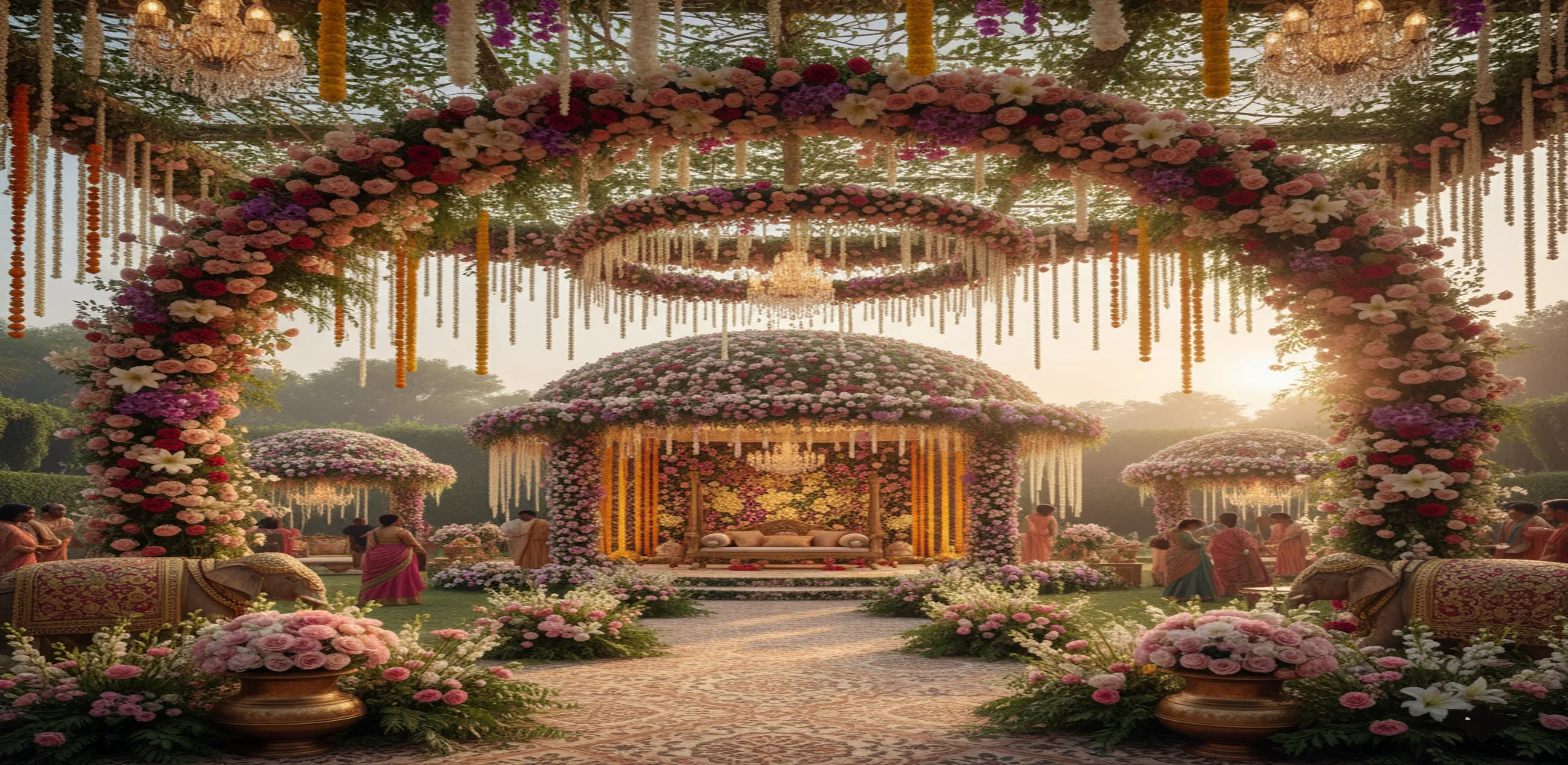
In 2025, one of the most captivating and visually rich trends in Indian weddings is the rise of floral fantasy & botanical decor—where flowers and greenery cease to be mere accents and instead become the focal design element. From ceiling-hung floral installations, botanical walls, immersive flower tunnels, dramatic hanging garlands and lush mandap canopies, weddings are embracing nature in large scale and high-style. Below is a detailed deep-dive into this trend: why it’s growing, what it looks like, how couples and planners are doing it (with Indian-specific considerations), what to watch out for, and how you can implement it.
Why Floral Fantasy & Botanical Décor is Trending in India
Cultural & Contextual Drivers
- Visual impact and shareability: With guest experience, photo-moments and social media shareability being major drivers, floral installations offer immediate “wow” visuals—tunnel of flowers, suspended installations, flower walls that become photo magnets. A 2025 décor trend article identifies “floral ceilings and floating gardens” as a key element.
- Return to nature & sensory experience: After years of heavy indoor banquets, couples increasingly prefer decor that offers scent (fresh flowers), texture (greenery), natural ambience and atmosphere rather than only artificial glitz. One trend piece on Indian weddings notes how exotic blooms and botanical touches are “redefining wedding aesthetics”.
- Customization & story-telling: Flowers lend themselves to narrative: couples are selecting flower types, colours, installation styles that reflect their personality, region, and wedding story. For example, mixing traditional Indian blooms like jasmine and marigold with imported florals to create bespoke décor.
- Elevated design language: Décor is being treated as art installation rather than filler. For Indian weddings, which are multi-day, multi-function and highly photographed, creating signature floral/ botanical zones helps differentiate each event and elevate the experience.
- Sustainability & local sourcing: As part of a broader shift in wedding décor, florals are being introspected—locally sourced, seasonal, reused structures, fewer wastages. Indian floral-trend texts emphasise this.
What the Trend Looks Like: Key Components & Practical Ideas
Here’s how the floral fantasy/botanical decor trend manifests in Indian weddings, broken down by component and with practical framing.
1. Ceiling installations, hanging gardens & floral chandeliers
- Idea: Instead of solely table centrepieces or backdrop florals, décor now uses vertical space and overhead installations: suspended garlands, floral chandeliers, literal “floated” blooms above mandaps/aisles. A floral-trend article lists “floral chandeliers & floating garlands” as major for 2025.
- Execution in Indian context:
- For a mandap under a venue with high ceiling or outdoor lawn under trees, hang installations of orchids, roses, greenery from the ceiling/trusses.
- Use local seasonal flowers (e.g., marigold, mogra, tuberose) combined with filler greens/ivy to reduce cost and add scent.
- Integrate lighting: uplights, fairy-lights within hanging installations to add depth in evening functions.
- For an aisle: create a tunnel of hanging florals and greenery so that guests pass “under” the decor, making it immersive.
- Why it works: Makes the space immersive and dramatic, gives layers to photos, uses often under-utilised ceiling space.
- Things to watch: Structural safety (weight of installations), vendor lead time (hanging installations are labour-intensive), flowers’ freshness/maintenance (especially if early set-up), cost versus budget.
2. Flower walls, interactive botanical backdrops & experiential zones
- Idea: Rather than a plain backdrop, couples are opting for flower walls (dense arrangements of blooms), botanical green walls, interactive zones where guests can walk in/through, photo-booths with botanical themes. For 2025 India décor trends: “flower walls with personalization… ceiling installations… immersive decorative zones.”
- Execution:
- A photo-wall near the entrance or lounge built entirely of one bloom type (mono-bloom; e.g., all roses) or mixed local flowers arranged in ombre colour gradients.
- Use interactive props: guests are invited to leave wishes on a floral wall, or sign a botanical guest-book, or pick a bloom as a keepsake.
- Incorporate couple’s initials in the flower wall using contrasting colour blooms, or embed LED lights in the floral structure.
- For multi-day events: designate each function a different botanical zone (Mehendi lounge = wildflowers & pampas grass, Wedding ceremony = rich roses & orchids, Reception lounge = minimalist greenery wall).
- Why it works: Provides a strong visual, guest-interaction point, photo-friendly design, and allows personalization.
- Things to watch: Cost of dense fresh-flower walls (labour & blooms), freshness if set up early, accessibility if guests interacting, stress on logistics (transport, setup). Consider using high-quality silk/artificial options for large walls if budget/time constrained.
3. Mandap & stage florals go botanical
- Idea: The mandap—the focal ritual space in Indian weddings—is being transformed into a botanical zone: dripping florals, foliage walls, minimal fabric + maximal blooms, or a mix of both. One trend article puts “statement mandaps suspended with floral chandeliers, floating water setups, forest-inspired canopies” among the big 2025 décor elements.
- Execution:
- Build a mandap frame that allows florals to wrap around columns, beam overhead, and cascade down sides; incorporate natural materials (wood, bamboo) rather than only heavy synthetic frames.
- Use a floral “ceiling” above the couple with trailing vines, orchids, and lights—so the couple sits in a “pod” of blooms.
- Combine greenery: moss, ferns, leaves, so the floral elements are mixed with botanical elements not only cut-flowers.
- For outdoor venues: integrate the natural backdrop (trees, sky) into the mandap design rather than hide it—so the mandap feels part of the landscape.
- Why it works: The ritual zone becomes immersive, iconic for photography, differentiates the wedding by design.
- Things to watch: Safety (hanging florals over ceremony area), sight-lines (guests must see the couple), weather (if outdoor), freshness of blooms throughout the extended ritual time.
4. Botanical dining & lounge décor
- Idea: Extending the floral/botanical theme into other wedding zones: dining tables with bungalows of blooms and greenery, lounge zones filled with potted plants, living walls, and botanical centrepieces rather than standard floral bunches. Floral décor articles note “bold blooms & colour-blocking”, “earthy progressive textures” as part of 2025 styling.
- Execution:
- Dining tables: long botanical centrepieces with trailing greenery, interspersed with low floral arrangements; or individual terrariums, succulents, potted plants plus flowers for multi-day reuse.
- Lounge areas: couches and lounge seating surrounded by vertical botanical walls, hanging vines, fairy-lights; create a “garden-room” feel inside the venue.
- Use potted plants instead of cut flowers so that décor can shift from one event to another (e.g., mehendi to brunch) – enhancing sustainability.
- Incorporate florals into tableware/menus: small sprigs of local flowers at each place setting, floral-printed napkins/menus, botanical signage.
- Why it works: Ensures consistency of theme across functions, helps elevate guest experience by being surrounded by nature-inspired décor, allows re-use of décor elements.
- Things to watch: Cost of potted plant rental/storage, ensuring greenery remains fresh; combination of bloom + greenery still matches your overall wedding palette.
5. Colour palettes, texture & material play in floral décor
- Idea: Floral and botanical décor is also about colour, texture and material contrasts: bold colour blocking, dried + fresh blooms mix, mono-bloom installations, botanical elements like leaves, moss, pampas grass. Trend-texts mention “bold colour combos”, “mono-bloom installations”, “textural contrast with soft petals + dried elements”.
- Execution:
- Choose bold palettes: peacock blue + mustard yellow, burgundy + blush pink, coral + mint green for floral installations.
- Use mono-bloom walls: walls covered only in roses or only marigolds for consistent texture and punch.
- Mix dried elements with fresh: Pampas grass, dried palm, seed pods, together with fresh flowers add depth and reduce cost.
- Incorporate regional materials: banana leaves, mango leaves, local blossoms (mogras, marigolds) for authenticity and sustainability.
- Why it works: Provides uniqueness, aligns décor with couple’s style, provides texture and dimension, enhances the botanical feel rather than just cut-flowers.
- Things to watch: Dried + fresh mix needs good design so dried elements don’t feel cheap; colour cohesion across functions; ensuring flowers chosen are in season or alternative sourced.
Indian-Specific Insights & Trends for 2025
- “Latest Trends in Floral Decor for Indian Weddings in 2025” highlights floral ceilings, floating gardens, and mono-bloom installations as key.
- Architectural Digest India’s piece “5 Gorgeous Floral Trends You Cannot Miss This Wedding Season” explains how Indian wedding designers treat floral installations as art pieces, emphasising local flowers and immersive design.
- Wedding décor blogs in India list sustainability and bold blooms together: “Instead of imported blooms and synthetic props … locally-sourced flowers like marigolds, jasmine … bold blooms & colour-blocking” for 2025.
- A trend text explains: “Floral fantasy wedding themes create romance and freshness … full floral backdrops, cascading arrangements, floral chandeliers and scented diffusers … ideal for day weddings and ethereal evening environments.”
- One article enumerates exotic blooms and interactive floral walls: exotic blooms, interactive installations, flower walls as major aesthetic moves.
The repetition across multiple independent sources shows how strong the floral/botanical décor trend is in the Indian wedding market for 2025.
Benefits & Why This Trend Works
- Visual signature & differentiation: Floral installations create memorable visuals that set a wedding apart, offering uniqueness and newspaper-/instagram-friendly moments.
- Sensory richness: Using real flowers adds fragrance, texture and natural ambience that artificial décor can’t replicate — guests sense the luxury.
- Flexibility & adaptability: Botanical décor can scale up or down depending on function, venue, guest-list; can be reused across multiple events.
- Story-telling & personalization: By choosing specific flowers, textures, colours, couples can embed personal narrative (e.g., childhood favourite flower, region-specific bloom) into decor.
- Sustainability alignment: Using local, seasonal flowers, botanical plants, potted green décor aligns with increasing eco-consciousness in Indian weddings.
- Compatibility with venue types: Whether open-air lawns, palace halls, heritage mansions, floral/botanical décor works beautifully across settings, and often complements nature-infused venues.
- Guest interactivity: Floral zones, photo-walls, hanging installations create interactive guest experiences (walk-throughs, selfies, live photo-moments).
Challenges, Trade-Offs & Things to Consider
- Cost & volume of flowers: Dense floral installations, mono-bloom walls, hanging chandeliers require significant volume of blooms and labour. Budget may escalate. Reddit forums suggest for large installations expect many lakhs in India.
- Freshness & durability: Flowers wilt, especially in Indian climates (heat/humidity). Planning must consider irrigation/maintenance, shade if outdoors, backup blooms or artificial hybrid mix.
- Logistics & installation time: Hanging installations, ceiling works, floral tunnels require vendor time, structural support, set-up before arrivals. Outdoor venues add complication (wind, sun, insect control).
- Venue constraints: Some venues (heritage sites, outdoor lawns) might restrict heavy installations, necessitate lightweight décor, or offer low ceiling height — design must adapt.
- Over-design risk: If every zone is heavily floral, the space may feel over-themed or overwhelming. A balance of floral focus and breathing zones/ minimal spaces helps.
- Sustainability & waste: While floral décor is inherently biological, waste (cut flowers thrown away) can be high. Using potted plants, reused props, or donating floral waste helps. Indian sources urge locally-sourced/reusable décor.
- Colour coordination & coherence: Floral decorations must tie back to overall wedding palette (attire, venue, other décor) or may feel disjointed.
- Weather/Environment: If outdoors, wind, sun, insects may affect flowers; ensure contingency plan for décor deterioration or design accordingly.
Practical Blueprint for Implementing Floral Fantasy/Botanical Decor in Indian Weddings
Early Planning (12-9 months)
- Define your floral-theme vision: Do you want “flower-canopy mandap under trees”, “ceiling of blooms in palace hall”, “immersive botanical lounge zone”? Choose your style.
- Choose your colour palette tied to flowers: e.g., peacock-blue + mustard, fuchsia + lush green, pastels of blush/mint + white. Refer to bold combo trends.
- Choose vendor/decorator with strong floral/botanical experience. Ask for portfolios of installations, flower-walls, hanging décor.
- Venue check: Confirm ceiling height (for hanging florals), structural supports, access for installation, flower-storage/maintenance area, outdoor weather contingency.
- Budget control: Allocate a separate “floral/installations” line in budget; accept that botanical/flower décor is one of the high-impact cost items.
Conceptualisation & Design (9-6 months)
- Map out zones: entrance back-drop, mandap/stage, aisle, lounge, dining, photo-walls. Decide which zone gets the major floral focus.
- Decide flower types & sourcing: local blooms (marigold, jasmine, mogra), seasonal/imported blooms (orchids, peonies), dried elements (pampas grass). Choose sustainable options where possible (e.g., locally grown, potted plants).
- Design structure: For hanging installations ensure structural drawings; for flower walls decide dimensions, bloom density, maintenance access.
- Decide texture & material mix: How much greenery vs fresh blooms vs dried; height, density, lighting integration.
- Delivery & logistics timeline: Schedule set-up before guest arrival, plan for flower replacement if ceremony runs long, decide removal/repurpose plan post-event.
- Guest-interaction elements: Could the floral wall serve as guest photo-zone? Could guests take a small bloom as favour? Could there be a botanical lounge?
Execution (6-3 months)
- Confirm vendor schedule & load-in times: especially challenging for large installations.
- Finalise flower-order: Book seasonal imports early; verify freshness guarantee.
- Site walk-through: Check anchor points, rigging, ceiling supports, power for lighting, access for vendor teams.
- Décor mock-up or rendering: Especially for hangings/flower-canopy. Set vendor expectations.
- Guest comfort planning: If hanging lots of flowers overhead, check sight-lines, ensure space is not imposing; ensure no allergen issues for guests (flowers/pollen).
- Sustainability check: Will potted elements be reused/donated? Is there a plan for floral waste management? Use of foam vs eco-friendly structure? Being in India, many decorators mention biodegradable options.
1-2 weeks before & Wedding Day
- Final site check: Mock-install lights, check flower freshness, ensure hanging installations stable.
- Install early morning or prior evening; monitor until guests arrive.
- For outdoor settings: Monitor weather; for heat/humidity ensure fresh blooms are kept hydrated; for wind, ensure hangings secure.
- Guest flow: Ensure corridors, lounge, photo-zones are clearly demarcated; floral zones do not become bottlenecks.
- Post-event plan: Removal/repurpose of florals; plants can be gifted or donated, flower walls could be reused; clean-up by vendor.
Future Directions & What to Expect in 2025 and Beyond
- More immersive botanical installations: Entire venue as “garden” – flower tunnels, botanical ceilings, walk-in floral pods, interactive flower zones. Trend text: “Immersive floral installations, 3D floral tunnels, hanging gardens … flowers aren’t just décor; they are experiences.”
- Conscious floral design: More reuse, fewer cut flowers, more potted plants, local seasonal blooms, recycling of structures – as Indian décor blogs note.
- Integration of botanical + technology: Projection mapping onto floral walls, LED-embedded flower installations, live flower-walls that change colour/mood, interactive guest experiences amid botanical zones.
- Regional storytelling through florals: Use of region-specific flower types, heritage flora, botanical motifs tied into décor — e.g., South Indian jasmine-chandeliers, Rajasthani local wildflowers.
- Hybrid décor: using fresh + dried + sculptural botanical elements to create sculptures of plants/flowers rather than just arrangements — shifting décor from “flower bunch” to “botanical sculpture”.
- Sustainable luxury: high-impact visuals but low waste/environmental impact. Designer blogs suggest this is gaining traction.
Final Thoughts
The shift toward floral fantasy and botanical décor in Indian weddings represents more than just pretty arrangements—it signifies an evolution where décor becomes immersive, sensory, story-driven and environmentally conscious. For couples in 2025, choosing to centre flowers and botanical elements is choosing to create a mood, a world, an experience. It’s about walking into a setting that feels like a garden, a forest, a dream, not just a banquet hall decorated for an afternoon.
For you, if you’re involved in weddings or wedding-services (as your interests suggest), this trend offers multiple angles: vendor partnerships in premium floral/botanical décor, modular botanical décor offerings for weddings, curated “flower-wall + hanging garden” packages, sustainability-certified floral décor services, and visuals that help brides/grooms imagine the “walk through flowers” moment.