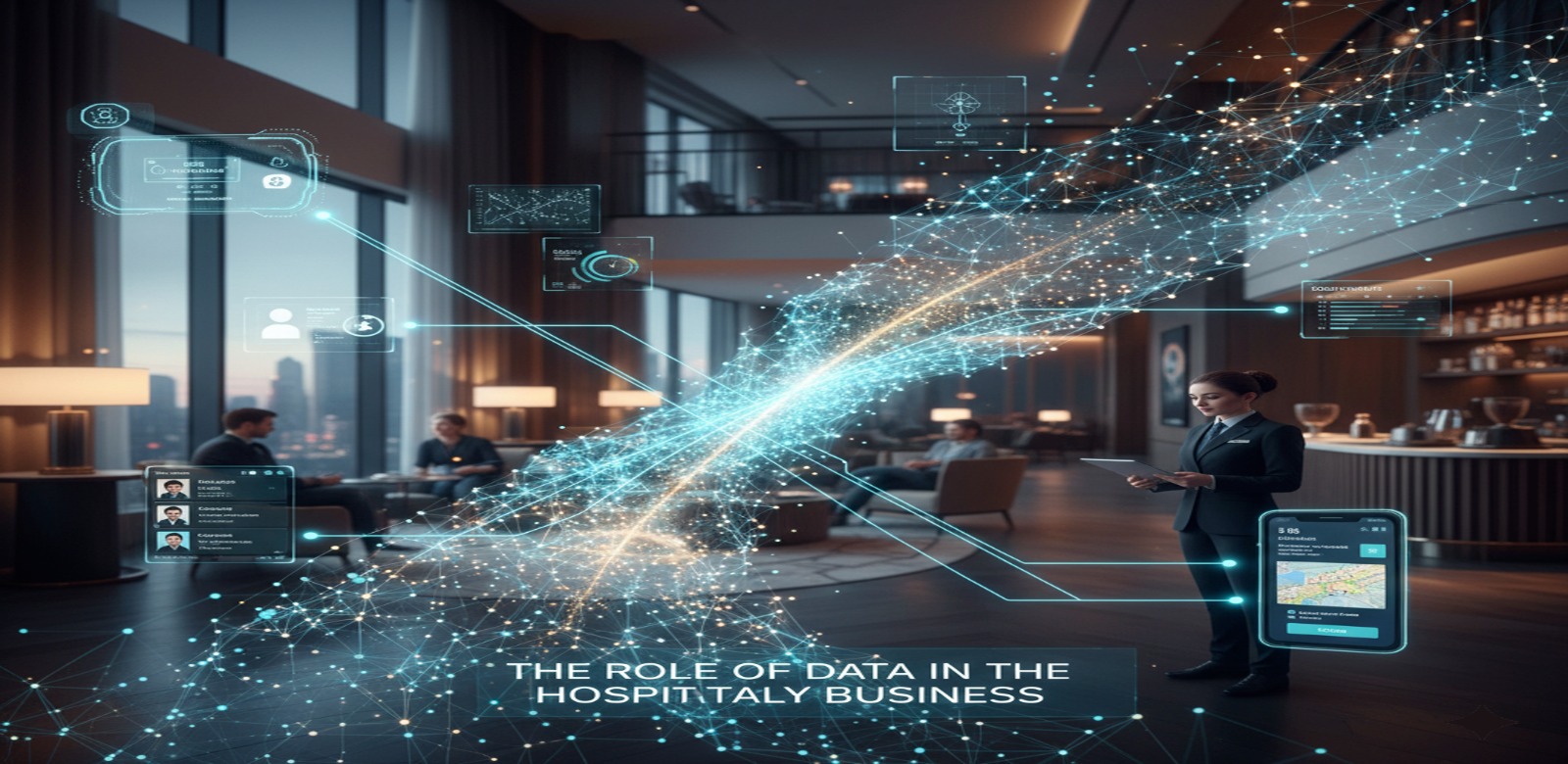
In the hospitality industry, data has evolved from being a background resource to becoming a central strategic asset. Whether for a boutique resort, a full-service hotel chain, or a resort complex, the ability to collect, process, analyse and act upon data is transforming how organisations operate, compete and deliver guest value. With the hospitality sector facing pressures from changing guest expectations, heightened competition, operational cost increases, sustainability demands and digital disruption, data offers a way to connect, optimise and innovate. In this article, we’ll explore why data matters, what types of data are relevant, how hospitality firms use it (across operations, marketing, revenue management, guest experience and more), the organisational implications (technology, culture, governance), the challenges and risks, and what the future holds.
Why data matters in hospitality
Strategic value of data
At a strategic level, data enables hospitality organisations to move from intuition-based decisions to evidence-based decision-making. As one study put it, “data-driven decision-making has become crucial for the hospitality industry”. advhtech.com+2Longdom+2 When managers have access to reliable data on guest behaviour, market trends, operational metrics and external factors, they can make more informed strategic choices—such as where to locate a new property, how to position the brand, which segments to target, and how to invest in assets.
Competitive differentiation
Data increasingly serves as a differentiator: properties that understand their guests, anticipate needs and adjust operations quickly can outperform peers. For example, analytics-driven pricing, guest-personalisation and operational efficiency give a competitive edge. A report noted that hotels using big data / analytics can optimise pricing and inventory management, leading to increased revenue per available room (RevPAR). alation.com+2Longdom+2
Efficiency and cost control
In hospitality, operating costs (energy, labour, maintenance, F&B waste, inventory) can erode margins. Data provides visibility into these cost centres and allows for optimisation. For example: predictive maintenance data can reduce downtime; guest behaviour data can inform efficient staffing; usage data can inform equipment replacement. SOEG Consulting
Guest-centric value and loyalty
Modern guests expect more than a standard stay—they want personalisation, seamless service, digital convenience, meaningful experiences. Data is the enabler: by understanding guest preferences, past behaviour, feedback and context, hotels can design and deliver differentiated experiences, enhancing satisfaction and loyalty. Torrens University Australia+1
Risk and adaptability
The hospitality environment is volatile: demand fluctuations, economic cycles, events, global disruptions (e.g., pandemics). Data and analytics help organisations anticipate shifts, forecast demand, allocate resources appropriately, and respond faster. The Knowledge Academy+1
Thus, the role of data is multifaceted: strategically enabling growth and differentiation, operationally driving efficiency and control, and tactically improving guest experience and responsiveness.
Types of data in hospitality
To operationalise the role of data, it helps to understand what kinds of data hospitality businesses collect and use. According to the literature, key categories include:
- Guest/Customer data: demographic information (age, gender, nationality), booking history, loyalty programme data, preferences (room type, dietary, amenities), feedback, online reviews, social-media sentiment. expertstudyguides.com+1
- Operational data: occupancy rates, room-turn times, housekeeping schedules, maintenance logs, equipment performance, energy consumption, F&B usage, staffing levels. expertstudyguides.com+1
- Financial & revenue data: RevPAR, ADR (average daily rate), occupancy percentage, revenue by segment, cost line items (labour, utilities, supplies), margin analysis. Longdom
- Market/competitive data: competitor pricing, local market supply/demand, events calendar, economic indicators, external data (weather, transportation disruptions) that affect demand. Torrens University Australia
- Technological / sensor / IoT data: in more advanced settings, hotels collect data from IoT sensors (such as occupancy sensors, HVAC monitoring, keycard usage, smart room controls), mobile app engagements, digital channels, and social media streams. The Knowledge Academy+1
- Qualitative / unstructured data: guest reviews (text), photos, social media posts, service agent logs, maintenance narratives. These are harder to quantify but vital for sentiment, experience and reputation management. iraj.in
Each data category offers different opportunities and must be integrated with care. Many hospitality firms struggle with “islands of information” (for example, separate systems for reservations, F&B, guest services) that prevent a unified view. iftmuniversity.ac.in
Core applications of data in hospitality
Let us now examine how data is applied across major functions in a hospitality business.
Revenue management & dynamic pricing
One of the earliest and most value-generating applications of data in hospitality is revenue management. Using historical booking data, market demand signals, competitor pricing and real-time signals, hotels can implement dynamic pricing—adjusting room rates, packages or promotions in real time or near-real time. Torrens University Australia+1
For example: using search engine and booking engine data to identify when demand is rising (or falling) and adjusting prices accordingly; recognising events, holidays or weather patterns; segmenting customers by behaviour and willingness to pay. This enables maximizing occupancy and revenue simultaneously, avoiding both under-pricing and over-pricing. alation.com+1
It also extends to inventory management: for example, deciding how many rooms to allocate to which channel (OTA vs direct), or which packages to offer during low-demand windows. The end result: improved RevPAR, margin uplift and competitive positioning.
Marketing, segmentation & guest acquisition
Data supports targeted marketing campaigns and guest acquisition with greater precision. By analysing guest profiles, behavior, booking paths, device usage and channel preferences, hotels can segment their audience into meaningful clusters (business travellers, leisure families, couples, repeat guests) and tailor promotions accordingly. Engine+1
For example: sending early-bird ski-resort offers to past winter guests, including customised add-ons for families; sending last-minute flash offers for solo business travellers. These campaigns convert at higher rates than generic mass communications. Engine
Also, data enables attribution: tracking which channels, messages or offers lead to bookings, enabling marketing spend optimisation and higher ROI. advhtech.com
Guest experience & personalisation
Data drives differentiation through personalised guest experiences. By collecting guest preferences, past stay history, feedback, purchase behaviour and even mobile app/room sensor behaviour, hotels can craft tailored offers, room settings, dining suggestions, loyalty recognition and surprise-and-delight service. Vaia+1
For instance: if a guest has previously ordered a vegan dinner and requested a quiet room near the elevator, the system can flag this and prepare accordingly. Or via mobile apps, guests can receive offers for spa treatments based on their previous interest. This level of personalisation drives guest satisfaction, loyalty and positive reviews.
Furthermore, data from guest feedback can identify pain-points—e.g., repeated complaints about WiFi speed in a wing—and prompt improvement. Continuous feedback loop supported by analytics is increasingly critical. Longdom
Operational efficiency & cost optimisation
Beyond guest-facing functions, data enables significant operational optimisation:
- Staffing optimisation: analysing occupancy patterns, guest check-in/out flows, peak service times etc to schedule the right number of staff, avoid over- or under-staffing. Quantaco
- Energy & maintenance: using sensor data, IoT and predictive analytics to monitor equipment, HVAC, lighting and alert maintenance before breakdowns, reducing downtime and guest disruption. For example, hotels using predictive maintenance reduced unscheduled repairs. SOEG Consulting
- Inventory and waste management: F&B operations can analyse purchasing, consumption and waste data to optimise stock levels, reduce spoilage, improve menu engineering and align orders with actual demand. The Knowledge Academy
- Service consistency across properties: If one hotel in a chain has higher guest satisfaction scores, data can help compare process differences, staff performance and amenity standards, enabling replication of best practices across the network. Engine
Thus, data underpins the “back-of-house” as much as the “front-of-house.”
Risk management & business continuity
Data also plays a role in identifying risk and preparing for business continuity. By analysing past disruptions (weather, economic, supply chain), occupancy volatility, cancellation patterns, hotels can model scenarios and prepare contingency plans. advhtech.com
Examples: anticipating low occupancy due to a local large-event cancellation and running targeted promotions; identifying fraud patterns in booking behaviour (one global chain used analytics to alert potential fraudulent bookings) Acropolium
Strategic planning & benchmarking
At the strategic level, data enables long-term planning: expansion decisions, brand repositioning, asset allocation, benchmarking performance against competitors and industry standards. Market data (such as that provided by STR, Inc.) tracks supply and demand across markets globally. Wikipedia
Organisations can thus decide where to launch new properties, how to diversify segments and which markets to prioritise—all grounded in data rather than intuition alone.
Organisational & technological implications
Data infrastructure & architecture
To harness data effectively, hospitality organisations must invest in the right infrastructure: centralised data warehouses or cloud data lakes, APIs connecting PMS (Property Management System), CRM (Guest Relationship Management), POS (Point of Sale), IoT sensors, mobile apps and external data sources. Data must be collected, cleaned (pre-processed), integrated and made accessible via analytics platforms. expertstudyguides.com
This also means breaking down “islands of information” (front desk, F&B, spa, guest services) and creating unified guest and operational profiles. Without integrated data, insights are limited. iftmuniversity.ac.in
Data analytics capabilities & models
It’s not enough merely to collect data. Organisations must build analytics capabilities: descriptive (what has happened), diagnostic (why did it happen), predictive (what might happen) and prescriptive (what should we do). Techniques include statistical analysis, machine learning, segmentation, forecasting, optimisation. Some hospitality firms already apply machine-learning to demand forecasting and segmentation. arXiv
Visualisation dashboards, KPI tracking, alert systems and actionable insights are essential so managers can act quickly.
Culture, skills and governance
Technology is only part of the equation. A data-driven culture is essential: staff need to trust data, accept analytics insights, use them in daily decision-making. Hotel operations, revenue management, marketing, guest services and senior leadership all need to collaborate around data. Training is required so staff can interpret dashboards, understand insights and convert them into operational action.
Governance is also critical: data quality (accuracy, consistency, timeliness, veracity) must be maintained. Hospitality data is volume-intensive, high-velocity, varied and sometimes volatile—characteristics of “big data”. Proper governance, security, privacy protocols (GDPR, CCPA) must be in place. The Knowledge Academy
Technology ecosystem & ecosystem partners
Hotels often work with vendors: revenue management systems, CRM platforms, guest experience apps, IoT sensor providers, analytics as a service. Integrating these systems and managing change is a significant project. The technology ecosystem must support real-time or near real-time analytics, connectivity between systems, and the ability to act on insights (for example dynamic pricing engines, mobile guest apps).
Challenges & risks
Data quality and integration
One of the major hurdles is poor data quality: incomplete, inconsistent or siloed systems. Without high-quality data, analytics outcomes may be flawed. The fragmented nature of hospitality systems (PMS, POS, CRM, housekeeping systems) means integration is challenging. iraj.in
Privacy, security and regulatory compliance
With guest data (including payment, personal preferences, loyalty data), hotels must ensure compliance with data protection laws, implement robust cybersecurity, maintain trust. Failure here can result in reputational damage and regulatory cost.
Change management & skills shortage
Implementing analytics is as much about people as technology. Many hospitality organisations lack staff with data literacy, analytics mindset, and the willingness to change processes based on insights. The shift from “practice what we’ve always done” to “act on data” can meet organisational inertia.
Additionally, the ROI may take time—operators may resist until they see concrete benefits.
Ethical and bias issues
Use of analytics and AI must consider ethical implications: for example, pricing based on guest profile must not lead to discriminatory practices; personalisation must respect privacy; automated decisions (e.g., staffing) must consider fairness.
Bias in data or algorithms can lead to faulty conclusions.
Keeping up with pace of change
Demand patterns, guest expectations, disruptive competitors (e.g., alternative lodging platforms) change fast. Hotels must ensure their data and analytics capabilities evolve accordingly—static analytics platforms may not suffice. The “volatility” of hospitality data (due to events, seasonality, crises) means analytics must adapt quickly. The Knowledge Academy
Future trends and opportunities
Real-time analytics and continuous learning
As digital guest touchpoints increase (mobile apps, smart rooms, IoT devices), the volume and velocity of data will rise. Real-time analytics will become more prevalent: detecting guest needs on the fly, adjusting staffing, room settings, promotions dynamically.
AI, machine learning and predictive modelling
More advanced machine-learning models will enable deeper forecasting of demand, guest behaviour, micro-segmentation, and even service automation (chatbots, smart room controls). For example, unsupervised machine learning for guest segmentation has already been studied in hospitality. arXiv
Guest journey orchestration and personalization at scale
With increasingly fine-grained data, hotels will move beyond segment-level personalisation to truly one-to-one guest experience orchestration—anticipating needs, adjusting offers even before the guest asks, delivering contextually relevant interactions throughout the journey.
Sustainability and operational intelligence
Data will play a critical role in sustainability efforts: tracking energy and water usage, waste generation, carbon footprint, supply-chain sourcing. Analytics will support decision-making around green investments, monitoring ESG (Environmental, Social & Governance) metrics and reporting to regulators/investors.
Integration of external ecosystem data
Hotels will increasingly integrate external data sources—weather, transport disruptions, events, social media trends, local macroeconomics—to enhance forecasting and responsiveness. This will drive smarter demand management, pricing, service planning.
Experience economy and new formats
As hospitality blends with lifestyle, wellness, local experiences, data will support new business models: membership models, subscriptions, hybrid workspace + lodging models, extended stays, local community integration. Monitoring guest behaviour and preferences will help define what new formats succeed.
Practical steps for hospitality organisations
For hospitality operators, brands and owners who want to leverage data successfully, here are practical steps and best practices:
- Define clear objectives
• What business outcomes do you aim to influence — RevPAR, guest satisfaction, energy cost reduction, loyalty membership uptake, waste reduction?
• Align data initiatives with strategic goals (not just “let’s get analytics”). - Assess your data maturity and infrastructure
• Map current data sources, systems, data architectures, integration levels, data quality.
• Identify silos (PMS, POS, CRM, IoT) and develop integration roadmap.
• Ensure foundational systems (data warehouse, ETL, dashboards) are in place. - Build analytics capabilities
• Hire or train staff with analytics, data science or business intelligence skills.
• Create analytics teams or centres of excellence.
• Use visualization tools and dashboards that deliver actionable insights (not just raw data). - Pilot value-drivers and scale
• Begin with high-ROI use cases: dynamic pricing, guest segmentation, marketing attribution, housekeeping optimisation.
• Demonstrate quick wins and build credibility.
• Scale to other functions once value is proven. - Embed data-driven culture
• Leadership must champion data.
• Encourage staff to use data in decision-making.
• Provide training in data literacy across departments.
• Accept that culture change often takes time. - Governance, quality & ethics
• Implement data governance frameworks (ownership, roles, processes, data standards).
• Ensure data quality (completeness, consistency, accuracy).
• Comply with data protection laws, cybersecurity protocols.
• Monitor for ethical use of data—avoid unintended bias or discrimination. - Leverage ecosystem and partners
• Collaborate with technology vendors, analytics platforms, IoT providers.
• Use external data feeds (market data, event data, weather data) to enrich internal data.
• Benchmark versus industry through data providers (e.g., STR). - Continuous improvement and measurement
• Define KPIs for data initiatives (e.g., percentage of decisions driven by data, revenue uplift from pricing, guest satisfaction improvement, cost reduction).
• Monitor, review and refine models and dashboards over time.
• Stay agile—update models for new behaviours or external shocks (like the pandemic).
Case examples and illustrative insights
- One article documented how hotels using analytics for pricing and inventory management achieved measurable improvements in RevPAR and margin. alation.com
- Another detailed how one chain used data to detect fraudulent booking patterns, reducing charge-backs and preserving trust. Acropolium
- Academic research has shown that segmentation using unsupervised machine learning in hospitality can deliver improved targeting and profit outcomes. arXiv
These examples underline that data is not just a theoretical tool—it is operational and can deliver tangible business impact.
Risks of ignoring data
Failing to capitalise on data leaves hospitality businesses exposed:
- Pricing and inventory decisions may be reactive rather than proactive, leading to sub-optimal occupancy or revenue.
- Guest experience may be generic rather than personalised, reducing loyalty, satisfaction and word-of-mouth.
- Operational inefficiencies accumulate unchecked—over-staffing, excessive energy use, maintenance surprises.
- Competitors who use data aggressively will out-pace slower organisations, eroding market share.
- Lack of preparedness for disruptions means slower response, higher cost and reputation risk.
In a world where guest expectations and competitive intensity are rising, data-deficient organisations risk becoming commoditised.
Conclusion
The role of data in the hospitality business is profound and accelerating. From transforming how hotels set pricing, manage inventory and allocate staff, to redefining how they market, personalise guest experiences and operate sustainably, data touches every facet of the industry. However, the opportunity is only realised when organisations combine technology, analytics, culture and governance to become truly data-driven. The path involves building infrastructure, developing skills, integrating systems, piloting use cases, measuring outcomes and embedding insights into daily operations. The future will reward hospitality players who treat data not as a by-product of operations but as a strategic asset—a foundation for competitive differentiation, agile operations and guest-centric innovation. If the past was about “rooms and service”, the next era is about “data, insight and experience.”
For any hospitality business charting the way forward, investing in data capabilities is not optional—it is imperative.