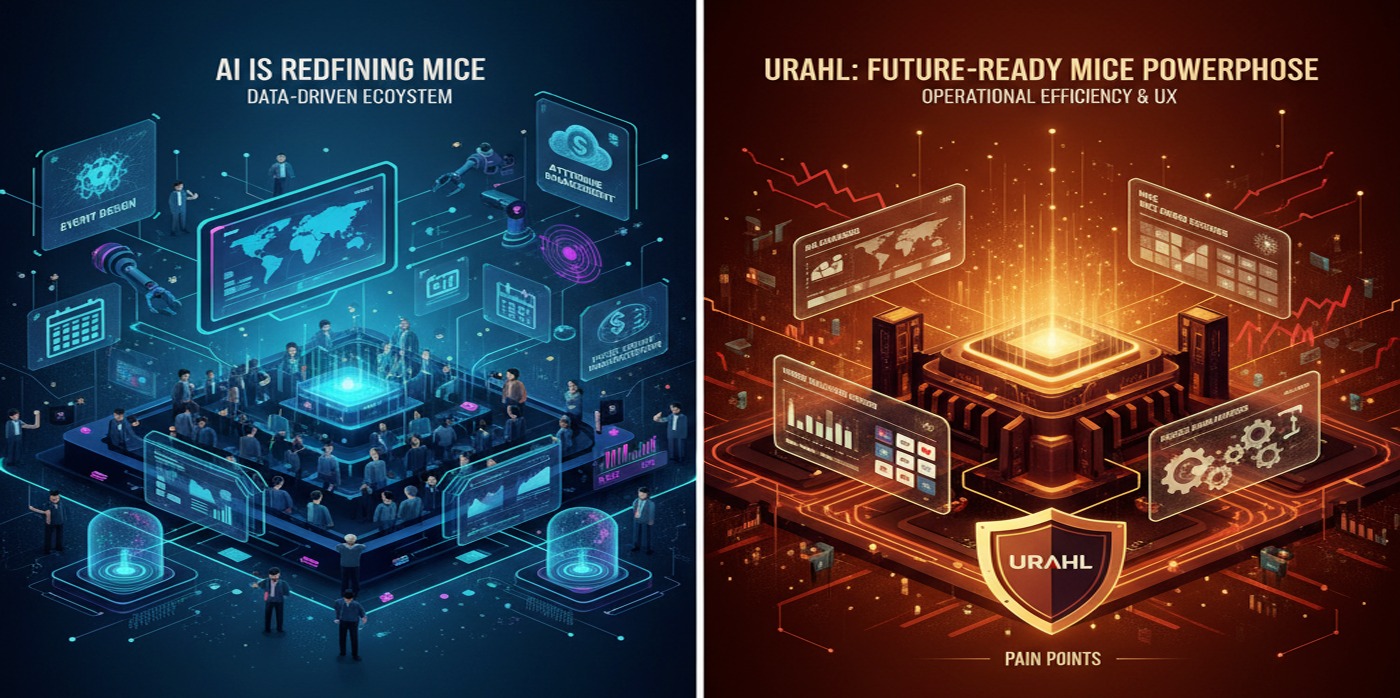
Artificial Intelligence (AI) is redefining the MICE (Meetings, Incentives, Conferences, and Exhibitions) industry, reshaping every operational layer — from event design and logistics to attendee engagement, analytics, sponsorship ROI, and post-event monetization. The integration of AI technologies is not merely a digital upgrade; it represents a fundamental paradigm shift that transforms MICE from a service-led sector into a data-driven ecosystem of predictive insights, personalization, and automation.
URAHL, recognizing this tectonic change early, has built an AI-Enabled MICE Ecosystem that embeds intelligence at every touchpoint — through its MICE Dashboards, Vendor Qualification Matrices, Ecosystem Command Centers, and Process Flow Automations. This analysis explores, in detail, how AI impacts the MICE industry globally, the pain points it solves, the challenges it brings, and how URAHL has proactively evolved into a future-ready, technology-empowered MICE powerhouse that sets new benchmarks in operational efficiency, user experience, and data-driven decision-making.
1. The New Paradigm: AI as the Core Engine of the MICE Industry
The global MICE landscape is no longer about managing logistics or venues — it’s about data orchestration, predictive personalization, and intelligent automation. AI influences four core domains of the industry:
- Intelligent Planning & Forecasting: Predicting attendance patterns, budget optimizations, F&B requirements, and venue utilization through AI-based predictive models.
- Personalized Attendee Experiences: Using AI to craft individual event journeys based on attendee intent, preferences, and behavioral analytics.
- Operational Automation: Automating registration, scheduling, matchmaking, marketing, and post-event analytics through chatbots, recommendation engines, and process automation tools.
- Post-Event Intelligence: Leveraging natural language processing (NLP) and sentiment analysis to measure engagement, brand recall, and deal-conversion probabilities.
URAHL has strategically embraced each of these domains, not just as technology adoptions, but as an integrated AI-Operational Framework that converts traditional events into dynamic, learning, and adaptive ecosystems.
2. Key Areas Where AI is Transforming the MICE Industry
2.1 Predictive Analytics in Event Planning
Traditional MICE planning relied heavily on human experience and manual estimation. AI introduces predictive event intelligence — algorithms that analyze past data to forecast:
- Attendee turnout based on registration behavior
- Venue suitability by traffic and accessibility data
- Catering requirements by demographic consumption patterns
- Budget allocation optimization based on ROI patterns
URAHL’s Application:
URAHL’s MICE Process Flow Dashboard integrates predictive analytics to anticipate resource requirements, thereby minimizing waste, optimizing logistics, and improving the financial predictability of events.
2.2 AI-Driven Matchmaking and Networking
Networking is the lifeblood of MICE events. AI algorithms now enable intelligent matchmaking between delegates, sponsors, vendors, and investors based on shared interests, professional goals, or purchasing intent.
URAHL’s Application:
Through its MICE Ecosystem Command Dashboard, URAHL employs machine learning models that match participants by industry vertical, deal potential, and partnership compatibility — turning random networking into structured business opportunities. This has significantly improved conversion rates for B2B meetings and post-event collaborations.
2.3 Chatbots and Conversational AI for Event Engagement
Attendees expect 24/7 information access and instant support. Conversational AI assists in registration, session selection, Q&A management, and even providing real-time translation.
URAHL’s Application:
URAHL’s AI Helpdesk Integration within its event dashboards provides multilingual, context-aware chat support for attendees, vendors, and sponsors. This not only reduces manpower dependency but also ensures faster issue resolution and consistent communication tone across platforms.
2.4 Personalized Content and Recommendation Engines
AI analyzes attendee interests to suggest sessions, workshops, networking partners, or sponsor booths. This creates a tailored journey that enhances engagement.
URAHL’s Application:
The URAHL MICE Advertisement & Sponsorship Dashboard uses AI-driven recommendation systems to match sponsors with the most relevant audience segments, maximizing ROI and exposure. It also curates content feeds for participants based on prior interactions and declared interests.
2.5 Automated Marketing and Lead Scoring
AI tools automate social media campaigns, email follow-ups, and ad placements by analyzing audience responses in real time. Lead scoring systems predict which attendees are most likely to convert into clients or investors.
URAHL’s Application:
URAHL’s Marketing Automation Stack, integrated with its MICE ecosystem, applies AI-driven lead scoring to classify event leads into “hot,” “warm,” and “cold,” based on interaction frequency, engagement depth, and purchasing signals. This ensures focused post-event follow-up and higher conversion.
2.6 Event Sentiment Analysis
Natural Language Processing (NLP) allows the extraction of insights from attendee feedback, social mentions, and surveys. AI can identify pain points, satisfaction levels, and emerging interests.
URAHL’s Application:
URAHL’s Post-Event Feedback Engine uses AI-based sentiment analysis to evaluate each event’s qualitative performance — measuring speaker effectiveness, content impact, hospitality satisfaction, and overall event reputation in real time.
2.7 Predictive ROI and Financial Intelligence
AI integrates financial analytics to predict sponsorship yields, attendee acquisition costs, and revenue scenarios. Predictive models assess which event configurations generate maximum returns.
URAHL’s Application:
URAHL’s Sponsorship Dashboard utilizes AI to predict sponsor ROI using data from previous events, ensuring better pricing and partnership alignment. Sponsors receive live dashboards that display engagement metrics during the event, ensuring transparency and accountability.
3. The AI Disruption Cycle in MICE: Challenges and Adjustments
While AI offers unprecedented efficiency, it also introduces new complexities for the industry:
| Challenge | Industry Impact | URAHL’s Mitigation Strategy |
| Data Silos and Integration | Disconnected data from multiple sources limits AI’s learning capabilities. | URAHL’s unified data model integrates F&B, venues, sponsors, and attendee databases into one centralized ecosystem. |
| Algorithmic Bias | Misleading matchmaking due to biased data inputs. | URAHL applies ethical AI protocols with human moderation layers for validation. |
| Cost of AI Adoption | High initial cost and training requirements for smaller event firms. | URAHL’s modular AI integration allows scalability — users can adopt features incrementally. |
| Privacy Concerns | Risk of attendee data misuse or exposure. | URAHL complies with GDPR and Indian IT Act data policies with end-to-end encryption and consent-based data sharing. |
| Over-Automation Risk | Excessive automation may dilute the human touch essential to hospitality. | URAHL balances automation with curated personal engagement — human hosts supported by AI assistants. |
4. How URAHL’s AI-Powered MICE Ecosystem Works
4.1 Integrated AI Dashboards
URAHL’s MICE Digital Ecosystem unifies six intelligent dashboards that collectively cover every operational dimension:
- MICE Food Menu (F&B) Dashboard: AI forecasts consumption and personalizes dietary offerings for diverse audiences.
- Global MICE Venues Dashboard: AI evaluates venue performance based on historical satisfaction data, travel convenience, and carbon footprint.
- MICE Process Flow Dashboard: Predictive models automate task assignments and resource allocation.
- Ecosystem Command Dashboard: Real-time tracking of sessions, lead capture, and audience heatmaps.
- Advertisement & Sponsorship Dashboard: AI recommends sponsorship packages based on audience demographics.
- MICE Process Matrix Dashboard: Uses AI scoring to qualify vendors, startups, and investors, ensuring credibility and synergy.
Together, these dashboards enable URAHL to operate with surgical precision — reducing planning time, optimizing cost, and enhancing every participant’s experience.
4.2 Real-Time Decision Support System (DSS)
URAHL’s AI Decision Engine delivers actionable insights during live events — alerting managers about overcrowded sessions, low engagement areas, or underperforming sponsor booths. This allows dynamic, real-time interventions.
Example: If AI detects low footfall at a sponsor booth, it can automatically trigger push notifications or flash incentives to attendees nearby — converting a potential loss into engagement.
4.3 AI in Logistics and Vendor Management
Logistical coordination is one of the biggest cost centers in MICE. URAHL’s AI automates procurement and vendor matching through its Vendor Qualification Algorithm, which ranks suppliers by reliability, delivery timelines, and feedback scores.
This minimizes operational delays, ensures quality consistency, and fosters an ecosystem of verified, performance-driven partners.
5. AI’s Role in Sustainable and Inclusive MICE Practices
Sustainability is now a key KPI for global MICE organizations. AI supports green practices by:
- Optimizing energy usage and reducing food waste through consumption prediction.
- Selecting eco-certified venues with lower carbon footprints.
- Tracking and reporting sustainability metrics for ESG reporting.
URAHL’s Application:
URAHL has embedded AI sustainability scoring in its Global Venues Dashboard, allowing event planners to select environmentally responsible locations. Predictive analytics also reduce resource wastage, aligning URAHL’s operations with global ESG standards.
6. The Human-AI Synergy: Balancing Intelligence and Hospitality
The MICE industry thrives on human warmth, empathy, and trust — attributes that machines cannot replicate. URAHL recognizes this and ensures AI enhances, not replaces, human hospitality.
- Human-in-the-loop workflows ensure every AI decision (matchmaking, sponsor suggestion, content curation) is validated by an expert.
- AI as a Co-Pilot: URAHL’s systems augment staff productivity rather than eliminate roles.
- Empathy-enhanced training: Staff are trained to interpret AI insights empathetically, ensuring guests feel personally attended to.
This synthesis of technology and humanity is central to URAHL’s MICE philosophy — “Technology serves hospitality, not the other way around.”
7. Quantifiable Impact: How AI Improves Business Outcomes
Based on URAHL’s data across multiple events, measurable improvements include:
- 30–40% reduction in event planning time
- 25% increase in lead conversion rate due to AI matchmaking
- 35% cost reduction in vendor management
- 50% faster post-event report generation and ROI analytics
- Significant increase in attendee satisfaction due to personalized experiences
These quantifiable gains demonstrate how AI transitions MICE management from an operational expense into a measurable business growth engine.
8. Future Roadmap: URAHL’s AI-Driven Vision for MICE 2030
URAHL envisions a fully autonomous MICE environment by 2030, integrating:
- Predictive Demand Graphs: AI forecasting attendee behavior and interest trends six months in advance.
- Blockchain-backed AI Contracts: Smart contracts automating sponsor settlements and vendor payments.
- XR + AI Hybrid Events: Merging AI with virtual and augmented reality for immersive networking.
- Emotion AI: Real-time emotion detection from facial cues to gauge engagement and speaker effectiveness.
- AI-Powered Procurement Tokens: Integrating UHT (URAHL Hospitality Token) into MICE transactions for instant, transparent settlements.
By aligning AI with tokenization and sustainability, URAHL is setting the stage for the next generation of intelligent, decentralized, and experiential MICE ecosystems.
9. URAHL’s Leadership in the AI-Driven MICE Revolution
AI is not an optional innovation in the MICE industry — it is the foundation of its future. While many organizations are still experimenting, URAHL has operationalized AI into its DNA, integrating it across data systems, event workflows, hospitality services, and sponsor ecosystems.
By leveraging predictive analytics, real-time intelligence, process automation, and human-centered AI, URAHL has turned its MICE operations into a living, adaptive organism that learns, improves, and scales continuously.
URAHL’s approach to AI in MICE isn’t just about adopting technology — it’s about redefining how human connection, business growth, and intelligent automation can coexist harmoniously. This balanced, structured, and ethically grounded transformation makes URAHL not only a pioneer but also the global benchmark for what the future of the MICE industry will look like — smart, sustainable, inclusive, and exponentially more powerful.